Advertisements
Advertisements
Question
Explain the following:
Electron gain enthalpy of chlorine is more negative as compared to fluorine.
Advertisements
Solution
Due to small size, the electron-electron repulsions in the relatively compact 2p-subshell of F are quite strong and hence the incoming electron is not accepted with the same ease as in case of bigger Cl atom where repulsions are comparatively weak. Thus, electron gain enthalpy of chlorine is more negative as compared to that of fluorine.
APPEARS IN
RELATED QUESTIONS
If B–Cl bond has a dipole moment, explain why BCl3 molecule has zero dipole moment.
What happens when BF3 is reacted with ammonia?
In some of the reactions thallium resembles aluminium, whereas in others it resembles with group I metals. Support this statement by giving some evidences.
Write a balanced equation for Al + NaOH → ?
Write a balanced equation for B2H6 + NH3 → ?
Ionisation enthalpy (∆iH1kJ mol–1) for the elements of Group 13 follows the order.
In the structure of diborane ______.
A compound X, of boron reacts with NH3 on heating to give another compound Y which is called inorganic benzene. The compound X can be prepared by treating BF3 with Lithium aluminium hydride. The compounds X and Y are represented by the formulas.
Which of the following statements are correct. Answer on the basis of Figure.
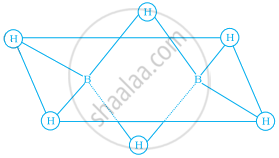
(i) The two birdged hydrogen atoms and the two boron atoms lie in one plane;
(ii) Out of six B – H bonds two bonds can be described in terms of 3 centre 2-electron bonds.
(iii) Out of six B – H bonds four B – H bonds can be described in terms of 3 centre 2 electron bonds;
(iv) The four-terminal B – H bonds are two centre-two electron regular bonds.
When BCl3 is treated with water, it hydrolyses and forms [B[OH]4]– only whereas AlCl3 in acidified aqueous solution forms [Al(H2O)6]3+ ion. Explain what is the hybridisation of boron and aluminium in these species?
Explain the following:
Boron does not exist as B3+ ion.
Identify the compounds A, X and Z in the following reactions:
\[\ce{X ->[Δ][370 K] HBO2 ->[Δ][> 370 K] Z}\]
Complete the following chemical equations:
\[\ce{Z + 3 LiAlH4 -> X + 3LiF + 3AlF_3}\]
\[\ce{X + 6H2 -> Y + 6H2}\]
\[\ce{3X + 3O2 ->[Δ] B2O3 + 3H2O}\]
Match the species given in Column I with the properties mentioned in Column II.
| Column I | Column II |
| (i) \[\ce{BF^{-}4}\] | (a) Oxidation state of central atom is +4 |
| (ii) AICI3 | (b) Strong oxidising agent |
| (iii) SnO | (c) Lewis acid |
| (iv) PbO2 | (d) Can be further oxidised |
| (e) Tetrahedral shape |
Match the species given in Column I with properties given in Column II.
| Column I | Column II |
| (i) Diborane | (a) Used as a flux for soldering metals |
| (ii) Galluim | (b) Crystalline form of silica |
| (iii) Borax | (c) Banana bonds |
| (iv) Aluminosilicate | (d) Low melting, high boiling, useful for measuring high temperatures |
| (v) Quartz | (e) Used as catalyst in petrochemical industries |
Describe the general trends in the following properties of the elements in Groups 13 and 14.
Oxidation states
Account for the following observations:
PbO2 is a stronger oxidising agent than SnO2
A nonmetallic element of group 13, used in making bullet proof vests is extremely hard solid of black colour. It can exist in many allotropic forms and has unusually high melting point. Its trifluoride acts as Lewis acid towards ammonia. The element exihibits maximum covalency of four. Identify the element and write the reaction of its trifluoride with ammonia. Explain why does the trifluoride act as a Lewis acid.
Boron compounds behave as Lewis acids because of their ______.
