Advertisements
Advertisements
Question
Account for the following observations:
PbO2 is a stronger oxidising agent than SnO2
Advertisements
Solution
PbO2, lead is in +2 oxidation state and can be reduced to its most stable oxidation state of +2. Hence PbO2 can be further exidised or act as a strong oxidising agent. and in SnO, Sn is and +2 oxidation state and can extend its oxidation state up to +4. Thus, SnO can be used as a reducing agent.
APPEARS IN
RELATED QUESTIONS
How can you explain higher stability of BCl3 as compared to TlCl3?
How would you explain the lower atomic radius of Ga as compared to Al?
In some of the reactions thallium resembles aluminium, whereas in others it resembles with group I metals. Support this statement by giving some evidences.
Write a balanced equation for Al + NaOH → ?
The geometry of a complex species can be understood from the knowledge of type of hybridisation of orbitals of central atom. The hybridisation of orbitals of central atom in [Be(OH)4]– and the geometry of the complex are respectively.
Ionisation enthalpy (∆iH1kJ mol–1) for the elements of Group 13 follows the order.
In the structure of diborane ______.
Which of the following statements are correct. Answer on the basis of Figure.
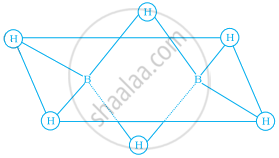
(i) The two birdged hydrogen atoms and the two boron atoms lie in one plane;
(ii) Out of six B – H bonds two bonds can be described in terms of 3 centre 2-electron bonds.
(iii) Out of six B – H bonds four B – H bonds can be described in terms of 3 centre 2 electron bonds;
(iv) The four-terminal B – H bonds are two centre-two electron regular bonds.
Explain why the following compounds behave as Lewis acids?
AlCl3
When BCl3 is treated with water, it hydrolyses and forms [B[OH]4]– only whereas AlCl3 in acidified aqueous solution forms [Al(H2O)6]3+ ion. Explain what is the hybridisation of boron and aluminium in these species?
Explain the following:
PbX2 is more stable than PbX4.
Explain the following:
Pb4+ acts as an oxidising agent but Sn2+ acts as a reducing agent.
Explain the following:
Tl (NO3)3 acts as an oxidising agent.
Complete the following chemical equations:
\[\ce{Z + 3 LiAlH4 -> X + 3LiF + 3AlF_3}\]
\[\ce{X + 6H2 -> Y + 6H2}\]
\[\ce{3X + 3O2 ->[Δ] B2O3 + 3H2O}\]
Match the species given in Column I with the properties mentioned in Column II.
| Column I | Column II |
| (i) \[\ce{BF^{-}4}\] | (a) Oxidation state of central atom is +4 |
| (ii) AICI3 | (b) Strong oxidising agent |
| (iii) SnO | (c) Lewis acid |
| (iv) PbO2 | (d) Can be further oxidised |
| (e) Tetrahedral shape |
Match the species given in Column I with the hybridisation given in Column II.
| Column I | Column II |
| (i) Boron in [B(OH)4]– | (a) sp2 |
| (ii) Aluminium in [Al(H2O)6]3+ | (b) sp3 |
| (iii) Boron in B2H6 | (c) sp3d2 |
| (iv) Carbon in Buckminsterfullerene | |
| (v) Silicon in \[\ce{SiO^{4-}4}\] | |
| (vi) Germanium in [GeCl6]2– |
Describe the general trends in the following properties of the elements in Groups 13 and 14.
Metallic character
Three pairs of compounds are given below. Identify that compound in each of the pairs which has group 13 element in more stable oxidation state. Give reason for your choice. State the nature of bonding also.
AlCl3 , AlCl
BCl3 exists as monomer whereas AlCl3 is dimerised through halogen bridging. Give reason. Explain the structure of the dimer of AlCl3 also.
