Advertisements
Advertisements
Question
Draw the structure of the pyran.
Advertisements
Solution

APPEARS IN
RELATED QUESTIONS
Draw a neat diagram for the following:
Haworth formula of maltose
The glycosidic linkage in maltose is formed between _______________
Write the name of the polysaccharide used for the commercial preparation of glucose.
Write the name of the unit to which glucose unit is linked to from sucrose.
Write chemical reaction for following conversions
glucose into gluconic acid
What is the action of the following reagents on glucose?
hydrogen iodide
Define carbohydrates.
Write a chemical reaction to convert glucose into glucose cyanohydrin.
Identify the bond that links the carbon of two adjacent monosaccharides.
Which enzymes would work sequentially on potatoes consumed by an individual?
Which of the following monosaccharides is a tetrose sugar?
Which of the following is the basic unit of carbohydrates?
Which of the following carbohydrate is sweet to taste?
Formation of lactose by conden ation results in the release of how many molecules of water?
From the following identify the group that is exclusively consists of polysaccharides.
The reserve food material in animals is ____________.
Which among the following compounds is obtained when glucose reacts with hydrogen cyanide?
Identify a non-reducing carbohydrate from the following.
Which among the following type of linkages is present in cellulose?
Raffinose, sucrose and stachyose are respectively ____________.
All these carbohydrates contain \[\ce{1 -> 4β}\] glycosidic linkage, EXCEPT ____________.
One mole of a carbohydrate on hydrolysis gives one mole of glucose and one mole of galactose. Identify the carbohydrate.
Stachyose is ____________.
Which one of the following is NOT soluble in water?
How many moles of fructose and galactose respectively are obtained on hydrolysis of 1 mole stachyose?
What is the number of hydroxyl groups present in lactic acid?
Which among the following reagents is used to confirm the presence of carbonyl group in glucose?
Which among the following sugars does not reduce Tollen's reagent?
Identify the number of oxygen atoms present in saccharic acid?
What is the product obtained when Br2 water reacts with glucose?
How many hydroxyl groups are present in Erythrulose?
\[\ce{Glucose ->[(HCN)] Product ->[(hydrolysis)] Product ->[(HI + Heat)] A}\], the compound A is:
α-D (+) Glucose and β-D (+) glucose are ____________.
Classify the following into monosaccharides, oligosaccharides and polysaccharides.
Lactose
Write the structure of α-D (+) glucopyranose.
Is the following sugar, D-sugar or L-sugar?

The molecule of glucose is also called ______.
Glucose on oxidation with bromine water yields gluconic acid. This reaction confirms the presence of ______.
Which carbon atoms of fructose are bonded together through oxygen forming fructofuranose?
Match the Column I with Column II and choose the correct answer from options below:
| Column I | Column II |
| A. Purine | 1. Glycogen |
| B. Pyrimidine | 2. Cellulose |
| C. Structural polysaccharide | 3. Glucagon |
| D. Storage polysaccharide | 4. Adenine |
| 5. Cytosine |
Identify the monosaccharide containing only one asymmetric carbon atom in its molecule.
Consider the following reaction
\[\ce{A <-[Br2 - H2O] Glucose ->[HNO3] B}\]
Here, 'A' and 'B' are respectively.
Why carbohydrates are generally optically active.
Assign D/L configuration to the following monosaccharides:
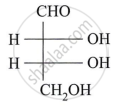
Describe the action of the following reagent on glucose:
Bromine water
Describe the action of the following reagent on glucose:
dil. Nitric acid.
Write Fischer projection formulae for glucose.
The linkage present in Lactose is ______.
CH2 OH - CO - (CHOH)4 - CH2 OH is an example of ______.
Why carbohydrates are generally optically active?
Why carbohydrates are generally optically active?
Given below are two statements.
Statement I - Lactose on hydrolysis converts into glucose and galactose.
Statement II - Galactose also plays same role as glucose in respiration.
In light of the above statements, select the correct option given below.
The sugar found in milk is ______.
