Advertisements
Advertisements
Question
Write the name of the polysaccharide used for the commercial preparation of glucose.
Advertisements
Solution
Starch
APPEARS IN
RELATED QUESTIONS
\[\ce{CH2OH-CO-(CHOH)4-CH2OH}\] is an example of ______.
Give scientific reasons:
Hydrolysis of sucrose is called inversion.
Give two evidences for presence of formyl group in glucose.
Draw the structure of α-D glucopyranose.
Write the name of the unit to which glucose unit is linked to from sucrose.
Write chemical reaction for following conversions
glucose into glucoxime
What is the action of the following reagents on glucose?
hydroxylamine
What is the action of the following reagents on glucose?
hydrogen iodide
Explain D and L configuration in sugars.
Write a commercial method for preparation of glucose.
Identify the substances having glycosidic bond and peptide bond, respectively in their structure:
Which enzymes would work sequentially on potatoes consumed by an individual?
Which of the following is the basic unit of carbohydrates?
Fructose is the fruit sugar and chemically it is ketohexose but it has a ______ rather than a ______.
Which among the following compounds is obtained when glucose reacts with hydrogen cyanide?
Identify a non-reducing carbohydrate from the following.
Monosaccharides are ______ in nature.
From the following identify the two types of glucose polymers present in starch.
Raffinose, sucrose and stachyose are respectively ____________.
4-O-(α-D-Glucopyranosyl)-D-glucopyranose is ____________.
Identify the INCORRECT statement regarding glucose.
Which one of the following is an oligosaccharide?
Which one of the following is a carbohydrate but does NOT follow the general formula of carbohydrate?
Which of the following molecules reduces Fehling's solution?
Which one of the following sugar does NOT have same empirical fonnula as that of carbohydrate?
How many moles of fructose and galactose respectively are obtained on hydrolysis of 1 mole stachyose?
When 2 moles of stachyose is hydrolyzed, the number of moles of galactose obtained is ____________.
Which of the following statement is NOT true about saccharic acid?
What is the quantity of glucose obtained when 68.4 g of sucrose is hydrolyzed in laboratory under ideal condition?
(Molar mass of sucrose = 342 g mol−1)
Identify the product Y in the following reaction.
\[\ce{Maltose ->[Hydrolysis] X ->[dil. HNO3][(excess)] Y}\]
Which among the following is a product of hydrolysis of one mole raffinose?
How many hydroxyl groups are present in Erythrulose?
\[\ce{Glucose ->[(HCN)] Product ->[(hydrolysis)] Product ->[(HI + Heat)] A}\], the compound A is:
Assertion: A solution of sucrose in water is dextrorotatory. But on hydrolysis in the presence of little hydrochloric acid, it becomes levorotatory.
Reason: Sucrose hydrolysis gives equal amounts of glucose and fructose. As a result of this change in sign of rotation is observed.
Glucose is an aldose. Which one of the following reactions is not expected with glucose?
Classify the following into monosaccharides, oligosaccharides and polysaccharides.
Maltose
Write the structure of α-D (+) glucopyranose.
A molecule of stachyose contains how many carbon atoms?
Formation of gluconic acid from glucose by oxidation using Br2 water.
\[\ce{CH2OH - CO - (CHOH)4 - CH2OH}\] is an example of ______.
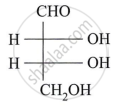
Assign D/L configuration to the following monosaccharides:
Carbohydrates that do not undergo hydrolysis further are called ______.
Write the ring structure of glucose.
Why carbohydrates are generally optically active.
Why carbohydrates are generally optically active.
CH2 OH - CO - (CHOH)4 - CH2 OH is an example of ______.
\[\ce{CH2OH - CO - (CHOH)4 - CH2 OH}\] is an example of ______.
Why carbohydrates are generally optically active.
What are the number of chiral carbon atoms and the number of formyl groups, respectively, present in ribose?
