Advertisements
Advertisements
प्रश्न
Write the name of the polysaccharide used for the commercial preparation of glucose.
Advertisements
उत्तर
Starch
APPEARS IN
संबंधित प्रश्न
Give two evidences for presence of formyl group in glucose.
Explain the preparation of glucose from sucrose.
Write chemical reaction for following conversions
glucose into gluconic acid
Classify the following carbohydrates into monosaccharide, disaccharide, oligosaccharide and polysaccharide:
glucose, cellulose, maltose, stachyose
Write a commercial method for preparation of glucose.
Which of the following type of carbohydrates cannot be hydrolyzed?
Identify the bond that links the carbon of two adjacent monosaccharides.
From the following identify an example of disaccharides.
Which enzymes would work sequentially on potatoes consumed by an individual?
Which of the following is the basic unit of carbohydrates?
Carbohydrates can contain which of the following chemical groups?
The reserve food material in animals is ____________.
Which is the product obtained, when Br2 water reacts with glucose?
The number of asymmetric carbon atoms in the glucose molecule is ____________.
Identify the CORRECT combination.
Match the columns and select the correct option.
| Column I | Column II | ||
| i. | Starch | a. | Animal storage molecule |
| ii. | Cellulose | b. | Plant storage molecule |
| iii. | Glycogen | c. | Heparin |
| iv. | Heteropolysaccharide | d. | Plant cell wall component |
All these carbohydrates contain \[\ce{1 -> 4β}\] glycosidic linkage, EXCEPT ____________.
Identify the INCORRECT statement regarding glucose.
One mole of a carbohydrate on hydrolysis gives one mole of glucose and one mole of galactose. Identify the carbohydrate.
Which one of the following is NOT soluble in water?
Glucose and gluconic acid treated with dilute nitric acid forms saccharic acid. What does this indicate?
Which of the following molecules reduces Fehling's solution?
Which following reagent is used to detect presence of five hydroxyl groups in a glucose molecule?
Which among the following statements is true for amylose?
Identify the number of secondary carbon atoms in glucose.
On hydrolysis sucrose gives ____________.
Which among the following reagents is used for conversion of glucose to glucoxime?
How many hydroxyl groups are present in Erythrulose?
How many optical isomers are possible for a compound having four asymmetric carbon atoms?
The correct corresponding order of names of four aldoses with configuration given below Respectively is:
\[\ce{Glucose ->[(HCN)] Product ->[(hydrolysis)] Product ->[(HI + Heat)] A}\], the compound A is:
α-D (+) Glucose and β-D (+) glucose are ____________.
Classify the following into monosaccharides, oligosaccharides and polysaccharides.
Lactose
Is the following sugar, D-sugar or L-sugar?

The molecule of glucose is also called ______.
If 'n' represents total number of asymmetric carbon atoms in a compound, then the possible· number of optical isomers of the compound is ______.
Glucose on oxidation with bromine water yields gluconic acid. This reaction confirms the presence of ______.
The two monosaccharides in a disaccharide are held together by ______ bonds.
Starch and cellulose are compounds made up of many units of ______.
Which one is a non-reducing commercial sugar?
Identify the product obtained in the following conversion.
\[\ce{Glucose ->[(O)][Br2 water] Product}\]
The glycosidic linkage present in maltose is ______.
Why carbohydrates are generally optically active.
Why carbohydrates are generally optically active.
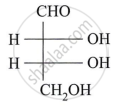
Assign D/L configuration to the following monosaccharides:
Describe the action of the following reagent on glucose:
Bromine water
Explain the hydrolysis of sucrose.
The linkage present in Lactose is ______.
CH2 OH - CO - (CHOH)4 - CH2 OH is an example of ______.
Why are carbohydrates generally optically active?
Why carbohydrates are generally optically active.
Why carbohydrates are generally optically active.
What are the number of chiral carbon atoms and the number of formyl groups, respectively, present in ribose?
The sugar found in milk is ______.
