Advertisements
Advertisements
प्रश्न
Glucose on oxidation with dilute nitric acid gives _______________
पर्याय
saccharic acid
oxalic acid
gluconic acid
malonic acid
Advertisements
उत्तर
Glucose on oxidation with dilute nitric acid gives saccharic acid
APPEARS IN
संबंधित प्रश्न
Give scientific reasons:
The disaccharide sucrose gives negative Tollens test while the disaccharide maltose gives a positive Tollens test.
Give two evidences for presence of formyl group in glucose.
Draw a neat diagram for the following:
Haworth formula of glucopyranose.
Draw a neat diagram for the following:
Haworth formula of maltose
Write the name of the polysaccharide used for the commercial preparation of glucose.
Classify the following carbohydrates into monosaccharide, disaccharide, oligosaccharide and polysaccharide:
glucose, cellulose, maltose, stachyose
What is the action of the following reagents on glucose?
hydroxylamine
What is the action of the following reagents on glucose?
hydrogen iodide
Define carbohydrates.
Explain D and L configuration in sugars.
Write a chemical reaction to convert glucose into glucose cyanohydrin.
Identify the bond that links the carbon of two adjacent monosaccharides.
Identify the given structure 'P' and 'Q'.

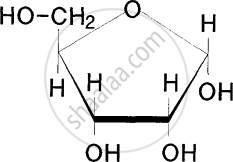
Which of the following monosaccharides is a tetrose sugar?
Formation of lactose by conden ation results in the release of how many molecules of water?
From the following which is a heteropolysaccharide?
The reserve food material in animals is ____________.
By which of the following feature we can identify the relatively small DNA molecules of plasmids?
Match the Column I and Column II select the correct option.
| Column I | Column II | ||
| i. | Monosaccharides | a. | Stored energy in animals |
| ii. | Glycogen | b. | Polymer made from ß-glucose molecules |
| iii. | Cellulose | c. | Exoskeleton of arthropods |
| iv. | Chitin | d. | Building blocks of carbohydrates |
| e. | Plant hormone |
Chitin is a/an ______.
The number of asymmetric carbon atoms in the glucose molecule is ____________.
____________ do not give smaller sugar units on hydrolysis.
Which among the following type of linkages is present in cellulose?
Prolonged heating of glucose with hot HI results in the formation of ____________.
One mole of a carbohydrate on hydrolysis gives one mole of glucose and one mole of galactose. Identify the carbohydrate.
Which of the following monosaccharide is a ketohexose?
Which element among the following is not present in saccharine?
\[\ce{CH3 - CH2 - CH2 - Br ->[Na][dry ether] A ->[Cl2] B}\]
Identify the product B in the above reaction.
Which one of the following sugar does NOT have same empirical fonnula as that of carbohydrate?
How many moles of fructose and galactose respectively are obtained on hydrolysis of 1 mole stachyose?
Which among the following reagents is used to confirm the presence of carbonyl group in glucose?
Which of the following statement is NOT true about saccharic acid?
Which among the following sugars does not reduce Tollen's reagent?
Which among the following is a product of hydrolysis of one mole raffinose?
What is the product obtained when Br2 water reacts with glucose?
Which among the following observations suggests that glucose also exists in cyclic form?
\[\ce{Glucose ->[(HCN)] Product ->[(hydrolysis)] Product ->[(HI + Heat)] A}\], the compound A is:
Glucose is an aldose. Which one of the following reactions is not expected with glucose?
Which of the following are epimers?
Classify the following into monosaccharides, oligosaccharides and polysaccharides.
Sucrose
Classify the following into monosaccharides, oligosaccharides and polysaccharides.
Maltose
Write the structure of α-D (+) glucopyranose.
Is the following sugar, D-sugar or L-sugar?

If 'n' represents total number of asymmetric carbon atoms in a compound, then the possible· number of optical isomers of the compound is ______.
Lactose is made of ______.
Match the Column I with Column II and choose the correct answer from options below:
| Column I | Column II |
| A. Purine | 1. Glycogen |
| B. Pyrimidine | 2. Cellulose |
| C. Structural polysaccharide | 3. Glucagon |
| D. Storage polysaccharide | 4. Adenine |
| 5. Cytosine |
Starch and cellulose are compounds made up of many units of ______.
Which one is a non-reducing commercial sugar?
Why carbohydrates are generally optically active?
CH2 OH - CO - (CHOH)4 - CH2 OH is an example of ______.
Why are carbohydrates generally optically active?
\[\ce{CH2OH - CO - (CHOH)4 - CH2OH}\] is an example of ______.
Why carbohydrates are generally optically active.
Two monosaccharides are held together by ______ bond.
What are the number of chiral carbon atoms and the number of formyl groups, respectively, present in ribose?
