Advertisements
Advertisements
प्रश्न
What is the action of the following reagents on glucose?
hydroxylamine
Advertisements
उत्तर
Glucose forms oxime by reaction with hydroxylamine:
\[\begin{array}{cc}
\phantom{}\ce{CHO}\phantom{..............}\ce{CH = N - OH}\phantom{..}\\
\phantom{.}|\phantom{..................}|\phantom{...............}\\
\ce{(CHOH)4 ->[NH2 - OH](CHOH)4 + H2O}\\
\phantom{}|\phantom{..................}|\phantom{..............}\\
\phantom{}\ce{\underset{\text{Glucose}}{CH2OH} \phantom{..........}\underset{\text{Oxime}}{CH2OH}}\phantom{........}
\end{array}\]
APPEARS IN
संबंधित प्रश्न
\[\ce{CH2OH-CO-(CHOH)4-CH2OH}\] is an example of ______.
Give two evidences for presence of formyl group in glucose.
The glycosidic linkage in maltose is formed between _______________
Write the name of the polysaccharide used for the commercial preparation of glucose.
Draw the structure of α-D glucopyranose.
Write chemical reaction for following conversions
glucose into gluconic acid
Define carbohydrates.
Draw the Haworth projection structure of the following.
α-D-(–)-Fructofuranose
Write a chemical reaction to convert glucose into glucose cyanohydrin.
From the following identify an example of disaccharides.
Identify the substances having glycosidic bond and peptide bond, respectively in their structure:
Which enzymes would work sequentially on potatoes consumed by an individual?
Which of the following monosaccharides is a tetrose sugar?
Formation of lactose by conden ation results in the release of how many molecules of water?
Identify the sugar having the molecular formula C6H1206.
Identify the WRONG statement.
Which among the following compounds is obtained when glucose reacts with hydrogen cyanide?
Identify a non-reducing carbohydrate from the following.
Monosaccharides are ______ in nature.
Identify the CORRECT combination.
Which carbon atoms of α- D glucopyranose and β-D-fructofuranose respectively are linked together to form glycosidic linkage in sucrose?
Raffinose, sucrose and stachyose are respectively ____________.
Prolonged heating of glucose with hot HI results in the formation of ____________.
Which of the following monosaccharide is a ketohexose?
Which element among the following is not present in saccharine?
Which one of the following is an oligosaccharide?
Which of the following molecules reduces Fehling's solution?
Which following reagent is used to detect presence of five hydroxyl groups in a glucose molecule?
Identify the number of secondary carbon atoms in glucose.
When 2 moles of stachyose is hydrolyzed, the number of moles of galactose obtained is ____________.
On hydrolysis sucrose gives ____________.
Which among the following reagents is used to obtain gluconic acid from glucose?
Identify the product Y in the following reaction.
\[\ce{Maltose ->[Hydrolysis] X ->[dil. HNO3][(excess)] Y}\]
How many moles of acetic acid are obtained in the reaction when one mole glucose is treated with excess acetic anhydride?
How many hydroxyl groups are present in Erythrulose?
Which one given below is a non-reducing sugar?
Glucose is an aldose. Which one of the following reactions is not expected with glucose?
Classify the following into monosaccharides, oligosaccharides and polysaccharides.
Sucrose
Classify the following into monosaccharides, oligosaccharides and polysaccharides.
Maltose
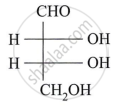
Is the following sugar, D-sugar or L-sugar?

If 'n' represents total number of asymmetric carbon atoms in a compound, then the possible· number of optical isomers of the compound is ______.
\[\ce{CH2OH - CO - (CHOH)4 - CH2OH}\] is an example of ______.
Assign D/L configuration to the following monosaccharides:
Write the ring structure of glucose.
Why carbohydrates are generally optically active.
The linkage present in Lactose is ______.
Write the Zwitter ion structure of alanine.
Why carbohydrates are generally optically active?
\[\ce{CH2OH - CO - (CHOH)4 - CH2OH}\] is an example of ______.
Which of the following is used to separate glucose and fructose from hydrolysate of sucrose?
