Advertisements
Advertisements
प्रश्न
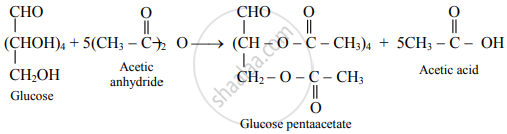
What is the action of the following reagents on glucose?
acetic anhydride
Advertisements
उत्तर
Glucose reacts with acetic anhydride to form glucose pentaacetate.
APPEARS IN
संबंधित प्रश्न
Give scientific reasons:
Hydrolysis of sucrose is called inversion.
Draw a neat diagram for the following:
Haworth formula of maltose
The glycosidic linkage in maltose is formed between _______________
Explain D and L configuration in sugars.
Write a chemical reaction to convert glucose into glucose cyanohydrin.
Which of the following type of carbohydrates cannot be hydrolyzed?
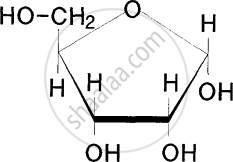
Identify the given structure 'P' and 'Q'.

Which enzymes would work sequentially on potatoes consumed by an individual?
Which of the following monosaccharides is a tetrose sugar?
Formation of lactose by conden ation results in the release of how many molecules of water?
From the following identify the group that is exclusively consists of polysaccharides.
From the following which is a heteropolysaccharide?
______ is the prosthetic group of glycoproteins.
Identify the sugar having the molecular formula C6H1206.
Fructose is the fruit sugar and chemically it is ketohexose but it has a ______ rather than a ______.
Identify the WRONG statement.
By which of the following feature we can identify the relatively small DNA molecules of plasmids?
Identify a non-reducing carbohydrate from the following.
From the following identify the two types of glucose polymers present in starch.
Which among the following type of linkages is present in cellulose?
All these carbohydrates contain \[\ce{1 -> 4β}\] glycosidic linkage, EXCEPT ____________.
Which one of the following is an oligosaccharide?
The general formula for polysaccharide is ____________.
Which one of the following is a carbohydrate but does NOT follow the general formula of carbohydrate?
Which one of the following carbohydrates is insoluble in water?
Which of the following statements is NOT true for glyceraldehyde?
How many moles of fructose and galactose respectively are obtained on hydrolysis of 1 mole stachyose?
Which among the following reagents is used to confirm the presence of carbonyl group in glucose?
On hydrolysis sucrose gives ____________.
How many moles of acetic acid are obtained in the reaction when one mole glucose is treated with excess acetic anhydride?
How many hydroxyl groups are present in Erythrulose?
The correct corresponding order of names of four aldoses with configuration given below Respectively is:
Which one given below is a non-reducing sugar?
\[\ce{Glucose ->[(HCN)] Product ->[(hydrolysis)] Product ->[(HI + Heat)] A}\], the compound A is:
Glucose is an aldose. Which one of the following reactions is not expected with glucose?
Formation of gluconic acid from glucose by oxidation using Br2 water.
Consider the following reaction
\[\ce{A <-[Br2 - H2O] Glucose ->[HNO3] B}\]
Here, 'A' and 'B' are respectively.
Why carbohydrates are generally optically active.
Why carbohydrates are generally optically active.
Describe the action of the following reagent on glucose:
dil. Nitric acid.
Carbohydrates that do not undergo hydrolysis further are called ______.
CH2 OH - CO - (CHOH)4 - CH2 OH is an example of ______.
\[\ce{CH2OH - CO - (CHOH)4 - CH2 OH}\] is an example of ______.
\[\ce{CH2OH - CO - (CHOH)4 - CH2OH}\] is an example of ______.
Two monosaccharides are held together by ______ bond.
What are the number of chiral carbon atoms and the number of formyl groups, respectively, present in ribose?
Which of the following is used to separate glucose and fructose from hydrolysate of sucrose?
The sugar found in milk is ______.
