Advertisements
Advertisements
प्रश्न
Write a chemical reaction to convert glucose into glucose cyanohydrin.
Advertisements
उत्तर
Glucose forms cyanohydrin on reaction with hydrogen cyanide:
\[\begin{array}{cc}
\phantom{...........}\ce{CN}\\
\phantom{.........}|\\
\phantom{}\ce{CHO}\phantom{..........}\ce{CHOH}\phantom{..}\\
\phantom{}|\phantom{...............}|\phantom{.......}\\
\phantom{}\ce{(CHOH)4 ->[HCN] (CHOH)4}\phantom{}\\
\phantom{}|\phantom{...............}|\phantom{.......}\\
\phantom{..........}\ce{\underset{\text{Glucose}}{CH2OH} \phantom{....}\underset{\text{Glucose cyanohydrin}}{CH2OH}}\phantom{........}
\end{array}\]
संबंधित प्रश्न
\[\ce{CH2OH-CO-(CHOH)4-CH2OH}\] is an example of ______.
Give scientific reasons:
The disaccharide sucrose gives negative Tollens test while the disaccharide maltose gives a positive Tollens test.
Draw a neat diagram for the following:
Haworth formula of maltose
Glucose on oxidation with dilute nitric acid gives _______________
Write the name of the unit to which glucose unit is linked to from sucrose.
What is the action of the following reagents on glucose?
hydrogen iodide
Define carbohydrates.
Explain D and L configuration in sugars.
Identify the substances having glycosidic bond and peptide bond, respectively in their structure:
Which enzymes would work sequentially on potatoes consumed by an individual?
Which of the following is the basic unit of carbohydrates?
Which of the following carbohydrate is sweet to taste?
Carbohydrates can contain which of the following chemical groups?
From the following which is a heteropolysaccharide?
From the following identify the materials that are made up of cellulose.
i. Plant cell wall
ii. Exoskeleton of arthropods
iii. Paper from plant pulp
iv. Cotton fibre
Identify the WRONG statement.
Which among the following compounds is obtained when glucose reacts with hydrogen cyanide?
Identify a non-reducing carbohydrate from the following.
The number of asymmetric carbon atoms in the glucose molecule is ____________.
From the following identify the two types of glucose polymers present in starch.
Raffinose, sucrose and stachyose are respectively ____________.
Which element among the following is not present in saccharine?
Stachyose is ____________.
Which one of the following is Tetrose sugar?
Which one of the following carbohydrates is insoluble in water?
Glucose and gluconic acid treated with dilute nitric acid forms saccharic acid. What does this indicate?
Which among the following statements is true for amylose?
Which one of the following sugar does NOT have same empirical fonnula as that of carbohydrate?
How many moles of fructose and galactose respectively are obtained on hydrolysis of 1 mole stachyose?
Which of the following statement is NOT true about saccharic acid?
When one mole of lactose is hydrolysed, the hydrolysate contains ____________.
How many hydroxyl groups are present in Erythrulose?
Assertion: A solution of sucrose in water is dextrorotatory. But on hydrolysis in the presence of little hydrochloric acid, it becomes levorotatory.
Reason: Sucrose hydrolysis gives equal amounts of glucose and fructose. As a result of this change in sign of rotation is observed.
α-D (+) Glucose and β-D (+) glucose are ____________.
Classify the following into monosaccharides, oligosaccharides and polysaccharides.
Sucrose
Classify the following into monosaccharides, oligosaccharides and polysaccharides.
Maltose
The molecule of glucose is also called ______.
If 'n' represents total number of asymmetric carbon atoms in a compound, then the possible· number of optical isomers of the compound is ______.
Match the Column I with Column II and choose the correct answer from options below:
| Column I | Column II |
| A. Purine | 1. Glycogen |
| B. Pyrimidine | 2. Cellulose |
| C. Structural polysaccharide | 3. Glucagon |
| D. Storage polysaccharide | 4. Adenine |
| 5. Cytosine |
Starch and cellulose are compounds made up of many units of ______.
Formation of gluconic acid from glucose by oxidation using Br2 water.
\[\ce{CH2OH-CO-(CHOH)4-CH2OH}\] is an example of ______.
Why carbohydrates are generally optically active.
Why carbohydrates are generally optically active.
Assign D/L configuration to the following monosaccharides:
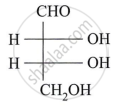
Write the ring structure of glucose.
CH2 OH - CO - (CHOH)4 - CH2 OH is an example of ______.
CH2 OH - CO - (CHOH)4 - CH2 OH is an example of ______.
Why are carbohydrates generally optically active?
Why carbohydrates are generally optically active?
Why carbohydrates are generally optically active?
Why carbohydrates are generally optically active.
Why carbohydrates are generally optically active.
