Advertisements
Advertisements
प्रश्न
Give scientific reasons:
Hydrolysis of sucrose is called inversion.
Advertisements
उत्तर
1) Sucrose (C12H22O11) is dextrorotatory (+66.5°). On hydrolysis with dilute acid or an enzyme called invertase, sucrose gives equimolar mixture of D-(+)-glucose and D-(–)-fructose.
\[\ce{\underset{\text{Sucrose}}{C12H22O11} + H2O ->[H+][\triangle]\underset{\text{D-(+)-Glucose}}{C6H12O6} + \underset{\text{D-(–)-Fructose}}{C6H12O6}}\]
2) Since the laevorotation of fructose (–92.4°) is larger than the dextrorotation of glucose (+52.7°), the hydrolysis product has net laevorotation.
Hence, hydrolysis of sucrose is also called inversion of sucrose.
APPEARS IN
संबंधित प्रश्न
\[\ce{CH2OH-CO-(CHOH)4-CH2OH}\] is an example of ______.
Give two evidences for presence of formyl group in glucose.
Glucose on oxidation with dilute nitric acid gives _______________
Explain the preparation of glucose from sucrose.
Write chemical reaction for following conversions
glucose into glucoxime
Classify the following carbohydrates into monosaccharide, disaccharide, oligosaccharide and polysaccharide:
glucose, cellulose, maltose, stachyose
Explain the classification of carbohydrates with examples.
What is the action of the following reagents on glucose?
hydroxylamine
What is the action of the following reagents on glucose?
hydrogen iodide
Define carbohydrates.
Write a commercial method for preparation of glucose.
What is monosaccharide?
Which of the following monosaccharides is a tetrose sugar?
Which of the following is the basic unit of carbohydrates?
The reserve food material in animals is ____________.
Monosaccharides are ______ in nature.
From the following identify the two types of glucose polymers present in starch.
Which reagent among the following is used to confirm presence of aldehydic carbonyl group in glucose?
Which carbon atoms of α- D glucopyranose and β-D-fructofuranose respectively are linked together to form glycosidic linkage in sucrose?
Which among the following type of linkages is present in cellulose?
4-O-(α-D-Glucopyranosyl)-D-glucopyranose is ____________.
Identify the INCORRECT statement regarding glucose.
One mole of a carbohydrate on hydrolysis gives one mole of glucose and one mole of galactose. Identify the carbohydrate.
Which one of the following is a carbohydrate but does NOT follow the general formula of carbohydrate?
Which one of the following is generally applicable to polysaccharides?
Which one of the following is NOT soluble in water?
Which following reagent is used to detect presence of five hydroxyl groups in a glucose molecule?
Which one of the following sugar does NOT have same empirical fonnula as that of carbohydrate?
Which among the following reagents is used to confirm the presence of carbonyl group in glucose?
Which among the following reagents is used to obtain gluconic acid from glucose?
Identify the product Y in the following reaction.
\[\ce{Maltose ->[Hydrolysis] X ->[dil. HNO3][(excess)] Y}\]
How many moles of acetic acid are obtained in the reaction when one mole glucose is treated with excess acetic anhydride?
What is the product obtained when Br2 water reacts with glucose?
Which among the following observations suggests that glucose also exists in cyclic form?
Which one given below is a non-reducing sugar?
Classify the following into monosaccharides, oligosaccharides and polysaccharides.
Starch
Classify the following into monosaccharides, oligosaccharides and polysaccharides.
Lactose
Classify the following into monosaccharides, oligosaccharides and polysaccharides.
Maltose
Write the structure of α-D (+) glucopyranose.
Is the following sugar, D-sugar or L-sugar?

The two monosaccharides in a disaccharide are held together by ______ bonds.
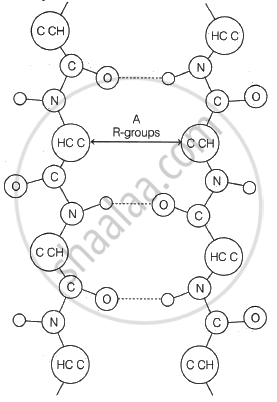
Starch and cellulose are compounds made up of many units of ______.
Formation of gluconic acid from glucose by oxidation using Br2 water.
The glycosidic linkage present in maltose is ______.
Why carbohydrates are generally optically active.
Why carbohydrates are generally optically active.
Assign D/L configuration to the following monosaccharides:
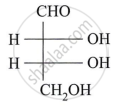
Describe the action of the following reagent on glucose:
dil. Nitric acid.
Explain the hydrolysis of sucrose.
Write the ring structure of glucose.
The linkage present in Lactose is ______.
CH2 OH - CO - (CHOH)4 - CH2 OH is an example of ______.
Why carbohydrates are generally optically active?
\[\ce{CH2OH - CO - (CHOH)4 - CH2 OH}\] is an example of ______.
\[\ce{CH2OH-CO-(CHOH)4-CH2OH}\] is an example of ______.
\[\ce{CH2OH - CO - (CHOH)4 - CH2OH}\] is an example of ______.
Why carbohydrates are generally optically active.
