Advertisements
Advertisements
Question
Glucose on oxidation with dilute nitric acid gives _______________
Options
saccharic acid
oxalic acid
gluconic acid
malonic acid
Advertisements
Solution
Glucose on oxidation with dilute nitric acid gives saccharic acid
APPEARS IN
RELATED QUESTIONS
Give scientific reasons:
Hydrolysis of sucrose is called inversion.
Give two evidences for presence of formyl group in glucose.
Write the name of the unit to which glucose unit is linked to from sucrose.
Explain the preparation of glucose from sucrose.
What is the action of the following reagents on glucose?
acetic anhydride
What is the action of the following reagents on glucose?
hydrogen iodide
Explain D and L configuration in sugars.
Draw the structure of the pyran.
By which of the following process formation of glycosidic bond occurs?
Identify the bond that links the carbon of two adjacent monosaccharides.
Which enzymes would work sequentially on potatoes consumed by an individual?
Which of the following is the basic unit of carbohydrates?
From the following identify the materials that are made up of cellulose.
i. Plant cell wall
ii. Exoskeleton of arthropods
iii. Paper from plant pulp
iv. Cotton fibre
By which of the following feature we can identify the relatively small DNA molecules of plasmids?
Which reagent among the following is used to confirm presence of aldehydic carbonyl group in glucose?
Raffinose, sucrose and stachyose are respectively ____________.
Prolonged heating of glucose with hot HI results in the formation of ____________.
Which of the following monosaccharide is a ketohexose?
Stachyose is ____________.
\[\ce{CH3 - CH2 - CH2 - Br ->[Na][dry ether] A ->[Cl2] B}\]
Identify the product B in the above reaction.
Which one of the following is generally applicable to polysaccharides?
Glucose and gluconic acid treated with dilute nitric acid forms saccharic acid. What does this indicate?
Which among the following statements is true for amylose?
Which of the following statement is NOT true about saccharic acid?
Which among the following sugars does not reduce Tollen's reagent?
What is the molecular formula of glyceraldehyde?
Which among the following reagents is used to obtain gluconic acid from glucose?
How many moles of acetic acid are obtained in the reaction when one mole glucose is treated with excess acetic anhydride?
What is the product obtained when Br2 water reacts with glucose?
When one mole of lactose is hydrolysed, the hydrolysate contains ____________.
How many hydroxyl groups are present in Erythrulose?
Which one given below is a non-reducing sugar?
Assertion: A solution of sucrose in water is dextrorotatory. But on hydrolysis in the presence of little hydrochloric acid, it becomes levorotatory.
Reason: Sucrose hydrolysis gives equal amounts of glucose and fructose. As a result of this change in sign of rotation is observed.
Glucose is an aldose. Which one of the following reactions is not expected with glucose?
Which of the following are epimers?
Classify the following into monosaccharides, oligosaccharides and polysaccharides.
Starch
Classify the following into monosaccharides, oligosaccharides and polysaccharides.
Maltose
Write the structure of α-D (+) glucopyranose.
Which of the following groups contain polysaccharides?
Lactose is made of ______.
Which carbon atoms of fructose are bonded together through oxygen forming fructofuranose?
Formation of gluconic acid from glucose by oxidation using Br2 water.
The glycosidic linkage present in maltose is ______.
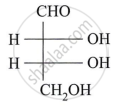
Assign D/L configuration to the following monosaccharides:
Carbohydrates that do not undergo hydrolysis further are called ______.
Explain the hydrolysis of sucrose.
Why carbohydrates are generally optically active.
Why are carbohydrates generally optically active?
Write the Zwitter ion structure of alanine.
Why carbohydrates are generally optically active.
\[\ce{CH2OH-CO-(CHOH)4-CH2OH}\] is an example of ______.
