Advertisements
Advertisements
Question
The glycosidic linkage in maltose is formed between _______________
Options
C-1 of α-D glucose and C-2 of α-D glucose
C-1 of α-D glucose and C-4 of α-D glucose
C-1 of α-D glucose and C-2 of α-D fructose
C-1 of α-D glucose and C-4 of α-D fructose
Advertisements
Solution
The glycosidic linkage in maltose is formed between C-1 of α-D glucose and C-4 of α-D glucose
APPEARS IN
RELATED QUESTIONS
Give scientific reasons:
The disaccharide sucrose gives negative Tollens test while the disaccharide maltose gives a positive Tollens test.
Give scientific reasons:
Hydrolysis of sucrose is called inversion.
Draw a neat diagram for the following:
Haworth formula of glucopyranose.
Glucose on oxidation with dilute nitric acid gives _______________
Explain the classification of carbohydrates with examples.
Draw the Haworth projection structure of the following.
α-D-(–)-Fructofuranose
Write a chemical reaction to convert glucose into glucose cyanohydrin.
Which of the following monosaccharides is a tetrose sugar?
Which of the following is the basic unit of carbohydrates?
Which of the following carbohydrate is sweet to taste?
Match the Column I and Column II select the correct option.
| Column I | Column II | ||
| i. | Monosaccharides | a. | Stored energy in animals |
| ii. | Glycogen | b. | Polymer made from ß-glucose molecules |
| iii. | Cellulose | c. | Exoskeleton of arthropods |
| iv. | Chitin | d. | Building blocks of carbohydrates |
| e. | Plant hormone |
Chitin is a/an ______.
The number of asymmetric carbon atoms in the glucose molecule is ____________.
Which among the following type of linkages is present in cellulose?
\[\ce{CH3 - CH2 - CH2 - Br ->[Na][dry ether] A ->[Cl2] B}\]
Identify the product B in the above reaction.
Which one of the following is a carbohydrate but does NOT follow the general formula of carbohydrate?
Which one of the following is Tetrose sugar?
Which of the following molecules reduces Fehling's solution?
Which following reagent is used to detect presence of five hydroxyl groups in a glucose molecule?
Which one of the following sugar does NOT have same empirical fonnula as that of carbohydrate?
What is the number of hydroxyl groups present in lactic acid?
Identify the number of secondary carbon atoms in glucose.
When 2 moles of stachyose is hydrolyzed, the number of moles of galactose obtained is ____________.
Which among the following reagents is used to confirm the presence of carbonyl group in glucose?
Which of the following statement is NOT true about saccharic acid?
Which among the following sugars does not reduce Tollen's reagent?
What is the quantity of glucose obtained when 68.4 g of sucrose is hydrolyzed in laboratory under ideal condition?
(Molar mass of sucrose = 342 g mol−1)
What is the molecular formula of glyceraldehyde?
What is the product obtained when Br2 water reacts with glucose?
Complete hydrolysis of cellulose gives ____________.
α-D (+) Glucose and β-D (+) glucose are ____________.
Which of the following are epimers?
Classify the following into monosaccharides, oligosaccharides and polysaccharides.
Lactose
Classify the following into monosaccharides, oligosaccharides and polysaccharides.
Maltose
Which of the following groups contain polysaccharides?
The two monosaccharides in a disaccharide are held together by ______ bonds.
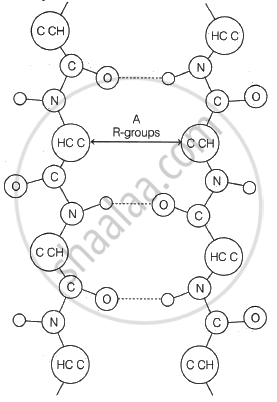
Corn is immersed in boiling water. It is then cooled, and the solution becomes sweet. It is due to ______.
Formation of gluconic acid from glucose by oxidation using Br2 water.
Identify the product obtained in the following conversion.
\[\ce{Glucose ->[(O)][Br2 water] Product}\]
Why carbohydrates are generally optically active.
Why carbohydrates are generally optically active.
Assign D/L configuration to the following monosaccharides:
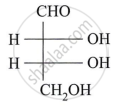
Why carbohydrates are generally optically active.
\[\ce{CH2OH-CO-(CHOH)4-CH2OH}\] is an example of ______.
\[\ce{CH2OH - CO - (CHOH)4 - CH2OH}\] is an example of ______.
\[\ce{CH2OH - CO - (CHOH)4 - CH2OH}\] is an example of ______.
Given below are two statements.
Statement I - Lactose on hydrolysis converts into glucose and galactose.
Statement II - Galactose also plays same role as glucose in respiration.
In light of the above statements, select the correct option given below.
