Advertisements
Advertisements
Question
Give two evidences for presence of formyl group in glucose.
Advertisements
Solution
- Glucose gets oxidized to a six-carbon monocarboxylic acid called gluconic acid on reaction with bromine water which is a mild oxidizing agent. Thus, the carbonyl group in glucose is in the form of formyl (–CHO).
- Hemiacetal group of glucopyranose structure is a potential aldehyde (formyl) group. It imparts reducing properties to glucose. Thus, glucose gives positive Tollen’s test or Fehling test.
APPEARS IN
RELATED QUESTIONS
\[\ce{CH2OH-CO-(CHOH)4-CH2OH}\] is an example of ______.
Draw the structure of α-D glucopyranose.
Write the name of the unit to which glucose unit is linked to from sucrose.
What is the action of the following reagents on glucose?
acetic anhydride
Which of the following type of carbohydrates cannot be hydrolyzed?
Identify the given structure 'P' and 'Q'.

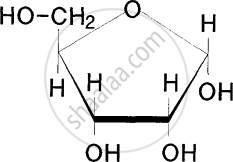
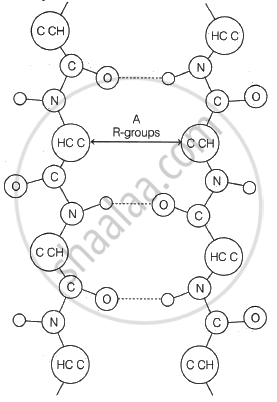
Identify the substances having glycosidic bond and peptide bond, respectively in their structure:
From the following identify the group that is exclusively consists of polysaccharides.
______ is the prosthetic group of glycoproteins.
Identify the sugar having the molecular formula C6H1206.
Fructose is the fruit sugar and chemically it is ketohexose but it has a ______ rather than a ______.
Identify the WRONG statement.
Which among the following compounds is obtained when glucose reacts with hydrogen cyanide?
By which of the following feature we can identify the relatively small DNA molecules of plasmids?
Which is the product obtained, when Br2 water reacts with glucose?
Match the Column I and Column II select the correct option.
| Column I | Column II | ||
| i. | Monosaccharides | a. | Stored energy in animals |
| ii. | Glycogen | b. | Polymer made from ß-glucose molecules |
| iii. | Cellulose | c. | Exoskeleton of arthropods |
| iv. | Chitin | d. | Building blocks of carbohydrates |
| e. | Plant hormone |
Chitin is a/an ______.
Monosaccharides are ______ in nature.
Which among the following type of linkages is present in cellulose?
Raffinose, sucrose and stachyose are respectively ____________.
Which one of the following is an oligosaccharide?
The general formula for polysaccharide is ____________.
Stachyose is ____________.
Which one of the following is a carbohydrate but does NOT follow the general formula of carbohydrate?
Which one of the following is generally applicable to polysaccharides?
Glucose and gluconic acid treated with dilute nitric acid forms saccharic acid. What does this indicate?
What is the quantity of glucose obtained when 68.4 g of sucrose is hydrolyzed in laboratory under ideal condition?
(Molar mass of sucrose = 342 g mol−1)
Which among the following reagents is used for conversion of glucose to glucoxime?
What is the molecular formula of glyceraldehyde?
When one mole of lactose is hydrolysed, the hydrolysate contains ____________.
\[\ce{Glucose ->[(HCN)] Product ->[(hydrolysis)] Product ->[(HI + Heat)] A}\], the compound A is:
α-D (+) Glucose and β-D (+) glucose are ____________.
What are reducing and non-reducing sugars?
Classify the following into monosaccharides, oligosaccharides and polysaccharides.
Starch
Classify the following into monosaccharides, oligosaccharides and polysaccharides.
Fructose
Classify the following into monosaccharides, oligosaccharides and polysaccharides.
Lactose
Is the following sugar, D-sugar or L-sugar?

The molecule of glucose is also called ______.
If 'n' represents total number of asymmetric carbon atoms in a compound, then the possible· number of optical isomers of the compound is ______.
Lactose is made of ______.
Glucose on oxidation with bromine water yields gluconic acid. This reaction confirms the presence of ______.
The two monosaccharides in a disaccharide are held together by ______ bonds.
Identify the monosaccharide containing only one asymmetric carbon atom in its molecule.
Identify the product obtained in the following conversion.
\[\ce{Glucose ->[(O)][Br2 water] Product}\]
The glycosidic linkage present in maltose is ______.
Assign D/L configuration to the following monosaccharides:
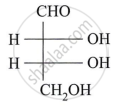
Describe the action of the following reagent on glucose:
dil. Nitric acid.
Write Fischer projection formulae for glucose.
Explain the hydrolysis of sucrose.
Why carbohydrates are generally optically active.
