Advertisements
Advertisements
Question
Define a unit charge.
Advertisements
Solution
One coulomb is the amount of charge which, when placed at a distance of one metre from another charge of the same magnitude in vacuum, experiences a force of 9.0 × 10⁹ N.
APPEARS IN
RELATED QUESTIONS
Four point charges qA = 2 μC, qB = −5 μC, qC = 2 μC, and qD = −5 μC are located at the corners of a square ABCD of side 10 cm. What is the force on a charge of 1 μC placed at the centre of the square?
- Two insulated charged copper spheres A and B have their centers separated by a distance of 50 cm. What is the mutual force of electrostatic repulsion if the charge on each is 6.5 × 10⁻⁷ C? The radii of A and B are negligible compared to the distance of separation.
- What is the force of repulsion if each sphere is charged double the above amount, and the distance between them is halved?
Suppose that the particle is an electron projected with velocity vx = 2.0 × 10⁶ m s−1. If E between the plates separated by 0.5 cm is 9.1 × 10² N/C, where will the electron strike the upper plate? (|e| = 1.6 × 10⁻¹⁹ C, me = 9.1 × 10⁻³¹ kg)
Three-point charges q, – 4q and 2q are placed at the vertices of an equilateral triangle ABC of side 'l' as shown in the figure. Obtain the expression for the magnitude of the resultant electric force acting on the charge q
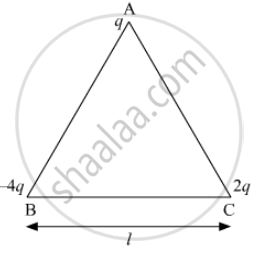
(b) Find out the amount of the work done to separate the charges at infinite distance.
Four charges +q, −q, +q and −q are to be arranged respectively at the four corners of a square ABCD of side 'a'.
(a) Find the work required to put together this arrangement.
(b) A charge q0 is brought to the centre of the square, the four charges being held fixed. How much extra work is needed to do this ?
Does the force on a charge due to another charge depend on the charges present nearby?
Find the dimensional formula of ε0.
Two equal charges are placed at a separation of 1.0 m. What should be the magnitude of the charges, so that the force between them equals the weight of a 50 kg person?
Suppose the second charge in the previous problem is −1.0 × 10⁻⁶ C. Locate the position where a third charge will not experience a net force.
Estimate the number of electrons in 100 g of water. How much is the total negative charge on these electrons?
Suppose all the electrons of 100 g water are lumped together to form a negatively-charged particle and all the nuclei are lumped together to form a positively-charged particle. If these two particles are placed 10.0 cm away from each other, find the force of attraction between them. Compare it with your weight.
Consider a gold nucleus to be a sphere of radius 6.9 fermi in which protons and neutrons are distributed. Find the force of repulsion between two protons situated at largest separation. Why do these protons not fly apart under this repulsion?
Find the ratio of the electrical and gravitational forces between two protons.
Suppose an attractive nuclear force acts between two protons which may be written as F=Ce−kr/r2. Write down the dimensional formulae and appropriate SI units of C and k.
Find the speed of the electron in the ground state of a hydrogen atom. The description of ground state is given in the previous problem.
Two identical balls, each with a charge of 2.00 × 10⁻⁷ C and a mass of 100 g, are suspended from a common point by two insulating strings, each 50 cm long. The balls are held at a separation 5.0 cm apart and then released. Find.
(a) the electric force on one of the charged balls
(b) the components of the resultant force on it along and perpendicular to the string
(c) the tension in the string
(d) the acceleration of one of the balls. Answers are to be obtained only for the instant just after the release.
Two small spheres, each with a mass of 20 g, are suspended from a common point by two insulating strings of length 40 cm each. The spheres are identically charged and the separation between the balls at equilibrium is found to be 4 cm. Find the charge on each sphere.
Two identical pith balls, each carrying a charge q, are suspended from a common point by two strings of equal length l. Find the mass of each ball if the angle between the strings is 2θ in equilibrium.
Two particles A and B, each carrying a charge Q, are held fixed with a separation dbetween them. A particle C of mass m and charge q is kept at the middle point of the line AB. Under what conditions will the particle C execute simple harmonic motion if it is released after such a small displacement? Find the time period of the oscillations if these conditions are satisfied.
Two particles of masses 5.0 g each and opposite charges of +4.0 × 10⁻⁵ C and −4.0 × 10⁻⁵ C are released from rest with a separation of 1.0 m between them. Find the speeds of the particles when the separation is reduced to 50 cm.
Write down Coulomb’s law in vector form and mention what each term represents.
Write a short note on superposition principle.
A spring of spring constant 5 × 10³ N/m is stretched initially by 5 cm from the unstretched position. Then the work required to stretch it further by another 5 cm is:
Coulomb's law is given by F = k q1q2 rn where n is
Two charge – 10c and + 10 c are placed 10 cm apart. Potential at centre of the line joining the two charge is:-
Two charges q and – 3q are placed fixed on x-axis separated by distance ‘d’. Where should a third charge 2q be placed such that it will not experience any force?
The ratio of the forces between two charges placed at a certain distance apart in the air and by the same distance apart in a medium of dielectric constant K is ______.
