Advertisements
Advertisements
प्रश्न
Define a unit charge.
Advertisements
उत्तर
One coulomb is the amount of charge which, when placed at a distance of one metre from another charge of the same magnitude in vacuum, experiences a force of 9.0 × 10⁹ N.
APPEARS IN
संबंधित प्रश्न
The electrostatic force on a small sphere of charge 0.4 μC due to another small sphere of charge −0.8 μC in air is 0.2 N.
- What is the distance between the two spheres?
- What is the force on the second sphere due to the first?
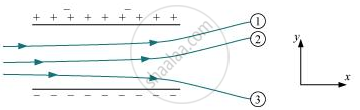
A particle of mass m and charge (−q) enters the region between the two charged plates initially moving along x-axis with speed vx (like particle 1 in the fig.). The length of plate is L and an uniform electric field E is maintained between the plates. Show that the vertical deflection of the particle at the far edge of the plate is qEL2/(2m`"v"_"x"^2`).
Four charges +q, −q, +q and −q are to be arranged respectively at the four corners of a square ABCD of side 'a'.
(a) Find the work required to put together this arrangement.
(b) A charge q0 is brought to the centre of the square, the four charges being held fixed. How much extra work is needed to do this ?
Write any two important points of similarities and differences each between Coulomb's law for the electrostatic field and Biot-Savart's law of the magnetic field ?
Find the dimensional formula of ε0.
Two equal charges are placed at a separation of 1.0 m. What should be the magnitude of the charges, so that the force between them equals the weight of a 50 kg person?
Suppose the second charge in the previous problem is −1.0 × 10⁻⁶ C. Locate the position where a third charge will not experience a net force.
Estimate the number of electrons in 100 g of water. How much is the total negative charge on these electrons?
Find the speed of the electron in the ground state of a hydrogen atom. The description of ground state is given in the previous problem.
Two identical pith balls, each carrying a charge q, are suspended from a common point by two strings of equal length l. Find the mass of each ball if the angle between the strings is 2θ in equilibrium.
A particle with a charge of 2.0 × 10⁻⁴ C is placed directly below and at a separation of 10 cm from the bob of a simple pendulum at rest. The mass of the bob is 100 g. What charge should the bob be given so that the string becomes loose?
Two identically-charged particles are fastened to the two ends of a spring of spring constant 100 N m−1 and natural length 10 cm. The system rests on a smooth horizontal table. If the charge on each particle is 2.0 × 10⁻⁸ C, find the extension in the length of the spring. Assume that the extension is small as compared to the natural length. Justify this assumption after you solve the problem.
A particle A with a charge of 2.0 × 10⁻⁶ C and a mass of 100 g is placed at the bottom of a smooth inclined plane of inclination 30°. Where should another particle B, with the same charge and mass, be placed on the incline so that it may remain in equilibrium?
Two particles A and B, each carrying a charge Q, are held fixed with a separation dbetween them. A particle C of mass m and charge q is kept at the middle point of the line AB. If it is displaced through a distance x perpendicular to AB, what would be the electric force experienced by it?
Two particles A and B, each carrying a charge Q, are held fixed with a separation dbetween them. A particle C of mass m and charge q is kept at the middle point of the line AB. Assuming x<<d, show that this force is proportional to x.
Two particles A and B, each carrying a charge Q, are held fixed with a separation dbetween them. A particle C of mass m and charge q is kept at the middle point of the line AB. Under what conditions will the particle C execute simple harmonic motion if it is released after such a small displacement? Find the time period of the oscillations if these conditions are satisfied.
A point charge produces an electric field of magnitude 5.0 NC−1 at a distance of 40 cm from it. What is the magnitude of the charge?
Two equal charges, 2.0 × 10⁻⁷ C each, are held fixed at a separation of 20 cm. A third charge of equal magnitude is placed midway between the two charges. It is now moved to a point 20 cm from both the charges. How much work is done by the electric field during the process?
Two charged particles, with equal charges of 2.0 × 10⁻⁵ C, are brought from infinity to within a separation of 10 cm. Find the increase in the electric potential energy during the process
What are the differences between the Coulomb force and the gravitational force?
Three charges +Q, q, +Q are placed respectively, at distance, 0, d/2 and d from the origin, on the X-axis. If the net force experienced by +Q, placed at x = 0, is zero then value of q is ____________.
A total charge Q is broken in two parts Q1 and Q2 and they are placed at a distance R from each other. The maximum force of repulsion between them will occur, when ____________.
Two positive charges ______.
The unit of charge is ______.
Two charges of equal magnitudes kept at a distance r exert a force F on each other. If the charges are halved and distance between them is doubled, then the new force acting on each charge is ______.
According to Coulomb's law, which is the correct relation for the following figure?

