Advertisements
Advertisements
Question
At what temperature is the root mean square speed of an atom in an argon gas cylinder equal to the rms speed of a helium gas atom at – 20 °C? (atomic mass of Ar = 39.9 u, of He = 4.0 u).
Advertisements
Solution 1
Temperature of the helium atom, THe = –20°C= 253 K
Atomic mass of argon, MAr = 39.9 u
Atomic mass of helium, MHe = 4.0 u
Let, (vrms)Ar be the rms speed of argon.
Let (vrms)He be the rms speed of helium.
The rms speed of argon is given by:
`(v_"rms")_"Ar" = sqrt((3RT_"Ar")/M_"Ar")` .... (1)
Where,
R is the universal gas constant
TAr is temperature of argon gas
The rms speed of helium is given by:
`(v_"rms")_"He" = sqrt((3RT_"He")/M_"He")` ... (ii)
It is given that
(vrms)Ar = (vrms)He
`sqrt((3RT_"Ar")/ M_"Ar")` = `sqrt((3RT_"He")/M_"He")`
`T_"Ar"/M_"Ar" = T_"He"/M_"He"`
`T_"Ar" = T_"He"/M_"He" xx M_"Ar"`
`= 253/4 xx 39.9`
= 2523.675 = 2.52 × 10³ K
Therefore, the temperature of the argon atom is 2.52 × 10³ K.
Solution 2
Let C and C’ be the rms velocity of argon and a helium gas atoms at temperature T K and T K respectively
Here, M = 39.9; M’ = 4.0; T =?; T = -20 + 273 = 253 K
Now, `C = sqrt((3RT)/M
)= sqrt((3RT)/39.9)` and `C' = sqrt((3RT')/M') = sqrt(3R xx 253)/4`
Since C =C'
Therefore `sqrt((3RT)/39.9) = sqrt(3Rxx253)/4` or `T = (39.9 xx 253)/4 = 2523.7 K`
APPEARS IN
RELATED QUESTIONS
Molar volume is the volume occupied by 1 mol of any (ideal) gas at standard temperature and pressure (STP: 1 atmospheric pressure, 0 °C). Show that it is 22.4 litres
An oxygen cylinder of volume 30 litres has an initial gauge pressure of 15 atm and a temperature of 27 °C. After some oxygen is withdrawn from the cylinder, the gauge pressure drops to 11 atm and its temperature drops to 17 °C. Estimate the mass of oxygen taken out of the cylinder (R = 8.31 J mol–1 K–1, molecular mass of O2 = 32 u)
Estimate the average thermal energy of a helium atom at the temperature of 10 million Kelvin (the typical core temperature in the case of a star).
During the practical session in the lab when hydrogen sulphide gas having offensive odour is prepared for some test, we can smell the gas even 50 metres away. Explain the phenomenon.
What is diffusion? Give an example to illustrate it.
Fill in the blanks:
If the temperature is reduced to half, ………….. would also reduce to half.
Give reason for the following:
Volumes of gases are converted into s.t.p. conditions and then compared.
Show that for monoatomic gas the ratio of the two specific heats is 5:3.
Show that for diatomic gas the ratio of the two specific heats is 7:5.
Gases exert pressure on the walls of the container because the gas molecules ______
Estimate the average thermal energy of a helium atom at the temperature on the surface of the Sun (6000 K).
Three vessels of equal capacity have gases at the same temperature and pressure. The first vessel contains neon (monatomic), the second contains chlorine (diatomic), and the third contains uranium hexafluoride (polyatomic).
Do the vessels contain an equal number of respective molecules?
Which of the following diagrams (Figure) depicts ideal gas behaviour?
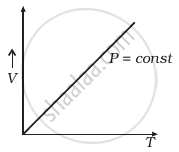 (a) |
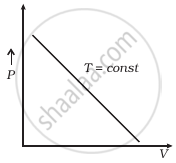 (b) |
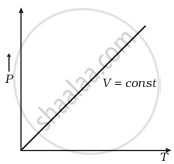 (c) |
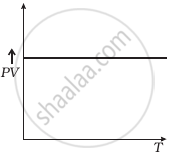 (d) |
Calculate the number of atoms in 39.4 g gold. Molar mass of gold is 197g mole–1.
A box of 1.00 m3 is filled with nitrogen at 1.50 atm at 300K. The box has a hole of an area 0.010 mm2. How much time is required for the pressure to reduce by 0.10 atm, if the pressure outside is 1 atm.
The volume V of an enclosure contains a mixture of three gases, 16 g of oxygen, 28 g of nitrogen and 44 g of carbon dioxide at absolute temperature T. Consider R as universal gas constant. The pressure of the mixture of gases is ______.
Cooking gas containers are kept in a lorry moving with uniform speed. The temperature of the gas molecules inside will ______.
Two tanks of equal volume contain equal mass of oxygen and nitrogen at 127°C. Find the ratio of pressure in two tanks.
