Advertisements
Advertisements
प्रश्न
At what temperature is the root mean square speed of an atom in an argon gas cylinder equal to the rms speed of a helium gas atom at – 20 °C? (atomic mass of Ar = 39.9 u, of He = 4.0 u).
Advertisements
उत्तर १
Temperature of the helium atom, THe = –20°C= 253 K
Atomic mass of argon, MAr = 39.9 u
Atomic mass of helium, MHe = 4.0 u
Let, (vrms)Ar be the rms speed of argon.
Let (vrms)He be the rms speed of helium.
The rms speed of argon is given by:
`(v_"rms")_"Ar" = sqrt((3RT_"Ar")/M_"Ar")` .... (1)
Where,
R is the universal gas constant
TAr is temperature of argon gas
The rms speed of helium is given by:
`(v_"rms")_"He" = sqrt((3RT_"He")/M_"He")` ... (ii)
It is given that
(vrms)Ar = (vrms)He
`sqrt((3RT_"Ar")/ M_"Ar")` = `sqrt((3RT_"He")/M_"He")`
`T_"Ar"/M_"Ar" = T_"He"/M_"He"`
`T_"Ar" = T_"He"/M_"He" xx M_"Ar"`
`= 253/4 xx 39.9`
= 2523.675 = 2.52 × 10³ K
Therefore, the temperature of the argon atom is 2.52 × 10³ K.
उत्तर २
Let C and C’ be the rms velocity of argon and a helium gas atoms at temperature T K and T K respectively
Here, M = 39.9; M’ = 4.0; T =?; T = -20 + 273 = 253 K
Now, `C = sqrt((3RT)/M
)= sqrt((3RT)/39.9)` and `C' = sqrt((3RT')/M') = sqrt(3R xx 253)/4`
Since C =C'
Therefore `sqrt((3RT)/39.9) = sqrt(3Rxx253)/4` or `T = (39.9 xx 253)/4 = 2523.7 K`
APPEARS IN
संबंधित प्रश्न
Molar volume is the volume occupied by 1 mol of any (ideal) gas at standard temperature and pressure (STP: 1 atmospheric pressure, 0 °C). Show that it is 22.4 litres
Estimate the average thermal energy of a helium atom at the temperature of 10 million Kelvin (the typical core temperature in the case of a star).
Three vessels of equal capacity have gases at the same temperature and pressure. The first vessel contains neon (monatomic), the second contains chlorine (diatomic), and the third contains uranium hexafluoride (polyatomic).
Is the root mean square speed of molecules the same in the three cases? If not, in which case is vrms the largest?
50 m3 of saturated vapour is cooled down from 30°C to 20°C. Find the mass of the water condensed. The absolute humidity of saturated water vapour is 30 g m−3 at 30°C and 16 g m−3 at 20°C.
During the practical session in the lab when hydrogen sulphide gas having offensive odour is prepared for some test, we can smell the gas even 50 metres away. Explain the phenomenon.
Give reasons for the following:
Gas fills the vessel completely in which it is kept.
Choose the correct answer:
The graph of PV vs P for gas is
Fill in the blanks:
If the temperature is reduced to half, ………….. would also reduce to half.
Correct the following statement:
0°C is equal to zero Kelvin.
Name or state the following:
The standard pressure of a gas in cm. of mercury corresponding to one atmospheric pressure.
Give reason for the following:
Temperature remaining constant the product of the vol. & the press, of a given mass of dry gas is a constant.
Show that for diatomic gas the ratio of the two specific heats is 7:5.
The equation of state for 2g of oxygen at a pressure 'P' and temperature 'T', when occupying a volume 'V' will be ______.
Which of the following diagrams (Figure) depicts ideal gas behaviour?
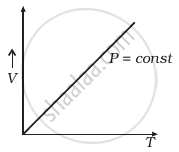 (a) |
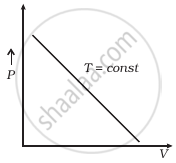 (b) |
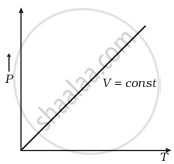 (c) |
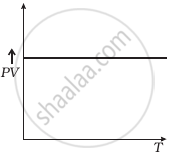 (d) |
The volume V of an enclosure contains a mixture of three gases, 16 g of oxygen, 28 g of nitrogen and 44 g of carbon dioxide at absolute temperature T. Consider R as universal gas constant. The pressure of the mixture of gases is ______.
At room temperature, a diatomic gas is found to have an r.m.s. speed of 1930 ms-1. The gas is ______.
For a wave, y = 0.0002 sin`[2pi(110"t"-x/3)+pi/3]` is travelling in a medium. The energy per unit volume being transferred by wave if density of medium is 1.5 kg/m3, is ______.
