Advertisements
Advertisements
Question
During the practical session in the lab when hydrogen sulphide gas having offensive odour is prepared for some test, we can smell the gas even 50 metres away. Explain the phenomenon.
Advertisements
Solution
The phenomenon is diffusion. In air, gas molecules diffuse to mix thoroughly. Hence, we can smell hydrogen sulphide gas from a distance in the laboratory.
APPEARS IN
RELATED QUESTIONS
Oxygen is filled in a closed metal jar of volume 1.0 × 10⁻³ m3 at a pressure of 1.5 × 10⁵Pa and temperature 400 K. The jar has a small leak in it. The atmospheric pressure is 1.0 × 10⁵ Pa and the atmospheric temperature is 300 K. Find the mass of the gas that leaks out by the time the pressure and the temperature inside the jar equalise with the surrounding.
Name or state the following:
An equation used in chemical calculations which gives a simultaneous effect of changes of temperature and pressure on the volume of a given mass of dry gas
Name or state the following:
The absolute temperature value corresponding to 35°C.
The average energy per molecule is proportional to ______
If the absolute temperature of a body is doubled, the power radiated will increase by a factor of ______
Show that for monoatomic gas the ratio of the two specific heats is 5:3.
Show that for diatomic gas the ratio of the two specific heats is 7:5.
Which of the following diagrams (Figure) depicts ideal gas behaviour?
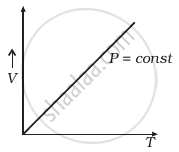 (a) |
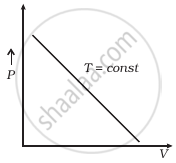 (b) |
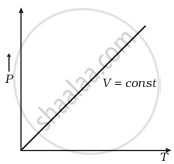 (c) |
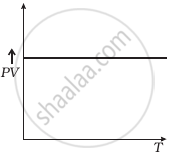 (d) |
At room temperature, a diatomic gas is found to have an r.m.s. speed of 1930 ms-1. The gas is ______.
Two tanks of equal volume contain equal mass of oxygen and nitrogen at 127°C. Find the ratio of pressure in two tanks.
