Advertisements
Advertisements
Question
The figure shows the plot of PV/T versus Pfor 1.00×10⁻³ kg of oxygen gas at two different temperatures.
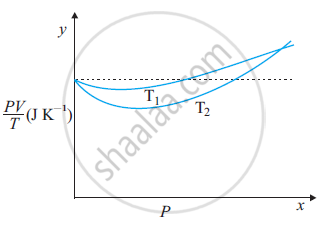
(a) What does the dotted plot signify?
(b) Which is true: T1 > T2 or T1 < T2?
(c) What is the value of PV/T where the curves meet on the y-axis?
(d) If we obtained similar plots for 1.00 ×10⁻³ kg of hydrogen, would we get the same value of PV/T at the point where the curves meet on the y-axis? If not, what mass of hydrogen yields the same value of PV/T (for low pressure high temperature region of the plot)? (Molecular mass of H2 = 2.02 u, of O2 = 32.0 u, R = 8.31 J mo1–1 K–1.)
Advertisements
Solution 1
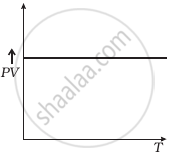
a) The dotted plot in the graph signifies the ideal behaviour of the gas, i.e., the ratio `"PV"/T` is equal. μR (μ is the number of moles and R is the universal gas constant) is a constant quality. It is not dependent on the pressure of the gas.
b) The dotted plot in the given graph represents an ideal gas. The curve of the gas at temperature T1 is closer to the dotted plot than the curve of the gas at temperature T2. A real gas approaches the behaviour of an ideal gas when its temperature increases. Therefore, T1 > T2 is true for the given plot.
c) The value of the ratio PV/T, where the two curves meet, is μR. This is because the ideal gas equation is given as:
PV = μRT
Where,
P is the pressure
T is the temperature
V is the volume
μ is the number of moles
R is the universal constant
Molecular mass of oxygen = 32.0 g
Mass of oxygen = 1 × 10⁻³ kg = 1 g
R = 8.314 J mole–1 K–1
`:. PV/T = 1/32 xx 8.314`
= 0.26 `J K^(-1)`
Therefore, the value of the ratio PV/T, where the curves meet on the y-axis, is 0.26 J K–1.
d) If we obtain similar plots for 1.00 × 10⁻³ kg of hydrogen, then we will not get the same value of PV/T at the point where the curves meet the y-axis. This is because the molecular mass of hydrogen (2.02 u) is different from that of oxygen (32.0 u).
We have:
`PV/T = 0.26 J K^(-1)`
R = 8.314 J mole–1 K–1
Molecular mass (M) of H2 = 2.02 u
`PV/T = muR` at constant temperature
Where, `mu = m/M`
`m = "Mass of " H_2`
`:.m = (PV)/T xx M/R`
`= (0.26 xx 2.02)/8.31`
= 6.3 × 10⁻² g = 6.3 × 10⁻⁵ kg
Hence, 6.3 × 10⁻⁵ kg of H2 will yield the same value of PV/T.
Solution 2
a) The dotted plot corresponds to ‘ideal’ gas behaviour as it is parallel to P-axis and it tells that value of PV/T remains same even when P is changed.
b) The upper position of PV/T shows that its value is lesser for T1 thus T1 > T2. This is because the curve at T1is more close to dotted plot than the curve at T2 Since the behaviour of a real gas approaches the perfect gas behaviour, as the temperature is increased.
c) Where the two curves meet, the value of PV/T on y-axis is equal to μR. Since ideal gas equation for μ moles is PV = μRT
Where `mu = (1.00 xx 10^(-3) kg)/(32xx10^(-3)kg) = 1/32`
`:. "Value of " "PV"/T = muR = 1/32 xx 8.31 JK^(-1) = 0.26 JK^(-1)`
d) if we obtained similar plots for 1.00 xx 10^(-3) kg of hydrogen, we will not get the same value of `"PV"/T` at the point, where the curves meet of the y-axis. This is because molecular mass of hydrogen is different form that of oxygen.
For the same value of `PV/T`, mass of hydrogen required is obtained from
`"PV"/T = nR = m/2.02 xx 8.31 = 0.26`
`m = (2.02 xx 0.26)/ 8.31 " gram" = 6.32 xx 10^(-2) "gram"`
APPEARS IN
RELATED QUESTIONS
Molar volume is the volume occupied by 1 mol of any (ideal) gas at standard temperature and pressure (STP: 1 atmospheric pressure, 0 °C). Show that it is 22.4 litres
At what temperature is the root mean square speed of an atom in an argon gas cylinder equal to the rms speed of a helium gas atom at – 20 °C? (atomic mass of Ar = 39.9 u, of He = 4.0 u).
Oxygen is filled in a closed metal jar of volume 1.0 × 10⁻³ m3 at a pressure of 1.5 × 10⁵Pa and temperature 400 K. The jar has a small leak in it. The atmospheric pressure is 1.0 × 10⁵ Pa and the atmospheric temperature is 300 K. Find the mass of the gas that leaks out by the time the pressure and the temperature inside the jar equalise with the surrounding.
What do you understand by gas?
What is diffusion? Give an example to illustrate it.
Match the following:
|
|
Column A |
Column B |
|
(a) |
cm3 |
(i) Pressure |
|
(b) |
Kelvin |
(ii) Temperature |
|
(c) |
Torr |
(iii) Volume |
|
(d) |
Boyle's law |
(iv) `"V"/"T" = ("V"_1)/("T"_1)` |
|
(a) |
Charles's law |
(v) `"PV"/"T" = ("P"_1 "V"_1)/"T"_1` |
|
|
|
(vi) PV = P1V1 |
Fill in the blanks:
If the temperature is reduced to half, ………….. would also reduce to half.
Name or state the following:
The absolute temperature value corresponding to 35°C.
The average energy per molecule is proportional to ______
The equation of state for 2g of oxygen at a pressure 'P' and temperature 'T', when occupying a volume 'V' will be ______.
Three vessels of equal capacity have gases at the same temperature and pressure. The first vessel contains neon (monatomic), the second contains chlorine (diatomic), and the third contains uranium hexafluoride (polyatomic).
Do the vessels contain an equal number of respective molecules?
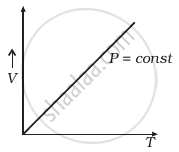
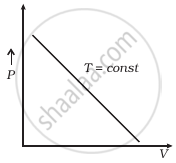
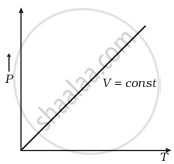
Which of the following diagrams (Figure) depicts ideal gas behaviour?
 (a) |
 (b) |
 (c) |
 (d) |
A box of 1.00 m3 is filled with nitrogen at 1.50 atm at 300K. The box has a hole of an area 0.010 mm2. How much time is required for the pressure to reduce by 0.10 atm, if the pressure outside is 1 atm.
Cooking gas containers are kept in a lorry moving with uniform speed. The temperature of the gas molecules inside will ______.
At room temperature, a diatomic gas is found to have an r.m.s. speed of 1930 ms-1. The gas is ______.
Two tanks of equal volume contain equal mass of oxygen and nitrogen at 127°C. Find the ratio of pressure in two tanks.
