Advertisements
Advertisements
प्रश्न
The figure shows the plot of PV/T versus Pfor 1.00×10⁻³ kg of oxygen gas at two different temperatures.
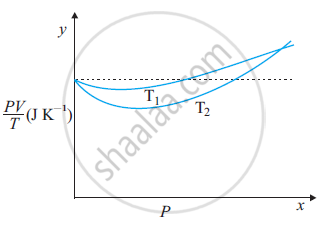
(a) What does the dotted plot signify?
(b) Which is true: T1 > T2 or T1 < T2?
(c) What is the value of PV/T where the curves meet on the y-axis?
(d) If we obtained similar plots for 1.00 ×10⁻³ kg of hydrogen, would we get the same value of PV/T at the point where the curves meet on the y-axis? If not, what mass of hydrogen yields the same value of PV/T (for low pressure high temperature region of the plot)? (Molecular mass of H2 = 2.02 u, of O2 = 32.0 u, R = 8.31 J mo1–1 K–1.)
Advertisements
उत्तर १
a) The dotted plot in the graph signifies the ideal behaviour of the gas, i.e., the ratio `"PV"/T` is equal. μR (μ is the number of moles and R is the universal gas constant) is a constant quality. It is not dependent on the pressure of the gas.
b) The dotted plot in the given graph represents an ideal gas. The curve of the gas at temperature T1 is closer to the dotted plot than the curve of the gas at temperature T2. A real gas approaches the behaviour of an ideal gas when its temperature increases. Therefore, T1 > T2 is true for the given plot.
c) The value of the ratio PV/T, where the two curves meet, is μR. This is because the ideal gas equation is given as:
PV = μRT
Where,
P is the pressure
T is the temperature
V is the volume
μ is the number of moles
R is the universal constant
Molecular mass of oxygen = 32.0 g
Mass of oxygen = 1 × 10⁻³ kg = 1 g
R = 8.314 J mole–1 K–1
`:. PV/T = 1/32 xx 8.314`
= 0.26 `J K^(-1)`
Therefore, the value of the ratio PV/T, where the curves meet on the y-axis, is 0.26 J K–1.
d) If we obtain similar plots for 1.00 × 10⁻³ kg of hydrogen, then we will not get the same value of PV/T at the point where the curves meet the y-axis. This is because the molecular mass of hydrogen (2.02 u) is different from that of oxygen (32.0 u).
We have:
`PV/T = 0.26 J K^(-1)`
R = 8.314 J mole–1 K–1
Molecular mass (M) of H2 = 2.02 u
`PV/T = muR` at constant temperature
Where, `mu = m/M`
`m = "Mass of " H_2`
`:.m = (PV)/T xx M/R`
`= (0.26 xx 2.02)/8.31`
= 6.3 × 10⁻² g = 6.3 × 10⁻⁵ kg
Hence, 6.3 × 10⁻⁵ kg of H2 will yield the same value of PV/T.
उत्तर २
a) The dotted plot corresponds to ‘ideal’ gas behaviour as it is parallel to P-axis and it tells that value of PV/T remains same even when P is changed.
b) The upper position of PV/T shows that its value is lesser for T1 thus T1 > T2. This is because the curve at T1is more close to dotted plot than the curve at T2 Since the behaviour of a real gas approaches the perfect gas behaviour, as the temperature is increased.
c) Where the two curves meet, the value of PV/T on y-axis is equal to μR. Since ideal gas equation for μ moles is PV = μRT
Where `mu = (1.00 xx 10^(-3) kg)/(32xx10^(-3)kg) = 1/32`
`:. "Value of " "PV"/T = muR = 1/32 xx 8.31 JK^(-1) = 0.26 JK^(-1)`
d) if we obtained similar plots for 1.00 xx 10^(-3) kg of hydrogen, we will not get the same value of `"PV"/T` at the point, where the curves meet of the y-axis. This is because molecular mass of hydrogen is different form that of oxygen.
For the same value of `PV/T`, mass of hydrogen required is obtained from
`"PV"/T = nR = m/2.02 xx 8.31 = 0.26`
`m = (2.02 xx 0.26)/ 8.31 " gram" = 6.32 xx 10^(-2) "gram"`
APPEARS IN
संबंधित प्रश्न
Estimate the total number of air molecules (inclusive of oxygen, nitrogen, water vapour and other constituents) in a room of capacity 25.0 m3 at a temperature of 27 °C and 1 atm pressure
Estimate the average thermal energy of a helium atom at the temperature of 10 million Kelvin (the typical core temperature in the case of a star).
At what temperature is the root mean square speed of an atom in an argon gas cylinder equal to the rms speed of a helium gas atom at – 20 °C? (atomic mass of Ar = 39.9 u, of He = 4.0 u).
50 m3 of saturated vapour is cooled down from 30°C to 20°C. Find the mass of the water condensed. The absolute humidity of saturated water vapour is 30 g m−3 at 30°C and 16 g m−3 at 20°C.
What do you understand by gas?
What is diffusion? Give an example to illustrate it.
Choose the correct answer:
The graph of PV vs P for gas is
Name or state the following:
The standard pressure of a gas in cm. of mercury corresponding to one atmospheric pressure.
Name or state the following:
The absolute temperature value corresponding to 35°C.
The average energy per molecule is proportional to ______
If the absolute temperature of a body is doubled, the power radiated will increase by a factor of ______
Show that for diatomic gas the ratio of the two specific heats is 7:5.
The equation of state for 2g of oxygen at a pressure 'P' and temperature 'T', when occupying a volume 'V' will be ______.
Estimate the average thermal energy of a helium atom at the temperature on the surface of the Sun (6000 K).
Three vessels of equal capacity have gases at the same temperature and pressure. The first vessel contains neon (monatomic), the second contains chlorine (diatomic), and the third contains uranium hexafluoride (polyatomic).
Do the vessels contain an equal number of respective molecules?
Which of the following diagrams (Figure) depicts ideal gas behaviour?
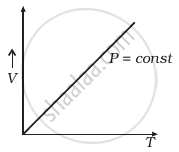 (a) |
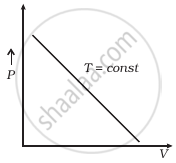 (b) |
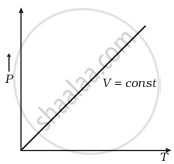 (c) |
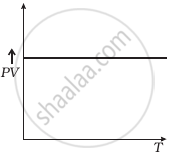 (d) |
P ∝ T at constant volume is the statement of ______.
