Advertisements
Advertisements
प्रश्न
What is diffusion? Give an example to illustrate it.
Advertisements
उत्तर
Diffusion is the process of gradual mixing of two substances, kept in contact, by molecular motion.
Example:
If a jar of chlorine is opened in a large room, the odorous gas mixes with air and spreads to every part of the room. Although chlorine is heavier than air, it does not remain at the floor level but spreads throughout the room.
APPEARS IN
संबंधित प्रश्न
Oxygen is filled in a closed metal jar of volume 1.0 × 10⁻³ m3 at a pressure of 1.5 × 10⁵Pa and temperature 400 K. The jar has a small leak in it. The atmospheric pressure is 1.0 × 10⁵ Pa and the atmospheric temperature is 300 K. Find the mass of the gas that leaks out by the time the pressure and the temperature inside the jar equalise with the surrounding.
50 m3 of saturated vapour is cooled down from 30°C to 20°C. Find the mass of the water condensed. The absolute humidity of saturated water vapour is 30 g m−3 at 30°C and 16 g m−3 at 20°C.
What do you understand by gas?
Give reasons for the following:
Gas fills the vessel completely in which it is kept.
Show that for diatomic gas the ratio of the two specific heats is 7:5.
Gases exert pressure on the walls of the container because the gas molecules ______
Which of the following diagrams (Figure) depicts ideal gas behaviour?
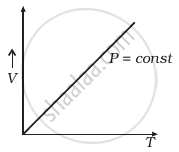 (a) |
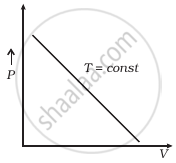 (b) |
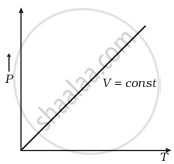 (c) |
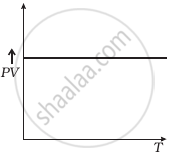 (d) |
Calculate the number of atoms in 39.4 g gold. Molar mass of gold is 197g mole–1.
Cooking gas containers are kept in a lorry moving with uniform speed. The temperature of the gas molecules inside will ______.
P ∝ T at constant volume is the statement of ______.
