Advertisements
Advertisements
प्रश्न
Give reason for the following:
Volumes of gases are converted into s.t.p. conditions and then compared.
Advertisements
उत्तर
Volumes of gases are converted into s.t.p. conditions and then compared as
volumes of gases change with temperature and pressure – hence a standard value of temperature and pressure is chosen to which gas volumes are referred.
APPEARS IN
संबंधित प्रश्न
Molar volume is the volume occupied by 1 mol of any (ideal) gas at standard temperature and pressure (STP: 1 atmospheric pressure, 0 °C). Show that it is 22.4 litres
Estimate the average thermal energy of a helium atom at the temperature of 10 million Kelvin (the typical core temperature in the case of a star).
What do you understand by gas?
Correct the following statement:
0°C is equal to zero Kelvin.
The average energy per molecule is proportional to ______
Show that for monoatomic gas the ratio of the two specific heats is 5:3.
Which of the following diagrams (Figure) depicts ideal gas behaviour?
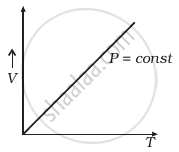 (a) |
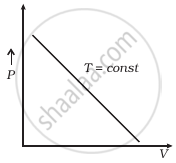 (b) |
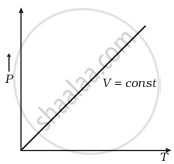 (c) |
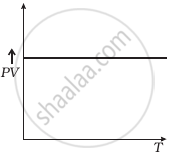 (d) |
The volume V of an enclosure contains a mixture of three gases, 16 g of oxygen, 28 g of nitrogen and 44 g of carbon dioxide at absolute temperature T. Consider R as universal gas constant. The pressure of the mixture of gases is ______.
Cooking gas containers are kept in a lorry moving with uniform speed. The temperature of the gas molecules inside will ______.
For a wave, y = 0.0002 sin`[2pi(110"t"-x/3)+pi/3]` is travelling in a medium. The energy per unit volume being transferred by wave if density of medium is 1.5 kg/m3, is ______.
