Advertisements
Advertisements
Question
Give reason for the following:
Volumes of gases are converted into s.t.p. conditions and then compared.
Advertisements
Solution
Volumes of gases are converted into s.t.p. conditions and then compared as
volumes of gases change with temperature and pressure – hence a standard value of temperature and pressure is chosen to which gas volumes are referred.
APPEARS IN
RELATED QUESTIONS
50 m3 of saturated vapour is cooled down from 30°C to 20°C. Find the mass of the water condensed. The absolute humidity of saturated water vapour is 30 g m−3 at 30°C and 16 g m−3 at 20°C.
During the practical session in the lab when hydrogen sulphide gas having offensive odour is prepared for some test, we can smell the gas even 50 metres away. Explain the phenomenon.
Choose the correct answer:
The graph of PV vs P for gas is
Correct the following statement:
0°C is equal to zero Kelvin.
Name or state the following:
The absolute temperature value corresponding to 35°C.
The average energy per molecule is proportional to ______
Estimate the average thermal energy of a helium atom at room temperature (27 °C).
Which of the following diagrams (Figure) depicts ideal gas behaviour?
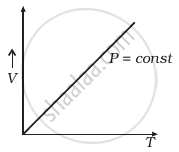 (a) |
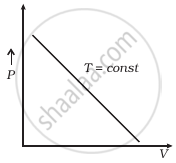 (b) |
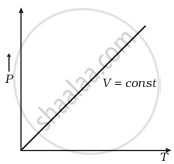 (c) |
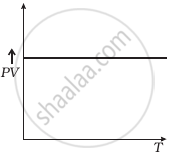 (d) |
Calculate the number of atoms in 39.4 g gold. Molar mass of gold is 197g mole–1.
At room temperature, a diatomic gas is found to have an r.m.s. speed of 1930 ms-1. The gas is ______.
