Advertisements
Advertisements
Question
Oxygen is filled in a closed metal jar of volume 1.0 × 10⁻³ m3 at a pressure of 1.5 × 10⁵Pa and temperature 400 K. The jar has a small leak in it. The atmospheric pressure is 1.0 × 10⁵ Pa and the atmospheric temperature is 300 K. Find the mass of the gas that leaks out by the time the pressure and the temperature inside the jar equalise with the surrounding.
Advertisements
Solution
Here,
V1 = 1.0 × 10⁻³ m3
T1 = 400K
P1 = 1.5 × 10⁵ Pa
P2 = 1.0 × 10⁵ Pa
T2 = 300
M = 32 g
Number of moles in the jar before \[n_1 =\frac{P_1 V_1}{R T_1} \]
Volume of the gas when pressure becomes equal to external pressure is given by
\[ \frac{P_1 V_1}{T_1} = \frac{P_2 V_2}{T_2} \]
\[ \Rightarrow V_2 = \frac{P_1 V_1 T_2}{P_2 T_1} \]
\[ \Rightarrow V_2 = \frac{1.5 \times {10}^5 \times 1.0 \times {10}^{-3} \times 300}{1.0 \times {10}^5 \times 400} = 1.125 \times {10}^{-3 }\]
Net volume of leaked gas = V2 - V1
= 1.125 × 10⁻³ - 1.0 × 10-3
= 1.25 × 10⁻⁴ m3
Let n2 be the number of moles of leaked gas. Applying equation of state on this amount of gas, we get
\[ n_2 = \frac{P_2 V_2}{R T_2} = \frac{1.0 \times {10}^5 \times 1.25 \times {10}^{-4}}{8.3 \times 300} = 0.005 \]
Mass of leaked gas = 32 × 0.005 = 0.16 g
APPEARS IN
RELATED QUESTIONS
The figure shows the plot of PV/T versus Pfor 1.00×10⁻³ kg of oxygen gas at two different temperatures.
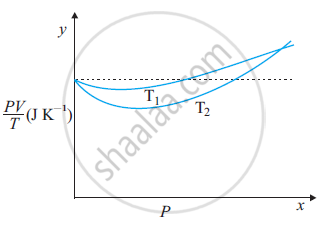
(a) What does the dotted plot signify?
(b) Which is true: T1 > T2 or T1 < T2?
(c) What is the value of PV/T where the curves meet on the y-axis?
(d) If we obtained similar plots for 1.00 ×10⁻³ kg of hydrogen, would we get the same value of PV/T at the point where the curves meet on the y-axis? If not, what mass of hydrogen yields the same value of PV/T (for low pressure high temperature region of the plot)? (Molecular mass of H2 = 2.02 u, of O2 = 32.0 u, R = 8.31 J mo1–1 K–1.)
Estimate the average thermal energy of a helium atom at the temperature of 10 million Kelvin (the typical core temperature in the case of a star).
Three vessels of equal capacity have gases at the same temperature and pressure. The first vessel contains neon (monatomic), the second contains chlorine (diatomic), and the third contains uranium hexafluoride (polyatomic).
Is the root mean square speed of molecules the same in the three cases? If not, in which case is vrms the largest?
A gas occupies 500 cm3 at a normal temperature. At what temperature will the volume of the gas be reduced by 20% of its original volume, the pressure is constant?
Name or state the following:
An equation used in chemical calculations which gives a simultaneous effect of changes of temperature and pressure on the volume of a given mass of dry gas
Name or state the following:
The standard pressure of a gas in cm. of mercury corresponding to one atmospheric pressure.
If the absolute temperature of a body is doubled, the power radiated will increase by a factor of ______
The equation of state for 2g of oxygen at a pressure 'P' and temperature 'T', when occupying a volume 'V' will be ______.
Estimate the average thermal energy of a helium atom at room temperature (27 °C).
Estimate the average thermal energy of a helium atom at the temperature on the surface of the Sun (6000 K).
Which of the following diagrams (Figure) depicts ideal gas behaviour?
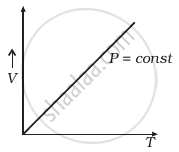 (a) |
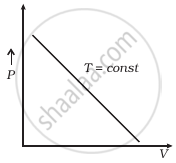 (b) |
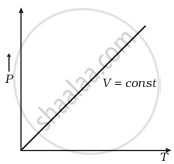 (c) |
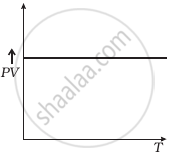 (d) |
Calculate the number of atoms in 39.4 g gold. Molar mass of gold is 197g mole–1.
The volume V of an enclosure contains a mixture of three gases, 16 g of oxygen, 28 g of nitrogen and 44 g of carbon dioxide at absolute temperature T. Consider R as universal gas constant. The pressure of the mixture of gases is ______.
At room temperature, a diatomic gas is found to have an r.m.s. speed of 1930 ms-1. The gas is ______.
For a wave, y = 0.0002 sin`[2pi(110"t"-x/3)+pi/3]` is travelling in a medium. The energy per unit volume being transferred by wave if density of medium is 1.5 kg/m3, is ______.
Two tanks of equal volume contain equal mass of oxygen and nitrogen at 127°C. Find the ratio of pressure in two tanks.
