Advertisements
Advertisements
प्रश्न
An oxygen cylinder of volume 30 litres has an initial gauge pressure of 15 atm and a temperature of 27 °C. After some oxygen is withdrawn from the cylinder, the gauge pressure drops to 11 atm and its temperature drops to 17 °C. Estimate the mass of oxygen taken out of the cylinder (R = 8.31 J mol–1 K–1, molecular mass of O2 = 32 u)
Advertisements
उत्तर १
Volume of oxygen, V1 = 30 litres = 30 × 10–3 m3
Gauge pressure, P1 = 15 atm = 15 × 1.013 × 105 Pa
Temperature, T1 = 27°C = 300 K
Universal gas constant, R = 8.314 J mole–1 K–1
Let the initial number of moles of oxygen gas in the cylinder be n1.
The gas equation is given as:
`P_1V_1 = eta_1RT_1`
`:.n_1 = P_1V_1/RT_1`
`= (15.195 xx10^5 xx 30 xx 10^(-3))/((8.314) xx 300) = 18.276`
Where,
m1 = Initial mass of oxygen
M = Molecular mass of oxygen = 32 g
∴m1 = n1M = 18.276 × 32 = 584.84 g
After some oxygen is withdrawn from the cylinder, the pressure and temperature reduces.
Volume, V2 = 30 litres = 30 × 10–3 m3
Gauge pressure, P2 = 11 atm = 11 × 1.013 × 105 Pa
Temperature, T2 = 17°C = 290 K
Let n2 be the number of moles of oxygen left in the cylinder.
The gas equation is given as:
P2V2 = n2RT2
`:. n_2= (P_2V_2)/(RT_2)`
`= (11.143 xx 10^5 xx 30 xx 10^(-3))/8.314 xx 290 = 13.86`
But `n_2 = m_2/M`
Where,
m2 is the mass of oxygen remaining in the cylinder
∴m2 = n2M = 13.86 × 32 = 453.1 g
The mass of oxygen taken out of the cylinder is given by the relation:
Initial mass of oxygen in the cylinder – Final mass of oxygen in the cylinder
= m1 – m2
= 584.84 g – 453.1 g
= 131.74 g
= 0.131 kg
Therefore, 0.131 kg of oxygen is taken out of the cylinder.
उत्तर २
Initial Volume, `V_1 = 30 litre = 30 xx 10^3 cm^3`
`= 30 xx 10^3 xx 10^(-6) m^3 = 30 xx 10^(-3) m^3`
Initla Pressure, P_1 = 15 atm
`= 15 xx1.013 xx 10^5 N m^(-2)`
Inital temperature, `T_1 = (27 + 273) K = 300 K`
Initial number of moles
`mu_1 = (P_1V_1)/RT_1 = (15xx1.013 xx10^5 xx 30xx10^(-3))/(8.31 xx 300) = 18.3`
Final Pressure, `P_2 = 11 atm`
`= 11 xx 1.013 xx 10^5 N m^(-2)`
Final Volume, V`_2 = 30 litre = 30 xx 10^(-3) cm^3`
Final temperature, `T_2 = 17 + 273 = 290 K`
Final number of moless, `mu_2 = (P_2V_2)/(RT_2) = (11xx 1.013xx 10^5xx 30xx10^(-3))/(8.31 xx 290) = 13.9`
Number of moles takesout of cyclinder = 18.3 - 13.9 = 4.4
Mass of gas taken out of cylinder = 4.4 xx 32 g = 140.8 g = 0.141 kg
APPEARS IN
संबंधित प्रश्न
Estimate the total number of air molecules (inclusive of oxygen, nitrogen, water vapour and other constituents) in a room of capacity 25.0 m3 at a temperature of 27 °C and 1 atm pressure
Estimate the average thermal energy of a helium atom at the temperature of 10 million Kelvin (the typical core temperature in the case of a star).
At what temperature is the root mean square speed of an atom in an argon gas cylinder equal to the rms speed of a helium gas atom at – 20 °C? (atomic mass of Ar = 39.9 u, of He = 4.0 u).
What do you understand by gas?
Give reasons for the following:
Gas fills the vessel completely in which it is kept.
Choose the correct answer:
The graph of PV vs P for gas is
Fill in the blanks:
If the temperature is reduced to half, ………….. would also reduce to half.
A gas occupies 500 cm3 at a normal temperature. At what temperature will the volume of the gas be reduced by 20% of its original volume, the pressure is constant?
Name or state the following:
The standard pressure of a gas in cm. of mercury corresponding to one atmospheric pressure.
Name or state the following:
The absolute temperature value corresponding to 35°C.
The average energy per molecule is proportional to ______
Show that for monoatomic gas the ratio of the two specific heats is 5:3.
Which of the following diagrams (Figure) depicts ideal gas behaviour?
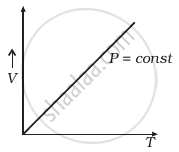 (a) |
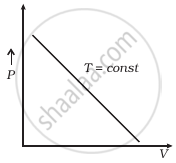 (b) |
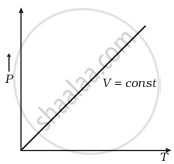 (c) |
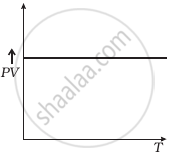 (d) |
Cooking gas containers are kept in a lorry moving with uniform speed. The temperature of the gas molecules inside will ______.
P ∝ T at constant volume is the statement of ______.
Two tanks of equal volume contain equal mass of oxygen and nitrogen at 127°C. Find the ratio of pressure in two tanks.
