Advertisements
Advertisements
प्रश्न
Calculate the number of atoms in 39.4 g gold. Molar mass of gold is 197g mole–1.
Advertisements
उत्तर
We know that,
Molar mass = Mass of Avogadro's number of atoms (Molecules).
= 6.023 × 10²³ atoms.
Given, molar mass of gold = 197 g/mol
Now,
∴ 197 g of gold contains = 6.023 × 10²³ atoms
∴ 1 g of gold contain = `(6.023 xx 10^23)/197` atoms
∴ 39.4 g of gold contains = `(6.023 xx 10^23 xx 39.4)/197`
⇒ 1.20 × 10²³ atoms.
APPEARS IN
संबंधित प्रश्न
An oxygen cylinder of volume 30 litres has an initial gauge pressure of 15 atm and a temperature of 27 °C. After some oxygen is withdrawn from the cylinder, the gauge pressure drops to 11 atm and its temperature drops to 17 °C. Estimate the mass of oxygen taken out of the cylinder (R = 8.31 J mol–1 K–1, molecular mass of O2 = 32 u)
Estimate the total number of air molecules (inclusive of oxygen, nitrogen, water vapour and other constituents) in a room of capacity 25.0 m3 at a temperature of 27 °C and 1 atm pressure
At what temperature is the root mean square speed of an atom in an argon gas cylinder equal to the rms speed of a helium gas atom at – 20 °C? (atomic mass of Ar = 39.9 u, of He = 4.0 u).
50 m3 of saturated vapour is cooled down from 30°C to 20°C. Find the mass of the water condensed. The absolute humidity of saturated water vapour is 30 g m−3 at 30°C and 16 g m−3 at 20°C.
Give reasons for the following:
Gas fills the vessel completely in which it is kept.
Fill in the blanks:
If the temperature is reduced to half, ………….. would also reduce to half.
Name or state the following:
An equation used in chemical calculations which gives a simultaneous effect of changes of temperature and pressure on the volume of a given mass of dry gas
Name or state the following:
The absolute temperature value corresponding to 35°C.
If the absolute temperature of a body is doubled, the power radiated will increase by a factor of ______
Show that for diatomic gas the ratio of the two specific heats is 7:5.
Gases exert pressure on the walls of the container because the gas molecules ______
The equation of state for 2g of oxygen at a pressure 'P' and temperature 'T', when occupying a volume 'V' will be ______.
Estimate the average thermal energy of a helium atom at the temperature on the surface of the Sun (6000 K).
Three vessels of equal capacity have gases at the same temperature and pressure. The first vessel contains neon (monatomic), the second contains chlorine (diatomic), and the third contains uranium hexafluoride (polyatomic).
Do the vessels contain an equal number of respective molecules?
Which of the following diagrams (Figure) depicts ideal gas behaviour?
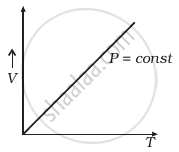 (a) |
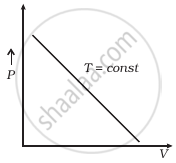 (b) |
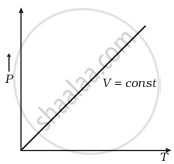 (c) |
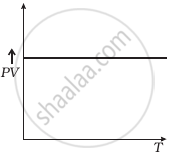 (d) |
Two tanks of equal volume contain equal mass of oxygen and nitrogen at 127°C. Find the ratio of pressure in two tanks.
