Advertisements
Advertisements
Question
A beam of white light falls on a glass prism. The colour of light which undergoes the least bending on passing through the glass prism is:
(a) violet
(b) red
(c) green
(d) blue
Advertisements
Solution
red
The colour red undergoes the least bending on passing through the glass prism as it has longest wavelength.
APPEARS IN
RELATED QUESTIONS
A narrow beam PQ of white light is passing through a glass prism ABC as shown in the diagram.

Trace it on your answer sheet and show the path of the emergent beam as observed on the screen DE.
(i) Write the name and cause of the phenomenon observed.
(ii) Where else in nature is this phenomenon observed?
(iii) Based on this observation, state the conclusion which can be drawn about the constituents of white light.
In the following ray diagram the correctly marked angle are:

(a) ∠i and ∠e
(b) ∠A and ∠D
(c) ∠i, ∠e and ∠D
(d) ∠r, ∠A and ∠D
After tracing the path of a ray of light through a glass prism a student marked the angle of incidence (∠i), angle of refraction (∠r) angle of emergence (∠e) and the angle of deviation (∠D) as shown in the diagram. The correctly marked angles are :

(A) ∠i and ∠r
(B) ∠i and ∠e
(C) ∠i, ∠e and ∠D
(D) ∠i, ∠r and ∠e
A student is observing a diagram showing the path of a ray of light passing through a glass prism. He would find that for all angles of incidence the ray of light bends:
(i) A ray of white light breaks up into its components while passing through a glass prism. Draw a ray diagram to show the path of rays.
(ii) Mark the least deviated colour in your diagram

(iii) Why do different coloured rays deviate differently in a prism?
What acts as tiny prisms in the formation of a rainbow?
The speed of light in air or vacuum is
State the speed of light in (a) air, (b) water, and (c) glass
What do you understand by the term spectrum? Name the various colours present in the spectrum of sunlight.
In an experiment to trace the path of a ray of light through a triangular glass prism, a student would observe that the emergent ray
(a) is parallel to the incident ray.
(b) is along the same direction of incident ray.
(c) gets deviated and bends towards the thinner part of the prism.
(d) gets deviated and bends towards the thicker part (base) of the prism.
In an experiment to trace the path of a ray of light through a glass prism for different values of angle of incidence a student would find that the emergent ray:
(A) is parallel to the incident ray
(B) perpendicular to the incident ray
(C) is parallel to the refracted ray
(D) bends at an angle to the direction of incident ray
Distinguish between an impure spectrum and a pure spectrum.
Write the range of wavelength of the infrared spectrum.
The process of separation of light into its component colours while passing through a medium is called _______.
Observe the given figure and answer the following questions.
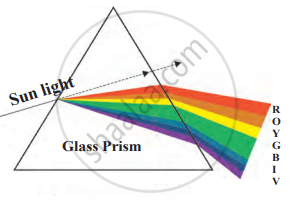
- Which colour light rays bend most?
- Which colour light rays bend least.
- What is the wavelength of violet light rays?
Which of the following is a natural phenomenon which is caused by the dispersion of sunlight in the sky?
Name the scientist who was the first to use a glass prism to obtain the spectrum of sunlight.
dispersive power of crown glass? Given that µv = 1.5230, µr = 1.5145
In the following diagram showing dispersion of white light by a glass prism, the colours 'P' and 'Q’ respectively are:

A ray of light is incident at 45° on an equilateral prism in the diagram below.

- Name the phenomenon exhibited by the ray of light when it enters and emerges out of the prism.
- State the cause of the above phenomenon mentioned by you.
