Advertisements
Chapters
Chapter 1: Electric Charges and Fields
Chapter 2: Gauss' Theorem
Chapter 3: Electric Potential
Chapter 4: Capacitors and Dielectrics
2. CURRENT ELECTRICITY
Chapter 5: Electric Resistance and Ohm's Law
Chapter 6: DC Circuits and Measurements
3. MAGNETIC EFFECTS OF CURRENT AND MAGNETISM
Chapter 7: Moving Charges and Magnetic Field
Chapter 8: Torque on a Current-Loop : Moving-Coil Galvanometer
Chapter 9: Magnetic Field and Earth's Magnetism
Chapter 10: Magnetic Classification of Substances
4. ELECTROMAGNETIC INDUCTION AND ALTERNATING CURRENTS
Chapter 11: Electromagnetic Induction
Chapter 12: Alternating Current
5. ELECTROMAGNETIC WAVES
Chapter 13: Electromagnetic Waves
6. OPTICS
Chapter 14: Reflection of Light: Spherical Mirrors
▶ 15: Refraction of Light at a Plane Interface : Total Internal Reflection : Optical Fibre
Chapter 16: Refraction of Light at Spherical Surfaces : Lenses
Chapter 17: Refraction and Dispersion of Light through a Prism
Chapter 18: Optical Instruments
Chapter 19: Wave Nature of Light : Huygens' Principle
Chapter 20: Interference of Light
Chapter 21: Diffraction of Light
Chapter 22: Polarisation of Light
7. DUAL NATURE OF RADIATION AND MATTER
Chapter 23: Photoelectric Effect
Chapter 24: Matter Waves
Chapter 25: X-Rays
8. ATOMS AND NUCLEI
Chapter 26: Atom, Origin of Spectra : Bohr's Theory of Hydrogen Atom
Chapter 27: Nuclear Structure
Chapter 28: Radioactivity
Chapter 29: Mass-Energy Equivalence : Nuclear Binding Energy
Chapter 30: Nuclear Fission and Nuclear Fusion : Sources of Energy
9. ELECTRONIC DEVICES
Chapter 31: Semiconductor Electronics
Chapter 32: Junction Diodes
Chapter 33: Junction Transistors
Chapter 34: Logic Gates
10. COMMUNICATION SYSTEMS
Chapter 35: Communication Systems
![Nootan solutions for फिज़िक्स पार्ट १ अँड २ [इंग्रजी] इयत्ता १२ आयएससी chapter 15 - Refraction of Light at a Plane Interface : Total Internal Reflection : Optical Fibre - Shaalaa.com](/images/physics-part-1-and-2-english-class-12-isc_6:016e788e661846bb9bcaa880fdf58789.png "Nootan solutions for फिज़िक्स पार्ट १ अँड २ [इंग्रजी] इयत्ता १२ आयएससी chapter 15 - Refraction of Light at a Plane Interface : Total Internal Reflection : Optical Fibre")
Advertisements
Solutions for Chapter 15: Refraction of Light at a Plane Interface : Total Internal Reflection : Optical Fibre
Below listed, you can find solutions for Chapter 15 of CISCE Nootan for फिज़िक्स पार्ट १ अँड २ [इंग्रजी] इयत्ता १२ आयएससी.
Nootan solutions for फिज़िक्स पार्ट १ अँड २ [इंग्रजी] इयत्ता १२ आयएससी 15 Refraction of Light at a Plane Interface : Total Internal Reflection : Optical Fibre QUESTIONS [Pages 777 - 783]
OBJECTIVE TYPE (carrying 1 mark)
Refractive index of a transparent material is ______.
same for all colours
maximum for violet colour
minimum for violet colour
maximum for red colour
When monochromatic light passes from a vacuum to a material medium and vice versa, which of the following characteristics of the light beam does not change?
Velocity
Intensity
Wavelength
Frequency
When a light wave travels from air to glass ______.
its wavelength decreases
its wavelength increases
there is no change in wavelength
its frequency decreases
A diver from inside the water `(n = 4/3)` looks at an object in the air whose natural colour is green. He sees the object as ______.
green
blue
yellow
red
Monochromatic light is refracted from air into a medium of refractive index n. The ratio of the wavelengths of the incident and the refracted waves is ______.
1 : 1
1 : n
n : 1
n2 : 1
A light ray passes from a vacuum into a medium of refractive index n. The angle of refraction is found to be half the angle of incidence. The angle of incidence is ______.
`cos^-1 (n/2)`
`2cos^-1 (n/2)`
2 sin−1 (n)
`2sin^-1 (n/2)`
A piece of glass immersed in a colourless liquid is not visible. It is so because ______.
glass and liquid are both colourless
both are of same density
both are of same refractive index
glass reflects the light transmitted by the liquid
The refractive indices of glass and water with respect to air are `3/2` respectively. The refractive index of glass with respect to water will be ______.
`8/9`
`9/8`
`7/6`
none of these
When a glass slab of refractive index 1.5 is placed on a cross marked on paper, the cross appears to be raised by 2 cm. The thickness of the slab is ______.
3 cm
4 cm
6 cm
8 cm
It is possible to observe total internal reflection when light travels from ______.
air to water
air to glass
water to glass
glass to water
The velocity of light in a medium is 1.5 × 10⁸ ms−1. The critical angle C for a ray going from the medium into air is ______.
30°
45°
60°
90°
The critical angle will be largest when light goes from ______.
water to air
glass to air
glass to water
diamond to air
A swimmer inside water looks up at the sky through the surface of the water. The sky is bright due to daylight. He can see ______.
nothing but darkness.
the entire top surface of water bright.
a small illuminated patch directly above his head, whose angular size depends upon the depth of the swimmer in water.
a small illuminated patch directly above his head, whose angular size is independent of the depth of the swimmer.
A fish which is at a depth of 12 cm in water `(n = 4/3)` is viewed by an observer on the bank of a lake. The apparent depth as observed by the observer is ______.
3 cm
9 cm
12 cm
16 cm
Light passes from air to glass and is deviated 3.5°. When the angle of incidence is 10°, the refractive index of the material of the glass is ______.
1.33
1.50
1.52
1.54
A bird in the air looks at a fish vertically below it and inside the water in a tank. If the distance of the fish as estimated by the bird is x1 and that of the bird as estimated by the fish is x2, then the refractive index of water is ______.
`x_1/x_2`
`x_2/x_1`
`(x_1 + x_2)/x_2`
`(x_1 + x_2)/x_1`
VERY SHORT ANSWER TYPE (Carrying 1 mark)
Why does refraction of light occur when light passes from one medium to another?
Does frequency change when light passes from one medium to another?
Does wavelength change when light passes from one medium to another?
Define the refractive index of glass in terms of the speed of light.
Can the absolute refractive index of a medium be less than one?
Can the refractive index of a medium relative to another medium be less than 1?
Define critical angle for a given medium.
Find a critical angle for a glass and water pair, given the refractive index of glass is 1.62 and that of water is 1.33.
A microscope is focused on a dot at the bottom of a beaker. Oil is poured into the beaker to a height of y cm. Now, the microscope is to be raised through a vertical distance of x cm to bring the dot again into focus. Express the refractive index of oil in terms of x and y.
Does critical angle depend upon the colour (wavelength) of light used?
Is the critical angle for a given interface greater for red light or for blue light?
What is the critical angle for a material of refractive index `sqrt2` relative to air?
Will the critical angle for the glass-water interface be smaller or larger than that for the glass-air interface?
What is the refractive index of diamond?
What is the critical angle of diamond?
Which has a larger critical angle, water or diamond?
Name the phenomenon responsible for mirage.
Name the principle on the basis of which optical fibres work.
SHORT ANSWER TYPE (carrying 2 marks)
Discuss refraction through a glass slab and show that the emergent ray is parallel to the incident ray but displaced.
For what angle of incidence, the lateral displacement is maximum? Can it be zero?
A beam of light is converging towards a point. A parallel-sided glass slab is introduced in the path of this beam. How will the point of convergence be shifted? Draw the ray diagram.
Define the critical angle for an interface of two media.
What is total internal reflection?
State two conditions necessary for total internal reflection to occur.
Can total internal reflection occur when light travels from a rarer to a denser medium?
What is meant by the term ‘critical angle’?
Give one application of total internal reflection.
What are optical fibres?
Give one use of optical fibres?
Show, with a diagram, how an image is produced in a totally reflecting prism.
What are the advantages of a totally reflecting prism over a plane mirror?
For the same value of angle of incidence, the angles of refraction in three media A, B and C are 15°, 25° and 35°, respectively. In which medium would the velocity of light be minimum?
A diver underwater looks obliquely at a fisherman standing on the bank of a lake. Would the fisherman look taller or shorter to the diver than what he actually is?
A straight stick partly dipped in water obliquely appears to be bent at the surface of the water.
The sun begins to be seen a little before it rises and continues to be seen for several minutes after it has actually set. Explain.
Sun (or moon), when near the horizon, appears elliptical and not circular. Explain why?
Why do stars appear twinkling?
An empty test tube dipped obliquely into water appears silvery when viewed in a suitable direction. Why?
The refractive index of diamond is much greater than that of glass. Does a diamond cutter use this fact?
Draw a diagram to show how an image is produced by a pair of total reflecting prisms arranged as in a periscope.
LONG ANSWER TYPE [A] (carrying 3 marks)
State the law of refraction.
Distinguish between absolute refractive index and refractive index of a medium.
Show that n = `c/v`, where letters have usual meanings.
Explain why does a swimming pool appears shallower than it actually is.
Obtain an expression for the normal displacement of an object immersed in water.
With a neat ray diagram, explain the concept of total internal reflection (TIR).
State two conditions necessary for total internal reflection to occur.
Obtain the relation between the critical angle and the refractive index of the denser medium.
Show, with a diagram, how an image is produced in a totally reflecting prism.
Show, by ray diagram, how a totally reflecting glass prism can be used to deviate a ray through 180°.
What is an optical fibre?
Name the principle on the basis of which optical fibres work.
Explain, by ray diagram, how optical fibres transmit signals.
Mention one practical application of optical fibres.
LONG ANSWER TYPE [B] (carrying 5 marks)
What is refraction of light?
State the law of refraction.
Derive the relation n = `"Real depth"/"Apparent depth"`.
What form does it take when the object is viewed through several media?
Define the reversibility of light.
Define the refractive index.
Prove that 1n2 × 2n3 × 3n1 = 1.
Can the absolute refractive index of a medium be less than one?
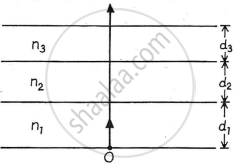
A vessel of depth d is filled upto a depth of d1 by a liquid of refractive index n1 upto a depth of d2 by a liquid of refractive index n2 and upto a depth of d3 by a liquid of refractive index n3. Show that the apparent depth of the vessel when viewed normally is given by:
`h_(app) = (d_1/n_1 + d_2/n_2 + d_3/n_3)`
[here d = d1 + d2 + d3 and n1 > n2 > n3]
LONG ANSWER TYPE [C] PASSAGE BASED (Carrying 5 marks)
Read the passage given below and answer the questions that follow:
|
When a ray of light travelling from a denser medium to a rarer medium is incident at the interface of the two media at an angle greater than the critical angle for the two media, the ray is ‘totally’ reflected back into the denser medium. Since refractive index depends upon the wavelength of light, the critical angle for a given pair of media is different for different wavelengths (colours) of light. |
Critical angle for glass-air interface can be written as
`sin i_c = 1/(""_an_g) = "velocity of light in glass"/"velocity of light in air"`
- Name the principle on the basis of which optical fibres work.
- Calculate the critical angle for the glass and water pair. Given the refractive index of glass is 1.62 and that of water is 1.33.
- A small bulb is placed at the bottom of a tank containing water to a depth of 80 cm. What is the area of the surface of water through which light from the bulb can emerge out? Refractive index of water is `4/3` (n = 3.14).
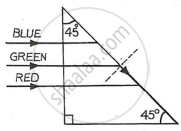
Light rays of blue, green and red colours are incident on a right-angled prism, as shown. Green ray makes a grazing emergence. Out of red and blue light, which one comes out of the prism without suffering total internal reflection?
NUMERICALS - I. Snell's Law and Refractive Index
The refractive index of diamond relative to air is 2.42 and that of glass is 1.51. How much faster does light travel in glass than in diamond?
A ray of light in air is incident on a glass plate at 45°. The refractive index of glass is 1.5. What is the angle of refraction?
A ray of light which is incident in air on the surface of a glass block is deviated through 15°. The angle of incidence in air is 60°. What is the angle of refraction in glass? Also calculate the critical angle for the glass-air interface.
NUMERICALS - II. Apparent Depth of Object
How deep will a 4 m deep tank appear when seen in air due to optical refraction? The refractive index of water is `4/3`.
A beaker is filled with water to a height of 12.5 cm. The apparent depth of a needle at the bottom of the beaker is 9.4 cm. Find the refractive index of water.
The apparent depth of an object at the bottom of a tank filled with a liquid of refractive index 1.3 is 7.7 cm. What is the actual depth?
A needle lying on a horizontal surface is viewed vertically from a distance of 100 cm. A glass slab of 12 cm thickness is placed on the needle. Find the distance of the vertical image of the needle from the eye, taking ang = 1.5.
A microscope focused on a pin lying at the bottom of a beaker reads 3.965 cm. When a liquid is poured up to a height of 2.537 cm into the beaker, the microscope focused again on the pin reads 3.348 cm. Find the refractive index of the liquid.
A beaker is filled with a liquid to a height of 14 cm. The apparent depth of a needle fixed at the bottom of the beaker is measured to be 10 cm by a microscope. What is the refractive index of the liquid? The height of the liquid in the beaker is now raised to 21 cm. By what distance would the microscope have to be moved to focus on the needle again?
A beaker 20 cm high is half filled with an oil of refractive index 1.40 and the upper half filled with water of refractive index 1.33. What is the apparent depth of the beaker as observed normally?
A beaker is filled with water (n = 1.5) to a height h. Height of the beaker is 15 cm. When the bottom of the beaker is viewed vertically by an observer, the beaker appears to be half filled. Find the value of h.
A container of uniform cross-section has a height of 14 m. Upto what height should water of refractive index `4/3` be filled inside the container so that the container seems to be half filled for normal viewing?
NUMERICALS - III. Total Internal Reflection
In total internal reflection, when the angle of incidence is equal to the critical angle for the pair of media in contact, what will be the angle of refraction?
Critical angle for total internal reflection from a medium to a vacuum is 60°. Find the velocity of light in the given medium.
A ray of light falls normally on the face of a glass prism (n = 1.5). Find the angle of the prism if the ray just fails to emerge from the second face.
A substance has a critical angle of 45° for yellow light. What is the refractive index of the substance?
The refractive index of glass relative to air is 1.5. What is the critical angle for the glass-air interface?
What is the critical angle for a light ray going from dense glass into water? The refractive indices of dense glass and water relative to air are 1.62 and 1.33 respectively.
The absolute refractive indices of water and glycerine are 1.33 and 1.46 respectively. Find the critical angle for a ray travelling from glycerine into water.
An equilateral prism of glass of refractive index 1.45 is immersed in water of refractive index 1.33. A narrow beam of light falls normally on one face of the prism. Find the angle of emergence of the beam.
A small bulb is placed at the bottom of a tank containing water to a depth of 80 cm. What is the area of the surface of water through which light from the bulb can emerge out? Refractive index of water is 1.33. (Consider the bulb to be a point source.)
A point source of light is placed at the centre of the bottom of a jar having a liquid of refractive index `5/3`. An opaque disc of radius 1.0 cm is placed on the liquid surface with its centre vertically above the source. What is the maximum height of the liquid for which the source is not visible from above?
Nootan solutions for फिज़िक्स पार्ट १ अँड २ [इंग्रजी] इयत्ता १२ आयएससी 15 Refraction of Light at a Plane Interface : Total Internal Reflection : Optical Fibre Questions from ISC Board Examinations [Pages 783 - 784]
Name the principle on the basis of which optical fibres work.
State one advantage in the use of optical fibres.
Draw a diagram to show how an image is produced by a pair of total reflecting prisms arranged as in a periscope.
A ray of light is normally incident on one face of an equilateral prism. Trace the course of the ray through the prism and emerging from it.
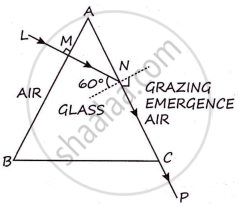
Find the refractive index of the liquid if a ray of light strikes surface AB normally and then comes out from face AC at grazing emergence. `(""_aμ_g = 3/2)`
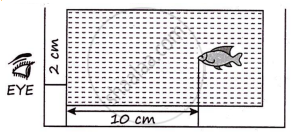
A fish is located at a distance of 10 cm from the wall of the fish pond. The thickness of the glass wall is 2 cm. Find the apparent position of the fish. `("Given" ""_aµ_g = 3/2 "and" ""_aµ_w = 4/3)`
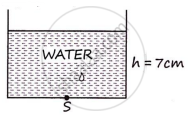
A point source of monochromatic light S is kept at the centre C of the bottom of a cylinder. The radius of the circular base of the cylinder is 15.0 cm.
The cylinder contains water `("Refractive index" = 4/3)` to a height of 7.0 cm, as shown in the figure. Find the area of the surface through which light emerges in air. `("Take", π = 22/7)`
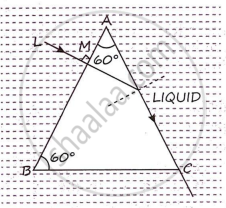
A ray LM of monochromatic light incident normally on one refracting surface AB of a regular glass prism ABC emerges in air from the adjacent surface AC as shown in the figure. Calculate the refractive index of the material of the prism.
Calculate the critical angle for the glass and water pair. (Take refractive index for glass is 1.50 and the refractive index for water is 1.33.)
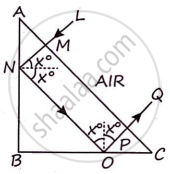
A ray of light LM incident normally on the surface AC of an isosceles right angled prism ABC (where AB = BC) emerges along PQ, parallel to LM, as shown in the figure below. What can you say about the refractive index µ of the material of the prism?
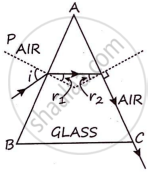
At what angle, a ray of light should be incident on the first face AB of a regular glass prism ABC, so that the emergent ray grazes the adjacent face AC? (Refractive index of glass = 1.6)
A narrow beam of monochromatic light, PQ, is incident normally on one face of an equiangular glass prism of refractive index 1.45. When the prism is immersed in a certain liquid, the ray makes a grazing emergence along the other face (See figure). Find the refractive index of this liquid. 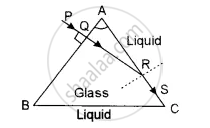
A fish which is at a depth of 12 cm in water `(mu = 4/3)` is viewed by an observer on the bank of a lake. Its apparent depth as observed by the observer is ______.
3 cm
9 cm
12 cm
16 cm
Find a critical angle for a glass and water pair, given the refractive index of glass is 1.62 and that of water is 1.33.
When a light wave travels from air to glass ______.
its wavelength decreases
its wavelength increases
there is no change in wavelength
its frequency decreases
Define critical angle for a given medium.
Name the principle on the basis of which optical fibres work.
Nootan solutions for फिज़िक्स पार्ट १ अँड २ [इंग्रजी] इयत्ता १२ आयएससी 15 Refraction of Light at a Plane Interface : Total Internal Reflection : Optical Fibre For Different Competitive Examinations [Pages 785 - 788]
[A] MULTICHOICE QUESTIONS
An observer can see the top end B of a thin rod of height h through a pin-hole. The height of the beaker is 3h, and the radius is h. When the beaker is filled with a liquid up to a height of 2h, the observer can see the lower end A of the rod. The refractive index of the liquid is:
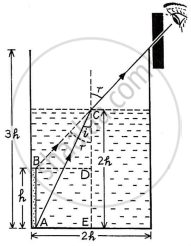
`5/2`
`sqrt(5/2)`
`sqrt(3/2)`
`3/2`
An air bubble in a glass slab of refractive index 1.5 (near normal incidence) is 5 cm deep when viewed from one surface and 3 cm deep when viewed from the opposite face. The thickness of the slab is ______.
8 cm
10 cm
12 cm
16 cm
A container is filled with water (n = 1.33) up to a height of 33.25 cm. A concave mirror is held 15 cm above the water level, and the image I of an object O placed at the bottom is formed 25 cm below the water level. The focal length of the mirror is roughly:
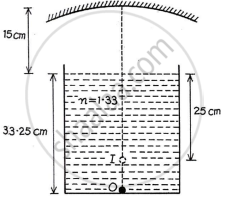
10 cm
15 cm
20 cm
25 cm
A ball is dropped from a height of 20 m above the surface of water in a lake. The refractive index of water is `4/3`. A fish inside the lake, in the line of fall of the ball is looking at the ball. At an instant, when the ball is 12.8 m above the water surface, the fish sees the speed of ball as ______.
9 ms−1
12 ms−1
16 ms−1
21.33 ms−1
A point source S is placed at the bottom of a transparent block of height 10 mm and refractive index 2.72. It is immersed in a lower refractive index liquid as shown in the figure. It is found that the light emerging from the block to the liquid forms a circular bright spot of diameter 11.54 mm on the top of the block. The refractive index of the liquid is ______.
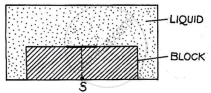
1.21
1.30
1.36
1.42
A light beam is travelling from Region I to Region IV as shown in the figure below: The refractive indices of Regions I, II, III and IV are `n_0, n_0/2,n_0/6` and `n_0/8` respectively. The angle of incidence θ for which the beam just misses entering Region IV is:
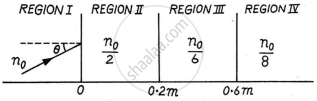
`sin^-1 (3/4)`
`sin^-1 (1/8)`
`sin^-1 (1/4)`
`sin^-1 (1/3)`
A green light is incident from the water to the air-water interface at the critical angle (C). Select the correct statement.
The entire spectrum of visible light will come out of the water at an angle of 90° to the normal.
The spectrum of visible light whose frequency is less than that of green light will come out to the air medium.
The spectrum of visible light whose frequency is more than that of green light will come out to the air medium.
The entire spectrum of visible light will come out of the water at various angles to the normal.
The velocity of light in transparent media A and B separated by a plane boundary are 2.0 × 10⁸ and 2.5 × 10⁸ ms−1 respectively. The critical angle for a light ray passing from A to B at the boundary is ______.
`sin^-1 (1/2)`
`sin^-1 (2/5)`
`sin^-1 (4/7)`
`sin^-1 (4/5)`
A beam of light consisting of red, green and blue colours is incident on a right-angled prism, as shown. The refractive indices of the material of the prism for the red, green and blue wavelengths are 1.39, 1.44 and 1.47 respectively. The prism will ______.
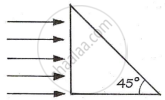
separate the part of the red colour from the green and blue colours.
separate the part of the blue colour from the red and green colours.
separate all the three colours from one another.
not separate even partially any colour from the other two colours.
A glass prism of refractive index 1.5 is immersed in water `("refractive index" = 4/3)`. A light beam is incident normally on the face AB. It will be totally reflected at the face AC to reach the face BC, if:
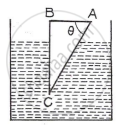
`sin θ > 8/9`
`2/ 3 < sin θ < 8/9`
`sin θ < 2/3`
none of these
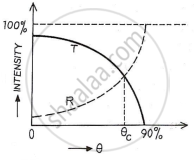
A light ray travelling in a glass medium is incident on a glass-air interface at an angle of incidence of θ. The reflected (R) and transmitted (T) intensities, both as functions of θ, are plotted. The correct sketch is:
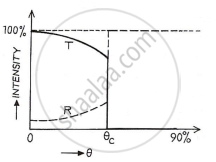
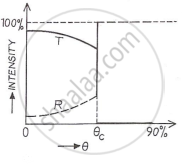
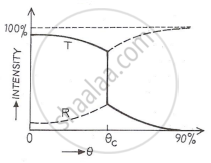
A ray of white light is incident on the interface of glass and air, as shown. The angle of incidence is such that green light just suffers total internal reflection. The ray of light emerging from glass to air contains:
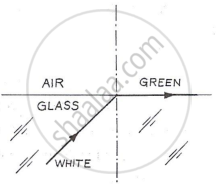
yellow, orange and red
violet, indigo and blue
all colours
all colours except green
A ray of light travelling in water is incident on its surface open to air. The angle of incidence is θ, which is less than the critical angle. Then, there will be ______.
only a reflected ray and no refracted ray.
only a refracted ray and no reflected ray.
a reflected ray and a refracted ray and the angle between them would be less than 180° − 2θ.
a reflected ray and a refracted ray and the angle between them would be greater than 180° − 2θ.
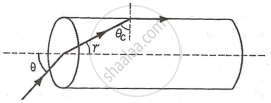
A transparent solid cylindrical rod has a refractive index of `2/sqrt3`. It is surrounded by air. A light ray is incident at the midpoint of one end of the rod as shown in the figure. The incident angle θ for which the light ray grazes along the wall of the rod is ______.
`sin^-1(1/2)`
`sin^-1(sqrt3/2)`
`sin^-1(2/sqrt3)`
`sin^-1(1/sqrt3)`
The angle of a prism is ‘A’. One of its refracting surfaces is silvered. Light rays falling at an angle of incidence of 2A on the first surface return back through the same path after suffering reflection at the silvered surface. The refractive index, n, of the prism is ______.
2 sin A
2 cos A
`1/2 cos A`
tan A
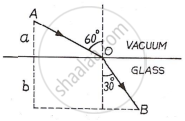
A ray of light AO in a vacuum is incident on a glass slab at an angle of 60° and refracted at an angle of 30° along OB as shown in the figure. The optical path length of the light ray from A to B is ______.
2a + 2b
`(2sqrt3)/a + 2b`
`2a + (2b)/3`
`2a+(2b)/sqrt3`
In the figure, the optical fibre is l = 2 m long and has a diameter of d = 20 µm. If a ray of light is incident on one end of the fibre at angle θ1 = 40°, the number of reflections it makes before emerging from the other end is close to:
(Refractive index of fibre is 1.31 and sin 40° = 0.64)

55000
66000
45000
57000
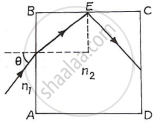
A transparent cube of side, made of a material of refractive index n2, is immersed in a liquid of refractive index n1 (n1 < n2). A ray is incident on the face AB at an angle θ (shown in the figure). Total internal reflection takes place at point E on the face BC. Then θ must satisfy:
`θ > sin^-1 sqrt((n_2^2)/(n_1^2) - 1)`
`θ < sin^-1 sqrt((n_2^2)/(n_1^2) - 1)`
`θ < sin^-1 n_1/n_2`
`θ > sin^-1 n_1/n_2`
In total internal reflection, when the angle of incidence is equal to the critical angle for the pair of media in contact, what will be the angle of refraction?
Equal to angle of incidence
90°
180°
0°
Pick the wrong answer in the context with rainbow.
An observer can see a rainbow when his front is toward the sun.
Rainbow is a combined effect of dispersion, refraction and reflection of sunlight.
When the light rays undergo two internal reflections in a water drop, a secondary rainbow is formed.
The order of colors is reversed in the secondary rainbow.
A light wave is incident normally on a glass slab of refractive index 1.5. If 10% of light gets reflected and the amplitude of the electric field of the incident light is `30 V/m`, then the amplitude of the electric field for the wave propagating in the glass medium will be:
`10 V/m`
`24 V/m`
`30 V/m`
`6 V/m`
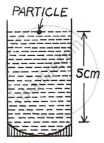
A concave mirror has a radius of curvature of 40 cm. It is at the bottom of a glass that has water filled up to 5 cm (see figure). If a small particle is floating on the surface of water, its image as seen from directly above the glass is at a distance d from the surface of water. The value of d is dose to: (Refractive index of water = 1.33)
11.7 cm
6.7 cm
13.4 cm
8.8 cm
If the critical angle for total internal reflection from a medium to a vacuum is 45°, then the velocity of light in the medium is ______.
3 × 10⁸ m/s
1.5 × 10⁸ m/s
`3/sqrt2 xx 10^8 m//s`
`sqrt2 xx 10^8 m//s`
A wide slab consisting of two media of refractive indices n1 and n2 is placed in air as shown in the figure. A ray of light is incident from medium n1 to n2 at an angle θ, where sin θ is slightly larger than `1/n_1`. Take the refractive index of air as 1. Which of the following statement(s) is(are) correct?
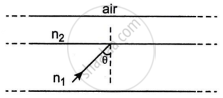
The light ray enters air if n2 = n1.
The light ray is finally reflected back into the medium of refractive index n1 if n2 < n1.
The light ray is finally reflected back into the medium of refractive index n1 if n2 > n1.
The light ray is reflected back into the medium of refractive index n1 if n2 = 1.
A light wave travelling linearly in a medium of dielectric constant 4, incident on the horizontal surface separating medium with air. The angle of incidence for which the total intensity of the incident wave will be reflected back into the same medium will be:
[Given relative permeability of the medium (µr = 1)]
10°
20°
30°
60°
Two transparent media A and B are separated by a plane boundary. The speed of light in those media are 1.5 × 10⁸ m/s and 2.0 × 10⁸ m/ s, respectively. The critical angle for a ray of light for these two media is ______.
tan−1 (0.750)
sin−1 (0.500)
sin−1 (0.750)
tan−1 (0.500)
[B] NUMERICAL VALUE TYPE QUESTIONS
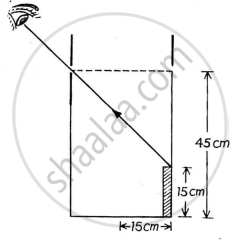
An observer can see through a small hole on the side of a jar (radius 15 cm) at a point at a height of 15 cm from the bottom (see figure). The hole is at a height of 45 cm. When the jar is filled with a liquid up to a height of 30 cm, the same observer can see the edge at the bottom of the jar. If the refractive index of the liquid is `N/100`, where N is an integer, the value of N is ..........
A ray of light is incident at an angle of incidence of 60° on the glass slab of refractive index `sqrt3`. After refraction the light ray emerges out from other parallel faces and the lateral shift between the incident ray and emergent ray is `4/sqrt3` cm. The thickness of the glass slab is ..........
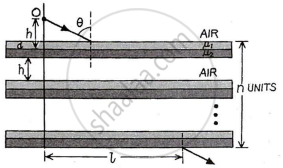
Consider a configuration of n identical units, each consisting of three layers. The first layer is a column of air of height h = `1/3` cm, and the second and third layers are of equal thickness d = `(sqrt3 - 1)/2` cm and refractive indices μ1 = `sqrt(3/2)` and μ2 = `sqrt3` respectively.
A light source O is placed on the top of the first unit, as shown in the figure. A ray of light from O is incident on the second layer of the first unit at an angle of θ = 60° to the normal. For a specific value of n, the ray of light emerges from the bottom of the configuration at a distance l = `8/sqrt3` cm, as shown in the figure. The value of n is ...........
Solutions for 15: Refraction of Light at a Plane Interface : Total Internal Reflection : Optical Fibre
Nootan solutions for फिज़िक्स पार्ट १ अँड २ [इंग्रजी] इयत्ता १२ आयएससी chapter 15 - Refraction of Light at a Plane Interface : Total Internal Reflection : Optical Fibre
Shaalaa.com has the CISCE Mathematics फिज़िक्स पार्ट १ अँड २ [इंग्रजी] इयत्ता १२ आयएससी CISCE solutions in a manner that help students grasp basic concepts better and faster. The detailed, step-by-step solutions will help you understand the concepts better and clarify any confusion. Nootan solutions for Mathematics फिज़िक्स पार्ट १ अँड २ [इंग्रजी] इयत्ता १२ आयएससी CISCE 15 (Refraction of Light at a Plane Interface : Total Internal Reflection : Optical Fibre) include all questions with answers and detailed explanations. This will clear students' doubts about questions and improve their application skills while preparing for board exams.
Further, we at Shaalaa.com provide such solutions so students can prepare for written exams. Nootan textbook solutions can be a core help for self-study and provide excellent self-help guidance for students.
Concepts covered in फिज़िक्स पार्ट १ अँड २ [इंग्रजी] इयत्ता १२ आयएससी chapter 15 Refraction of Light at a Plane Interface : Total Internal Reflection : Optical Fibre are Overview: Refraction of Light at a Plane Interface, Refraction of Light, Cause of Refraction, Physical Significance of Refractive Index, Reversibility of Light, Refraction through Parallel Multiple Media, Real and Apparent Depths: Normal Displacement, Refraction of Light Through a Rectangular Glass Block, Critical Angle, Total Internal Reflection, Applications of Total Internal Reflection, Laws of Refraction.
Using Nootan फिज़िक्स पार्ट १ अँड २ [इंग्रजी] इयत्ता १२ आयएससी solutions Refraction of Light at a Plane Interface : Total Internal Reflection : Optical Fibre exercise by students is an easy way to prepare for the exams, as they involve solutions arranged chapter-wise and also page-wise. The questions involved in Nootan Solutions are essential questions that can be asked in the final exam. Maximum CISCE फिज़िक्स पार्ट १ अँड २ [इंग्रजी] इयत्ता १२ आयएससी students prefer Nootan Textbook Solutions to score more in exams.
Get the free view of Chapter 15, Refraction of Light at a Plane Interface : Total Internal Reflection : Optical Fibre फिज़िक्स पार्ट १ अँड २ [इंग्रजी] इयत्ता १२ आयएससी additional questions for Mathematics फिज़िक्स पार्ट १ अँड २ [इंग्रजी] इयत्ता १२ आयएससी CISCE, and you can use Shaalaa.com to keep it handy for your exam preparation.
