Advertisements
Advertisements
प्रश्न
In the figure, the optical fibre is l = 2 m long and has a diameter of d = 20 µm. If a ray of light is incident on one end of the fibre at angle θ1 = 40°, the number of reflections it makes before emerging from the other end is close to:
(Refractive index of fibre is 1.31 and sin 40° = 0.64)

पर्याय
55000
66000
45000
57000
Advertisements
उत्तर
57000
Explanation:
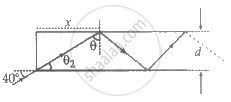
Given:
Optical fibre length, l = 2 m
Diameter of the fibre, d = 20 µm
Angle of incidence at the fiber’s entrance θ1 = 40°
Refractive index of fibre, μ2 = 1.31
To find:
The total number of reflections inside the fibre.
Calculation:
Using Snell’s law:
`mu_1/mu_2 = (sintheta_2)/(sin40^circ)`, ...(The refractive index of air is µ1.)
`sintheta_2 = 1/1.31 sin40^circ`
θ2 = 29.39
θ = 90 − θ2
= 90 − 29.39
= 60.6 ...(θ as shown in the diagram)
tan θ = tan 60.6 = `x/d` ....(x is labelled in the diagram.)
x = (20 × 10−6) tan 60.6 = 35.5 µm
Number of total reflections;
n = `1/x`
= `(2m)/(35.5mum)`
= 56338
Therefore, the total number of reflections is approximately 56,338. Since this does not exactly match any option, we select the nearest available option, which is 57,000.
संबंधित प्रश्न
The refractive index of glass is 1.5. What is the speed of light in glass? (Speed of light in vacuum is 3.0 × 10⁸ m s−1)
Is the speed of light in glass independent of the colour of light? If not, which of the two colours red and violet travels slower in a glass prism?
A plane wavefront propagating in a medium of refractive index 'μ1' is incident on a plane surface making the angle of incidence 'i' as shown in the figure. It enters into a medium of refractive index 'μ2' (μ2 > μ1). Use Huygens' construction of secondary wavelets to trace the propagation of the refracted wavefront. Hence verify Snell's law of refraction.

The optical properties of a medium are governed by the relative permittivity (εr) and relative permeability (µr). The refractive index is defined as `sqrt(µ_r ε_r) = n`. For ordinary material εr > 0 and µr > 0 and the positive sign is taken for the square root. In 1964, a Russian scientist V. Veselago postulated the existence of material with εr < 0 and µr < 0. Since then such ‘metamaterials’ have been produced in the laboratories and their optical properties studied. For such materials `n = - sqrt(µ_r ε_r)`. As light enters a medium of such refractive index the phases travel away from the direction of propagation.
- According to the description above show that if rays of light enter such a medium from air (refractive index = 1) at an angle θ in 2nd quadrant, them the refracted beam is in the 3rd quadrant.
- Prove that Snell’s law holds for such a medium.
White light is an incident at 20° on a material of silicate flint glass slab as shown. `μ_"violet"` = 1.66 and µr = 1.6. For what value of d will the separation be 1 mm in red and violet rays?

Which principle can be used to derive the laws of refraction?
In the refraction construction, which medium is assumed to be denser?
What is the direction of the refracted ray relative to the refracted wavefront?
Which expression gives the wavelength of light in medium 1?
How are the wavelengths in the two media related to the speeds of light in those media?
