Advertisements
Advertisements
Question
In the figure, the optical fibre is l = 2 m long and has a diameter of d = 20 µm. If a ray of light is incident on one end of the fibre at angle θ1 = 40°, the number of reflections it makes before emerging from the other end is close to:
(Refractive index of fibre is 1.31 and sin 40° = 0.64)

Options
55000
66000
45000
57000
Advertisements
Solution
57000
Explanation:
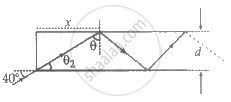
Given:
Optical fibre length, l = 2 m
Diameter of the fibre, d = 20 µm
Angle of incidence at the fiber’s entrance θ1 = 40°
Refractive index of fibre, μ2 = 1.31
To find:
The total number of reflections inside the fibre.
Calculation:
Using Snell’s law:
`mu_1/mu_2 = (sintheta_2)/(sin40^circ)`, ...(The refractive index of air is µ1.)
`sintheta_2 = 1/1.31 sin40^circ`
θ2 = 29.39
θ = 90 − θ2
= 90 − 29.39
= 60.6 ...(θ as shown in the diagram)
tan θ = tan 60.6 = `x/d` ....(x is labelled in the diagram.)
x = (20 × 10−6) tan 60.6 = 35.5 µm
Number of total reflections;
n = `1/x`
= `(2m)/(35.5mum)`
= 56338
Therefore, the total number of reflections is approximately 56,338. Since this does not exactly match any option, we select the nearest available option, which is 57,000.
RELATED QUESTIONS
The refractive index of glass is 1.5. What is the speed of light in glass? (Speed of light in vacuum is 3.0 × 10⁸ m s−1)
Explain how Corpuscular theory predicts the speed of light in a medium, say, water, to be greater than the speed of light in vacuum. Is the prediction confirmed by experimental determination of the speed of light in water? If not, which alternative picture of light is consistent with the experiment?
The wavefronts of light coming from a distant source of unknown shape are nearly _________ .
The optical properties of a medium are governed by the relative permittivity (εr) and relative permeability (µr). The refractive index is defined as `sqrt(µ_r ε_r) = n`. For ordinary material εr > 0 and µr > 0 and the positive sign is taken for the square root. In 1964, a Russian scientist V. Veselago postulated the existence of material with εr < 0 and µr < 0. Since then such ‘metamaterials’ have been produced in the laboratories and their optical properties studied. For such materials `n = - sqrt(µ_r ε_r)`. As light enters a medium of such refractive index the phases travel away from the direction of propagation.
- According to the description above show that if rays of light enter such a medium from air (refractive index = 1) at an angle θ in 2nd quadrant, them the refracted beam is in the 3rd quadrant.
- Prove that Snell’s law holds for such a medium.
In the given figure, the face AC of the equilateral prism is immersed in a liquid of refractive index 'n'. For incident angle 60° at the side AC, the refracted light just grazes along face AC. The refractive index of the liquid n = `sqrtx/4`. The value of x is ______.
(Given refractive index of glass = 1.5)

In the refraction construction, which medium is assumed to be denser?
When a light wave travels from one medium to another, which property remains the same?
Which expression gives the wavelength of light in medium 1?
How does the speed of light in a denser medium compare with its speed in a rarer medium?
What could the ray picture of light explain while remaining silent on why light's speed differs between media?
