Advertisements
Advertisements
प्रश्न
In the figure, the optical fibre is l = 2 m long and has a diameter of d = 20 µm. If a ray of light is incident on one end of the fibre at angle θ1 = 40°, the number of reflections it makes before emerging from the other end is close to:
(Refractive index of fibre is 1.31 and sin 40° = 0.64)

विकल्प
55000
66000
45000
57000
Advertisements
उत्तर
57000
Explanation:
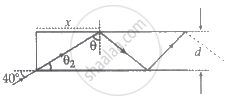
Given:
Optical fibre length, l = 2 m
Diameter of the fibre, d = 20 µm
Angle of incidence at the fiber’s entrance θ1 = 40°
Refractive index of fibre, μ2 = 1.31
To find:
The total number of reflections inside the fibre.
Calculation:
Using Snell’s law:
`mu_1/mu_2 = (sintheta_2)/(sin40^circ)`, ...(The refractive index of air is µ1.)
`sintheta_2 = 1/1.31 sin40^circ`
θ2 = 29.39
θ = 90 − θ2
= 90 − 29.39
= 60.6 ...(θ as shown in the diagram)
tan θ = tan 60.6 = `x/d` ....(x is labelled in the diagram.)
x = (20 × 10−6) tan 60.6 = 35.5 µm
Number of total reflections;
n = `1/x`
= `(2m)/(35.5mum)`
= 56338
Therefore, the total number of reflections is approximately 56,338. Since this does not exactly match any option, we select the nearest available option, which is 57,000.
संबंधित प्रश्न
Explain how Corpuscular theory predicts the speed of light in a medium, say, water, to be greater than the speed of light in vacuum. Is the prediction confirmed by experimental determination of the speed of light in water? If not, which alternative picture of light is consistent with the experiment?
A plane wavefront propagating in a medium of refractive index 'μ1' is incident on a plane surface making the angle of incidence 'i' as shown in the figure. It enters into a medium of refractive index 'μ2' (μ2 > μ1). Use Huygens' construction of secondary wavelets to trace the propagation of the refracted wavefront. Hence verify Snell's law of refraction.

The wavefronts of light coming from a distant source of unknown shape are nearly _________ .
Light waves travel from optically rarer medium to optically denser medium. Its velocity decreases bec;ause of change in ______.
White light is an incident at 20° on a material of silicate flint glass slab as shown. `μ_"violet"` = 1.66 and µr = 1.6. For what value of d will the separation be 1 mm in red and violet rays?

What is the direction of the refracted ray relative to the refracted wavefront?
What does \[\frac{\sin i}{\sin r}\] equal in terms of the speeds in the two media?
When a light wave travels from one medium to another, which property remains the same?
Which expression gives the wavelength of light in medium 1?
How are the wavelengths in the two media related to the speeds of light in those media?
