Advertisements
Advertisements
प्रश्न
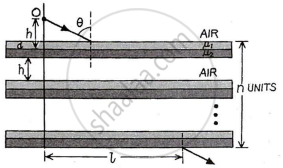
Consider a configuration of n identical units, each consisting of three layers. The first layer is a column of air of height h = `1/3` cm, and the second and third layers are of equal thickness d = `(sqrt3 - 1)/2` cm and refractive indices μ1 = `sqrt(3/2)` and μ2 = `sqrt3` respectively.
A light source O is placed on the top of the first unit, as shown in the figure. A ray of light from O is incident on the second layer of the first unit at an angle of θ = 60° to the normal. For a specific value of n, the ray of light emerges from the bottom of the configuration at a distance l = `8/sqrt3` cm, as shown in the figure. The value of n is ...........
Advertisements
उत्तर
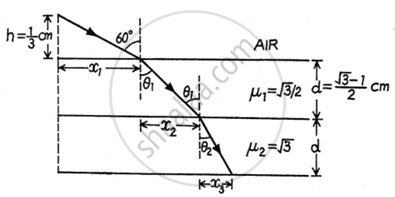
tan 60° = `x_1/((1/3))`
x1 = `1/sqrt3` cm
sin 60° = `sqrt(3/2)` sin θ1
`sqrt3/2 = sqrt(3/2) sin θ_1`
⇒ θ1 = 45°
Now, tan θ1 = `x_2/d`
x2 = d tan θ1
= `((sqrt3 - 1)/2)` tan 45°
= `((sqrt3 - 1)/2)` cm
Again, by Snell’s law
µ1 sin θ1 = µ2 sin θ2
`sin θ_2 = µ_2/µ_1 sin θ_1`
`sin θ_2 = sqrt(3/2)/sqrt3 sin 45°`
= `1/sqrt2 xx 1/sqrt2`
= `1/2`
⇒ θ2 = 30°
tan θ2 = `x_3/d`
x3 = d tan θ2
= `((sqrt3 - 1))/2` tan 30°
= `(1/2 - 1/(2sqrt3))` cm
Total lateral shift by one unit.
x = x1 + x2 + x3
= `1/sqrt3 + ((sqrt3 - 1)/2) + (1/2 - 1/(2sqrt3))`
= `1/sqrt3 - 1/(2sqrt3) + sqrt3/2 - 1/2 + 1/2`
= `(1/sqrt3 - 1/(2sqrt3)) + sqrt3/2`
= `1/(2sqrt3) + sqrt3/2`
= `(1 + (sqrt3)^2)/(2sqrt3)`
= `(1 + 3)/(2sqrt3)`
= `4/(2sqrt3)`
= `2/sqrt3` cm
As there are ‘n’ such units, the net lateral shift = `n xx 2/sqrt3` cm
So, `(2n)/sqrt3 = 8/sqrt3` ...(given)
2n = 8
n = `8/2`
n = 4
