CBSE Science (English Medium) इयत्ता १२ Important Questions for Physics - Semiconductor Electronics - Materials, Devices and Simple Circuits
Advertisements
Advertisements
Chapter wise important questions with answers and solutions for Physics in CBSE Science (English Medium) इयत्ता १२.
Answer the following question.
Why photodiodes are required to operate in reverse bias? Explain.
पाठ: [14] Semiconductor Electronics - Materials, Devices and Simple Circuits
Explain the formation of the barrier potential in a p-n junction.
पाठ: [14] Semiconductor Electronics - Materials, Devices and Simple Circuits
Pieces of copper and of silicon are initially at room temperature. Both are heated to temperature T. The conductivity of ______.
पाठ: [14] Semiconductor Electronics - Materials, Devices and Simple Circuits
Answer the following giving reasons:
A p-n junction diode is damaged by a strong current.
पाठ: [14] Semiconductor Electronics - Materials, Devices and Simple Circuits
Answer the following giving reasons:
Impurities are added to intrinsic semiconductors.
पाठ: [14] Semiconductor Electronics - Materials, Devices and Simple Circuits
During the formation of a p-n junction ______.
पाठ: [14] Semiconductor Electronics - Materials, Devices and Simple Circuits
What happens when a forward bias is applied to a p-n junction?
पाठ: [14] Semiconductor Electronics - Materials, Devices and Simple Circuits
What causes the setting up of high electric field even for small reverse bias voltage across the diode?
पाठ: [14] Semiconductor Electronics - Materials, Devices and Simple Circuits
In the following diagram 'S' is a semiconductor. Would you increase or decrease the value of R to keep the reading of the ammeter A constant when S is heated? Give reason for your answer.
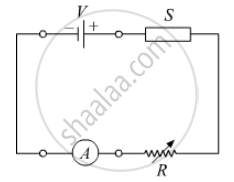
पाठ: [14] Semiconductor Electronics - Materials, Devices and Simple Circuits
Draw its I – V characteristics of photodiode
पाठ: [14] Semiconductor Electronics - Materials, Devices and Simple Circuits
A zener diode is fabricated by heavily doping both p- and n- sides of the junction. Explain, why?
पाठ: [14] Semiconductor Electronics - Materials, Devices and Simple Circuits
Explain briefly with the help of necessary diagrams, the forward biasing of a p-n junction diode. Also draw characteristic curves.
पाठ: [14] Semiconductor Electronics - Materials, Devices and Simple Circuits
Explain briefly with the help of necessary diagrams, the reverse biasing of a p-n junction diode. Also draw characteristic curves.
पाठ: [14] Semiconductor Electronics - Materials, Devices and Simple Circuits
In the following diagram, is the junction diode forward biased or reverse biased ?
पाठ: [14] Semiconductor Electronics - Materials, Devices and Simple Circuits
Plot a graph showing variation of current versus voltage for the material GaAs ?
पाठ: [14] Semiconductor Electronics - Materials, Devices and Simple Circuits
Draw a circuit diagram to study the input and output characteristics of an n-p-n transistor in its common emitter configuration. Draw the typical input and output characteristics.
पाठ: [14] Semiconductor Electronics - Materials, Devices and Simple Circuits
Explain, with the help of a circuit diagram, the working of n-p-n transistor as a common emitter amplifier.
पाठ: [14] Semiconductor Electronics - Materials, Devices and Simple Circuits
How is a zener diode fabricated so as to make it a special purpose diode? Draw I-V characteristics of zener diode and explain the significance of breakdown voltage.
Explain briefly, with the help of a circuit diagram, how a p-n junction diode works as a half wave rectifier.
पाठ: [14] Semiconductor Electronics - Materials, Devices and Simple Circuits
In a pure semiconductor crystal of Si, if antimony is added then what type of extrinsic semiconductor is obtained. Draw the energy band diagram of this extrinsic semiconductor so formed.
पाठ: [14] Semiconductor Electronics - Materials, Devices and Simple Circuits
ASSERTION (A): The electrical conductivity of a semiconductor increases on doping.
REASON (R): Doping always increases the number of electrons in the semiconductor.
