Advertisements
Advertisements
प्रश्न
Within a few pages, the author has packed the important events in the lives of John Ipe and his wife. Discuss how conciseness and economy of expression can achieve an effective portrayal of entire lives.
Advertisements
उत्तर
There are two ways of narrating a story, one style is the elongated narration with the detailing of each and every emotion and situation giving length to the story. The other style is a crisp one that keeps the story short yet highlighting the important events and emotions. Roy has narrated using the second style. She has kept the story short, yet she did not miss out on anything. She has described the relation of a husband and a wife with all the necessary details, though she did not ponder over the sentiments for long. She explained the face of the society we live in. Jean Genet was so correct when he said that society dwells on images and this is what Roy has tried to emphasise in her story. John had lost the chance to gain the recognition, he could have, felt the loss of identity along with it. Roy is economical when she describes the emotions and makes sure that nothing worthless is portrayed. All that she has spent in the short tale is worth the while. The narration is simple enough and achieves effectively the portrayal of the entire lives of the characters. The disturbance in the marriage, the physical violence, the emotional loss, the intervention of the young child, and its impact on the father. All have been portrayed wisely not wasting any time or making the reader wait for the following happenings.
APPEARS IN
संबंधित प्रश्न
Which of these words would you use to describe Santosh Yadav? Find reasons in the text to support your choices, and write a couple of paragraphs describing Santosh’s character
| contented | determined | resourceful | polite | adventurous | considerate |
| weak-willed | fearful |
independent |
pessimistic |
patient | persevering |
Write an original short story beginning with the following words :
She was delighted to find the sealed envelope lying on her table. As she reached for it .............
You are Nitin / Nitin from XYZ School. You wish to start applying to various colleges for admission after your ISC examination. In about 300 words, draft your personal profile using the guidelines given below :
Your name, year spend in the school you are passing out from – academin interests and performane – cultural activities you participated in – sports - positions of leadership held during your staty in the school – your future plans and goals – two characteristics that your consider to be your strengths – two characteristics that set you apart from the others.
How was the country affected by the war?
What is the encaged bird fearful of ?
What lesson do you learn from this poem?
Identify the figures of speech in the following lines from the poem.
(a) Awoke one night from a deep dream of peace.
(b) Making it rich, and like a lily in bloom.
Discuss trans-culturation as represented in Seattle’s speech.
Why is the old man at the bridge?
What is the significance of Easter Sunday in “Old Man at the Bridge”?
Fill in the blank with an appropriate word :
Sheila's grandmother found it difficult to climb __________ the steep staircase.
The ailing company was taken________by the government.
Inspite of having high fever the girl came to school...
(Begin: Despite ……………..)
She battled her way ___________the crowd.
Given below is an interesting combination of words. Explain why they have been used together.
scientific detachment
Discuss the following statement in groups of four.
“The Emperor may rule over the territory he has conquered, but only the artist knows the way within.”
Discuss the manner in which the author interweaves details of the narrator’s family with the flow of the main narrative.
Locate instances of irony in the story.
‘Forgiveness is often better than punishment’. Write two paragraphs – one for and another against this notion.
The poet says, “Beauty is heard in …”
Can you hear beauty? Add a sound that you think is beautiful to the sounds the poet thinks are beautiful.
The poet, Keats, said:
Heard melodies are Sweet,
But those unheard are sweeter.
What do you think this means? Have you ever heard a song in your head, long after the song was sung or played?
What is beauty? Where can, in the poet’s opinion, beauty be seen, heard, and experienced?
The extract deals with the atmosphere of two homes. Collect the words associated with - Library.
The extract deals with the atmosphere of two homes. Collect the words associated with - Garden.
Write down the significance of the following in the context of ‘On to the Summit’:
Red Scarf
The writer goes in search of an invaluable indigenous variety of seeds. List three reasons for the importance of keeping records of our indigenous agricultural practices.
Write a summary of the poem with the help of the points given below:
- Title
- Introductory paragraph (about the poem/type/nature/tone)
- Main body (central idea/gist of the poem)
- Conclusion/opinions/views/appeal.
A brilliant student from your school has won a Mathematics Quiz at the National Level.
Frame questions to interview him/her when the school felicitates him/her. Follow the steps given below.
- Greetings
- Introduction of the interviewee and achievements.
- 2 or 3 questions about growing years.
- 4 to 6 questions about the achievements.
- 2 or 3 questions about future plans and prospects.
- Expression of thanks and good wishes.
From the passage, find and write any two examples of the following:
Sentences containing
- 'must'
- 'can'
Write a few lines about yourself - your name, appearance, family, the place where you live, your school, your friends, neighbours, relatives, your likes, dislikes, hobbies, what you are good at, etc.
Now create an imaginary ‘persona’ for yourself. It can be quite different from your real self. Or, you may choose a fictional character - a character from a novel, story, etc. Write a few lines about this imaginary persona and introduce yourself in that role.
| Real Self | Imaginary Persona |
|
Hi, I am ____________________ ____________________________ ____________________________ |
Hi, I am ____________________ ____________________________ ____________________________ |
Prepare a formal invitation using the following format:
|
Mr and Mrs _______________________ solicit the pleasure of your company on the occasion of the ____________________ of their __________________ on _______________ (day), date _______________. Venue __________________ Time ____________________ (Include other requests like RSVP, No presents please, etc. at the bottom.) |
Form groups of 5-8. Prepare short autobiographical speeches for each of these animals (10-15 lines). Use the following points :
- How the animal lives - It’s the only way he/she can.
- How he interacts with nature and other animals.
- How humans interact with that species - whether it is fair, necessary, or desirable, etc.
- The possible ill effects of the way human beings treat the animals, for the whole living world.
- The animal getting ready to bid farewell to this world.

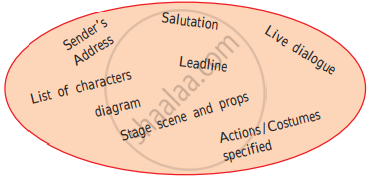
The diagram below encircles the various features that make the script of a skit/ play. List the other words and mention the form of writing of which it is a feature.
Write a letter to your friend or cousin telling him/her about a difficult choice you have recently made, for example, pursuing one sport or hobby rather than the other or choosing between your studies and hobbies.
Tell your friend/cousin how his/her example helped you to make a decision.
Write your opinion, in your own words:-
Why did they appreciate and praise the stranger’s story?
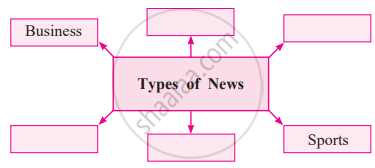
Complete the remaining blocks determining the types of news.
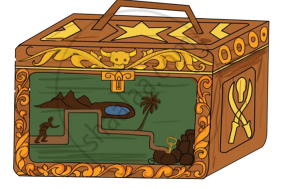
Nalan’s grandfather showed him an old treasure trunk. A road map was stuck on the trunk. It showed the spot where a key was hidden. Look at the road map and write five directions to reach the spot where the key is hidden. Discuss with your partner and compare your directions with those of your classmates.
- ____________
- ____________
- ____________
- ____________
- ____________
Local Historians
- Ask students to collect stories about their town from older people.
- Ask them to find out how the streets were named.
- Are there any interesting people or legends to which the street names refer?
- Are there any local places in town about which people tell stories?
- Any haunted houses?
- Let students find out when the town was founded and by whom.
- Visit a local historical society to see old photographs or artifacts.
Let students create an original historical fiction:
Describe the town from the point of view of a fictitious citizen who might have lived in the town long ago. Include local issues of the time in the story. Write the story of the town from the fictionalized point of view of a resident who actually lived.
Your friend has presented a beautiful art piece on your birthday. Write a letter to her appreciating her art work.
Are the singers homeless travellers? Why do you think so?
Develop the following hints.
Akbar - Birbal - courtiers jealous of Birbal - ask Akbar - test Birbal wiseness - Courtier puts a question - How many crows in Agra - Birbal asks for a week - every day sitting on the terrace - looking at the crows- after a week - courtier asks - Birbal says 156757 crows - asks the courtier to check- Akbar laughs.
Arrange the jumbled sentences and write a paragraph. Use appropriate conjunctions.
Jane Eyre is an orphan.
She lives with her aunt Mrs. Reed.
Mrs. Reed does not like Jane because Jane is not her daughter.
Jane’s uncle Mr. Reed likes Jane, but he dies.
He makes Mrs. Reed promise to take care of Jane, but instead she sends Jane away.
Jane is ten years old, she is sent to Lowood school.
Jane graduates and stays there to teach.
She leaves for Thornfield, where she is a governess.
She is very happy there.
Read the jumbled lines from the poem and rearrange them in correct order.
| 1. cinnamon, betel leaves |
| 2. and ginger and garlic” |
| 3. Go to Muthu’s |
| 4. My mother would say: |
| 5. and get some |
| 6. “Little boy Raj… |
| 7. And so I go to the shops |
| 8. singing all the way |
| 9. tomatoes and pickles” |
| 10. “Sesame seeds, onions |
| 11. I rattle off a list: |
| 12. what I’d want |
| 13. and when Muthu asks me |
| 14. my mother twists my ear |
| 15. and back home |
| 16. ouch! |
Fill in the form given below.

Fill in the blank by choosing the preposition from the option.
The boy ran ______ the dog.
______ do you go to school?
______ do you want for your birthday?
The word in the sentence is jumbled. Write them in order.
footprint to someone this belonged.
In the sentence below the capital letter, comma, full stop and question mark are missing. Put these in the correct place.
what is the colour of the sky
The word in the sentence is jumbled. Write them in order.
alone was not Robinson an island on
Sit in groups of five. Now, each student will tell a story. Decide which story was the best and declare a or of the group.
Find out stories about other great people’s lives and their childhood and write these in your notebook. Collect at least two such stories and share them with your friends.
You could think of famous
- scientists
- religious people
- freedom fighters
- brave children
- astronauts
- artists
State whether the following statement are true or false
The friends could not keep in touch because they lost each other’s phone numbers.
What was her first impression of America?
Rearrange the sentences given below and write a summary of the story in a paragraph. Begin with:
Philip Sletherby was travelling by train to Brill Manor.
- The young man introduced himself as Bertie, the son of Saltpen Jago.
- Bertie needed three pounds desperately and asked Sletherby to lend it to him.
- All the time Sletherby was gazing at the door panel of the car, on which were the two crests – a demi-lion and a greyhound courant.
- He was received by Claude People. K.C., who had kept on talking about various things.
- Bertie had left his purse behind, after sealing an envelope with the crest on the purse.
- Bertie stated that it was the Jago crest. He further added that his mother’s hair was dark brown similar to his.
- While describing the appearance of Honario Saltpen-Jago, K.C. referred to her altered hairstyle.
- Sletherby realized that Bertie had not lied to him, but that he had mistaken him for fraud.
- He explained that the Saltpen crest was that of a demi-lion.
- Sletherby sat dumbstruck on learning that Mrs. Honario Saltpen Jago had changed her dark brown hair to a blonde, just five weeks ago.
- Sletherby pointed out to him that his mother’s letter had a greyhound courant crest.
- His companion in the train was a young man who was searching for something frantically
- Suspecting foul play, Sletherby did not give him any money, as he knew Mrs. Saltpen-Jago was a blonde.
What was the knife that Miss Meadows carried with her?
We may not have money to buy all our wants at the same time. In such a situation, what are the options available?
Write a composition in approximately 350 – 400 words on the following subjects:
(You are reminded that you will be rewarded for orderly and coherent presentation of material, use of appropriate style and general accuracy of spelling, punctuation, and grammar.)
You have recently shifted to a new city. Describe the area where you live, your next-door neighbours, the difficulties you faced while shifting and why you like/dislike the place.
One cannot always get what one wants and sometimes it is for the best. Present your reflections on this statement.
As a Member of the Student Council of ABC School, you wish to start a Laughter Club to develop the appreciation for humour among students. Write a proposal in not more than 150 words, outlining the steps you would take to make this club a success.
Read the passage given below and answer the questions (i), (ii) and (iii) that follow.
| (1) | “Can I see the Manager?” I said, and added solemnly, “Alone.” I don't know why I said “Alone.” “Certainly,” said the accountant and fetched him. | |
| (2) | The Manager was a grave, calm man. I held my fifty-six dollars clutched in a crumpled ball in my pocket. “Are you the Manager?” I asked. God knows I did not doubt it. “Yes,” he said. “Can I see you …. alone?” I asked. |
5 |
| (3) | The Manager looked at me in some alarm. He felt that I had an awful secret to reveal. “Come in here,” he said, and led the way to a private room. He turned the key in the lock. “We are safe from interruption here,” he said; “Sit down.” We both sat down and looked at each other. I found no voice to speak. “You are one of Pinkerton’s men, I presume,” he said. |
10 |
| (4) |
He had gathered from my mysterious manner that I was a detective. I knew what he was thinking, and it made me worse. |
15
20
|
| (5) | The Manager got up and opened the door. He called to the accountant. “Mr. Montgomery,” he said unkindly loud, “this gentleman is opening an account, he will deposit fifty-six dollars. Good morning.” I rose. A big iron door stood open at the side of the room. “Good morning,” I said, and stepped into the safe. “Come out,” said the Manager coldly and showed me the other way. |
30 |
| (6) | I went up to the accountant’s wicket and poked the ball of money at him with a quick convulsive movement as if I were doing a conjuring trick. My face was ghastly pale. “Here,” I said, “deposit it.” The tone of the words seemed to mean, “Let us do this painful thing while the fit is on us.” He took the money and gave it to another clerk. |
35 |
| (7) | He made me write the sum on a slip and sign my name in a book. I no longer knew what I was doing. The bank swam before my eyes. “Is it deposited?” I asked in a hollow, vibrating voice. “It is,” said the accountant. “Then I want to draw a cheque.” My idea was to draw out six dollars of it for present use. Someone gave me a chequebook through a wicket and someone else began telling me how to write it out. The people in the bank had the impression that I was an invalid millionaire. I wrote something on the cheque and thrust it in at the clerk. He looked at it. |
40
45 |
| (8) | “What! Are you drawing it all out again?” he asked in surprise. Then I realised that I had written fifty-six instead of six. I was too far gone to reason now. I had a feeling that it was impossible to explain the thing. I had burned my boats. All the clerks had stopped writing to look at me. Reckless with misery, I made a plunge. “Yes, the whole thing.” “You withdraw all your money from the bank?” “Every cent of it.” “Are you not going to deposit anymore?” said the clerk, astonished. “Never.” |
50
55 |
| (9) | An idiot hope struck me that they might think something had insulted me while I was writing the cheque and that I had changed my mind. I made a wretched attempt to look like a man with a fearfully quick temper. | |
| (10) | The clerk prepared to pay the money. “How will you have it?” he said. This question came as a bolt from the blue. “What?” “How will you have it?” “Oh!”— I caught his meaning and answered without even trying to think— “in fifties.” He gave me a fifty-dollar bill. “And the six?” he asked dryly. “In sixes,” I said. He gave it to me and I rushed out. As the big door swung behind me. I caught the echo of a roar of laughter that went up to the ceiling of the bank. Since then, I bank no more. I keep my money in cash in my trousers pocket and my savings in silver dollars in a sock. |
60
65
70 |
| Adapted from: My Financial Career By Stephen Leacock |
||
-
- Find a single word from the passage that will exactly replace the underlined word or words in the following sentences. [3]
- The kind stranger went and got back the ball from where it had rolled into the bush.
- I took offence at the expression on his face that was clearly meant to insinuate I was a liar.
- The firm experienced a financial loss when the contract went to a contender who had just entered the business.
- For each of the words given below, choose the correct sentence that uses the same word unchanged in spelling, but with a different meaning from that which it carries in the passage. [3]
- alarm (line 8)
- The silence from the other end set off alarm bells in her head.
- The pallor of his skin alarmed those standing around.
- I set my alarm for six o’clock but slept through it.
- The sound of the approaching jets caused some alarm in the war room.
- wicket (line 44)
- The wicketkeeper was the true saviour of the day for that one match.
- The team wanted to bat while the wicket was still dry.
- The man at the window handed us our tickets through the wicket.
- The quick loss of wickets demoralised the team.
- reason (line 48)
- After the tragedy, his ability to reason is severely diminished.
- They reasoned they could get better seats if they arrived early.
- Recipients of funds were selected without rhyme or reason.
- We have every reason to celebrate.
- alarm (line 8)
- Find a single word from the passage that will exactly replace the underlined word or words in the following sentences. [3]
- Answer the following questions as briefly as possible in your own words.
- With reference to the passage, explain the meaning of the expression of the ‘I had burned my boats?’ [2]
- Cite any two instances of the behaviour of the bank employees that indicate the insignificance of a deposit of fifty-six dollars. [2]
- Why do you think the people in the bank thought of the narrator as an “invalid millionaire?” [2]
- Summarise why the narrator decided ‘to bank no more’ (paragraphs 6 to 10). You are required to write the summary in the form of a connected passage in about 100 words. Failure to keep within the word limit will be penalised. [8]
