Advertisements
Advertisements
प्रश्न
Why does compound (A) given below not form an oxime?

(A)
Advertisements
उत्तर
Glucose pentaacetate (structure A) does not have a free –OH group at C, and therefore, cannot be converted to the open chain form to give a free –CHO group and hence it does not form the oxime.
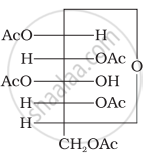
(Structure A)
APPEARS IN
संबंधित प्रश्न
How many moles of acetic anhydride will be required to form glucose pentaacetate from 2M of glucose?
(a) 2
(b) 5
(c) 10
(d) 2.5
Enumerate the reactions of D-glucose which cannot be explained by its open chain structure.
What happens when glucose is treated with hydroxylamine?
Answer the following question.
What is the basic structural difference between glucose and fructose?
Write the reaction involved when D-glucose is treated with the following reagent:
(CH3CO)2O
Acetylation of glucose yields ____________.
Which of the following statements is incorrect regarding glucose?
When glucose reacts with bromine water, the main product is ____________.
Reduction of glucose by HI suggest that ____________.
Which of the following reactions of glucose can be explained only by its cyclic structure?
A solution of D-glucose in water rotates the plane polarised light ____________.
The number of chiral carbon atoms present in cyclic structure α-D(+) glucose:
The α-D glucose and β-D glucose differ from each other due to difference in carbon atom with respect to its ____________.
The letter D and L in carbohydrates represent ____________.
The number of chiral carbons in ß-D(+) glucose is ____________.
The number of asymmetric carbon atoms in the glucose molecule in open and cyclic form is ______.
Match List - I with List - II.
| List I | List II | ||
| (A) | Glucose + HI | (I) | Gluconic acid |
| (B) | Glucose + Br2 water | (II) | Glucose pentacetate |
| (C) | Glucose + acetic anhydride | (III) | Saccharic acid |
| (D) | Glucose + HNO3 | (IV) | Hexane |
Choose the correct answer from the options given below:
Give a reason for the following observations:
Penta-acetate of glucose does not react with hydroxylamine.
