Advertisements
Advertisements
प्रश्न
Assertion: D (+) – Glucose is dextrorotatory in nature.
Reason: ‘D’ represents its dextrorotatory nature.
पर्याय
Assertion and reason both are correct statements and reason explains the assertion.
Both assertion and reason are wrong statements.
Assertion is correct statement and reason is wrong statement.
Assertion is wrong statement and reason is correct statement.
Assertion and reason both are correct statements but reason does not explain assertion.
Advertisements
उत्तर
Assertion is correct statement and reason is wrong. statement.
Explanation:
Glucose is correctly named as D(+)-glucose. ‘D’ before the name of glucose represents the configuration whereas ‘(+)’ represents dextrorotatory nature of the molecule. The letters ‘D’ or ‘L’ before the name of any compound indicate the relative configuration of a particular stereoisomer.
APPEARS IN
संबंधित प्रश्न
What happens when glucose is treated with hydroxylamine?
Answer the following question.
What is the basic structural difference between glucose and fructose?
Write the reactions involved when D-glucose is treated with the following reagent:
H2N-OH
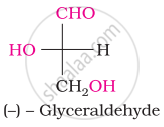
Choose the appropriate answer(s) for the below representation from the options given

Oxime is formed by treating glucose with ____________.
When glucose reacts with bromine water, the main product is ____________.
Which of the following properties of glucose cannot be explained by its open chain structure?
(i) Glucose does not form hydrogen sulphite with NaHSO3.
(ii) On oxidation with HNO3 glucose gives saccharic acid.
(iii) Glucose is found to exist in two different crystalline forms which are named as α and β.
The reaction of glucose with red P + HI is called ____________.
Which is the least stable form of glucose?
A solution of D-glucose in water rotates the plane polarised light ____________.
The number of chiral carbon atoms present in cyclic structure α-D(+) glucose:
Which of the following pairs represents anomers?
Three structures are given below in which two glucose units are linked. Which of these linkages between glucose units are between C1 and C4 and which linkages are between C1 and C6?
| (I) |  |
| (II) |  |
| (III) |  |
Why does compound (A) given below not form an oxime?

(A)
Account for the following:
What happens when D – glucose is treated with the following reagents
Bromine water
Account for the following:
What happens when D – glucose is treated with the following reagents
HNO3
Consider the following reactions:
(i) \[\ce{Glucose + R-OH ->[Conc. HNO3] [A] ->[X eq of][(CH3CO)2O] Acetyl derivative}\]
(ii) \[\ce{Glucose ->[Ni/H2] [A] ->[Y eq of][(CH3CO)2O] Acetyl derivative}\]
(iii) \[\ce{Glucose ->[Z eq of][(CH3CO)2O] Acetyl derivative}\]
'X, 'Y' and 'Z' in these reactions are respectively:
Match List - I with List - II.
| List I | List II | ||
| (A) | Glucose + HI | (I) | Gluconic acid |
| (B) | Glucose + Br2 water | (II) | Glucose pentacetate |
| (C) | Glucose + acetic anhydride | (III) | Saccharic acid |
| (D) | Glucose + HNO3 | (IV) | Hexane |
Choose the correct answer from the options given below:
Give a reason for the following observations:
Penta-acetate of glucose does not react with hydroxylamine.
