Advertisements
Advertisements
प्रश्न
Differentiable between the following:
Amylose and Amylopectin
Advertisements
उत्तर १
Amylose:
- Water soluble components
- Constitutes 15-20% of starch
Amylopectin:
- Water insoluble component
- Constitutes 80-85% starch.
उत्तर २
| Amylose | Amylopectin | |
| (a) | Only C1− C4 glycosidic linkage | C1− C4 glycosidic linkage but, branching occurs by C1− C6 glycosidic linkage |
| (b) | Water-soluble component of starch (15-20%) | Water-insoluble component of starch (80-85%) |
संबंधित प्रश्न
Write the product when D-glucose reacts with conc. HNO3.
Write the reactions involved when D-glucose is treated with the following reagent:
H2N-OH
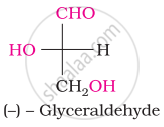
The number of asymmetric carbon atom(s) below the figure is/are

Glucose reacts with acetic anhydride to form ______.
The reaction of glucose with red P + HI is called ____________.
The two forms of D-glucopyranose obtained from the solution of D-glucose are called ____________.
Account for the following:
What happens when D – glucose is treated with the following reagents
Bromine water
Glucose with excess of phenyl hydrazine forms ______.
When D-glucose reacts with HI, it forms ______.
Give the reaction of glucose with hydrogen cyanide. Presence of which group is confirmed by this reaction?
