Advertisements
Advertisements
प्रश्न
Which of the following reactions of glucose can be explained only by its cyclic structure?
पर्याय
Glucose forms pentaacetate
Glucose reacts with hydroxylamine to form an oxime
Pentaacetate of glucose does not react with hydroxylamine
Glucose is oxidised by nitric acid to gluconic acid
Advertisements
उत्तर
Pentaacetate of glucose does not react with hydroxylamine
Explanation:
The pentaacetate of glucose does not react with hydroxylamine indicating the absence of free –CHO group. This property of glucose can be explained only by its cyclic structure.
APPEARS IN
संबंधित प्रश्न
Draw the simple Fisher projection formulae of D - (+) - glucose and D - (-) - fructose
What happens when glucose is treated with hydroxylamine?
Maltose is a
(a) Polysaccharide
(b) Disaccharide
(c) Trisaccharide
(d) Monosaccharide
Fill in the blanks by choosing the appropriate word/words from those given in the brackets:
(iodoform, acetaldehyde, positive, greater, acidic, acetone, disaccharide, negative, increases, glucose, decreases, chloroform, polysaccharide, lactose, lesser, basic, cationic hydrolysis, anionic hydrolysis)
Sucrose is a _________ and yields upon hydrolysis, a mixture of ________ and fructose.
Answer the following question.
What is the basic structural difference between glucose and fructose?
Write the reaction involved when D-glucose is treated with the following reagent:
(CH3CO)2O
The number of asymmetric carbon atom(s) below the figure is/are

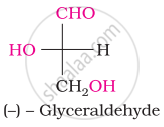
What is the most abundant organic compound on earth?
Acetylation of glucose yields ____________.
Glucose does not give Schiff’s test because of the formation of cyclic ____________.
Glucose does not react with ____________.
Glucose reacts with acetic anhydride to form ______.
The α-D glucose and β-D glucose differ from each other due to difference in carbon atom with respect to its ____________.
The two forms of D-glucopyranose obtained from the solution of D-glucose are called ____________.
Which of the following pairs represents anomers?
How will you distinguish 1° and 2° hydroxyl groups present in glucose? Explain with reactions.
Glucose with excess of phenyl hydrazine forms ______.
The number of asymmetric carbon atoms in the glucose molecule in open and cyclic form is ______.
Give a reason for the following observations:
Penta-acetate of glucose does not react with hydroxylamine.
