Advertisements
Advertisements
Question
Why does compound (A) given below not form an oxime?

(A)
Advertisements
Solution
Glucose pentaacetate (structure A) does not have a free –OH group at C, and therefore, cannot be converted to the open chain form to give a free –CHO group and hence it does not form the oxime.
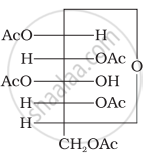
(Structure A)
APPEARS IN
RELATED QUESTIONS
Write the reaction that indicates the presence of -CHO group in glucose
Write the product when D-glucose reacts with conc. HNO3.
Glucose on reaction with HI gives n-hexane. What does it suggest about the structure of glucose?
What do you observe when glucose solution is heated with Tollen’s reagent?
Choose the appropriate answer(s) for the below representation from the options given

Acetylation of glucose yields ____________.
Which of the following statements is incorrect regarding glucose?
The symbols D and L represents ____________.
Which one of the following compounds is different from the rest?
When glucose reacts with bromine water, the main product is ____________.
Glucose does not react with ____________.
The α-D glucose and β-D glucose differ from each other due to difference in carbon atom with respect to its ____________.
Which of the following pairs represents anomers?
Assertion: D (+) – Glucose is dextrorotatory in nature.
Reason: ‘D’ represents its dextrorotatory nature.
Account for the following:
What happens when D – glucose is treated with the following reagents
HNO3
Glucose with excess of phenyl hydrazine forms ______.
Give a reason for the following observations:
Penta-acetate of glucose does not react with hydroxylamine.
The reagents with which glucose does not react to give the corresponding tests/products are:
- Tollen’s reagent
- Schiff’s reagent
- HCN
- NH2OH
- NaHSO3
Choose the correct options from the given below:
