Advertisements
Advertisements
Question
Maltose is a
(a) Polysaccharide
(b) Disaccharide
(c) Trisaccharide
(d) Monosaccharide
Advertisements
Solution
Disaccharide
APPEARS IN
RELATED QUESTIONS
Enumerate the reactions of D-glucose which cannot be explained by its open chain structure.
Enlist the properties of glucose that can not be explained on the basis of open chain structure of it
What do you observe when glucose solution is heated with Tollen’s reagent?
Fill in the blanks by choosing the appropriate word/words from those given in the brackets:
(iodoform, acetaldehyde, positive, greater, acidic, acetone, disaccharide, negative, increases, glucose, decreases, chloroform, polysaccharide, lactose, lesser, basic, cationic hydrolysis, anionic hydrolysis)
Sucrose is a _________ and yields upon hydrolysis, a mixture of ________ and fructose.
Write the reaction involved when D-glucose is treated with the following reagent:
Br2 water
Write the reactions involved when D-glucose is treated with the following reagent:
H2N-OH
The spatial arrangement of the given molecule is denoted by:

Choose the appropriate answer(s) for the below representation from the options given

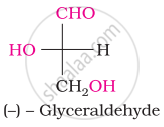
The number of asymmetric carbon atom(s) below the figure is/are

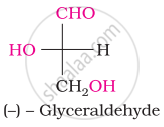
What is the most abundant organic compound on earth?
Glucose does not give Schiff’s test because of the formation of cyclic ____________.
The symbols D and L represents ____________.
When glucose reacts with bromine water, the main product is ____________.
Which of the following properties of glucose cannot be explained by its open chain structure?
(i) Glucose does not form hydrogen sulphite with NaHSO3.
(ii) On oxidation with HNO3 glucose gives saccharic acid.
(iii) Glucose is found to exist in two different crystalline forms which are named as α and β.
Which of the following reactions of glucose can be explained only by its cyclic structure?
Choose the correct relationship for glucose and fructose:
The number of chiral carbons in ß-D(+) glucose is ____________.
Which one is correct?
Which one of the following reactions is not explained by the open chain Structure of glucose?
Three structures are given below in which two glucose units are linked. Which of these linkages between glucose units are between C1 and C4 and which linkages are between C1 and C6?
| (I) |  |
| (II) |  |
| (III) |  |
Assertion: D (+) – Glucose is dextrorotatory in nature.
Reason: ‘D’ represents its dextrorotatory nature.
Write the reactions of D-glucose which can’t be explained by its open-chain structure. How can cyclic structure of glucose explain these reactions?
What happens when D-glucose is treated with the following reagent?
HI
Account for the following:
What happens when D – glucose is treated with the following reagents
HNO3
Consider the following reactions:
(i) \[\ce{Glucose + R-OH ->[Conc. HNO3] [A] ->[X eq of][(CH3CO)2O] Acetyl derivative}\]
(ii) \[\ce{Glucose ->[Ni/H2] [A] ->[Y eq of][(CH3CO)2O] Acetyl derivative}\]
(iii) \[\ce{Glucose ->[Z eq of][(CH3CO)2O] Acetyl derivative}\]
'X, 'Y' and 'Z' in these reactions are respectively:
Give the reaction of glucose with hydrogen cyanide. Presence of which group is confirmed by this reaction?
