Advertisements
Advertisements
Question
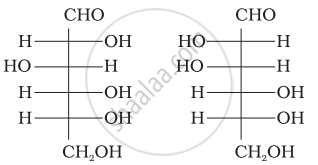
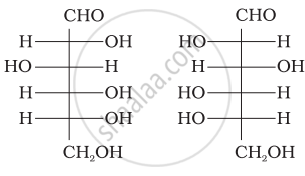
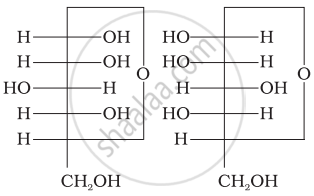
Which of the following pairs represents anomers?
Options
Advertisements
Solution
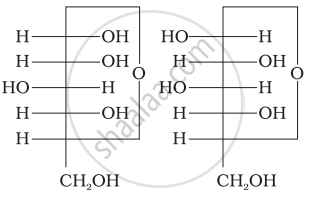
Explanation:
The isomers which differ only in the configuration of the hydroxyl group at C – 1 are called anomers and are referred to as α- and β-fonns.
APPEARS IN
RELATED QUESTIONS
How many moles of acetic anhydride will be required to form glucose pentaacetate from 2M of glucose?
(a) 2
(b) 5
(c) 10
(d) 2.5
What happens when glucose is treated with hydroxylamine?
Fill in the blanks by choosing the appropriate word/words from those given in the brackets:
(iodoform, acetaldehyde, positive, greater, acidic, acetone, disaccharide, negative, increases, glucose, decreases, chloroform, polysaccharide, lactose, lesser, basic, cationic hydrolysis, anionic hydrolysis)
Sucrose is a _________ and yields upon hydrolysis, a mixture of ________ and fructose.
Write the reactions involved when D-glucose is treated with the following reagent:
H2N-OH
What is the most abundant organic compound on earth?
Oxime is formed by treating glucose with ____________.
The symbols D and L represents ____________.
Which one of the following compounds is different from the rest?
When glucose reacts with bromine water, the main product is ____________.
Reduction of glucose by HI suggest that ____________.
Which is the least stable form of glucose?
The two forms of D-glucopyranose obtained from the solution of D-glucose are called ____________.
The letter D and L in carbohydrates represent ____________.
The number of chiral carbons in ß-D(+) glucose is ____________.
How will you distinguish 1° and 2° hydroxyl groups present in glucose? Explain with reactions.
Account for the following:
There are 5 OH groups in glucose
Consider the following reactions:
(i) \[\ce{Glucose + R-OH ->[Conc. HNO3] [A] ->[X eq of][(CH3CO)2O] Acetyl derivative}\]
(ii) \[\ce{Glucose ->[Ni/H2] [A] ->[Y eq of][(CH3CO)2O] Acetyl derivative}\]
(iii) \[\ce{Glucose ->[Z eq of][(CH3CO)2O] Acetyl derivative}\]
'X, 'Y' and 'Z' in these reactions are respectively:
Glucose with excess of phenyl hydrazine forms ______.
Give a reason for the following observations:
Penta-acetate of glucose does not react with hydroxylamine.
