Advertisements
Advertisements
Question
Enumerate the reactions of D-glucose which cannot be explained by its open chain structure.
Advertisements
Solution 1
- Aldehydes give 2, 4-DNP test, Schiff’s test, and react with NaHSO3 to form the hydrogen sulphite addition product. However, glucose does not undergo these reactions.
- The pentaacetate of glucose does not react with hydroxylamine. This indicates that a free −CHO group is absent from glucose.
- Glucose exists in two crystalline forms – α and β. The α-form (m.p. = 419 K) crystallises from a concentrated solution of glucose at 303 K and the β-form (m.p. = 423 K) crystallises from a hot and saturated aqueous solution at 371 K. This behaviour cannot be explained by the open chain structure of glucose.
Solution 2
D-(+)-glucose does not undergo certain characteristic reactions of aldehydes, e.g., glucose does not form NaHSO3 addition product.
Glucose reacts with NH2OH to form an oxime but glucose pentaacetate does not. This implies that the aldehydic group is absent in glucose pentaacetate.
D-(+)-glucose exists in two stereoisomeric forms, i.e., α-glucose and β-glucose.
Both α-D-glucose and β-D-glucose undergo mutarotation in aqueous solution. Although the crystalline forms of α- and β-D-(+)-glucose are quite stable in aqueous solution, each form slowly changes into an equilibrium mixture of both.
D-(+)-glucose forms two isomeric methyl glucosides. Aldehydes normally react with two moles of methanol per mole of the aldehyde to form an acetal but D-(+)-glucose, when treated with methanol in the presence of dry HCl gas, reacts with only one mole of methanol per mole of glucose to form a mixture of two methyl D-glucosides i.e., methyl-α-D-glucoside (melting point 438 K, specific rotation +158°) and methyl-β-D-glucoside (melting point 308 K, specific rotation – 33°).
APPEARS IN
RELATED QUESTIONS
Draw the simple Fisher projection formulae of D - (+) - glucose and D - (-) - fructose
How many moles of acetic anhydride will be required to form glucose pentaacetate from 2M of glucose?
(a) 2
(b) 5
(c) 10
(d) 2.5
Answer the following question.
What is the basic structural difference between glucose and fructose?
Write the reactions involved when D-glucose is treated with the following reagent:
H2N-OH
Write the reaction involved when D-glucose is treated with the following reagent:
(CH3CO)2O
Choose the appropriate answer(s) for the below representation from the options given

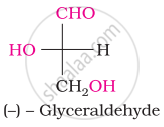
The number of asymmetric carbon atom(s) below the figure is/are

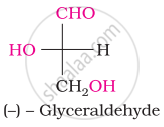
What is the most abundant organic compound on earth?
Glucose reacts with acetic anhydride to form ______.
Glucose is found to exist in two different α and β crystalline forms. These forms can be obtained by:
(i) The α form of glucose is obtained by crystallisation from a concentrated solution of glucose at 303 K.
(ii) The β form of glucose is obtained by crystallisation from a concentrated solution of glucose at 303 K.
(iii) The β form is obtained by crystallisation from hot and saturated aqueous solution at 371 K.
(iv) The α form is obtained by crystallisation from hot and saturated aqueous solution at 371 K.
Which of the following reactions of glucose can be explained only by its cyclic structure?
Which one is correct?
Why does compound (A) given below not form an oxime?

(A)
Write the reactions of D-glucose which can’t be explained by its open-chain structure. How can cyclic structure of glucose explain these reactions?
On the basis of which evidences D-glucose was assigned the following structure?
\[\begin{array}{cc}
\ce{CHO}\\
|\phantom{....}\\
\phantom{..}\ce{(CHOH)4}\\
|\phantom{....}\\
\phantom{..}\ce{CH2OH}
\end{array}\]
Consider the following reactions:
(i) \[\ce{Glucose + R-OH ->[Conc. HNO3] [A] ->[X eq of][(CH3CO)2O] Acetyl derivative}\]
(ii) \[\ce{Glucose ->[Ni/H2] [A] ->[Y eq of][(CH3CO)2O] Acetyl derivative}\]
(iii) \[\ce{Glucose ->[Z eq of][(CH3CO)2O] Acetyl derivative}\]
'X, 'Y' and 'Z' in these reactions are respectively:
Glucose with excess of phenyl hydrazine forms ______.
Match List - I with List - II.
| List I | List II | ||
| (A) | Glucose + HI | (I) | Gluconic acid |
| (B) | Glucose + Br2 water | (II) | Glucose pentacetate |
| (C) | Glucose + acetic anhydride | (III) | Saccharic acid |
| (D) | Glucose + HNO3 | (IV) | Hexane |
Choose the correct answer from the options given below:
Give a reason for the following observations:
Penta-acetate of glucose does not react with hydroxylamine.
