Advertisements
Advertisements
प्रश्न
Mention 'two' uses of propan-2-one.
Advertisements
उत्तर
(1)Propan-2-one is used as a commercial solvent
(2)It is used in the manufacture of explosive, lacquers, paint removers, plastics, drugs, perfumes, adhesives etc.
APPEARS IN
संबंधित प्रश्न
Give the structures of A, B and C in the following reactions :

Give the structures of A, B and C in the following reactions :

Write a short note on the following:
Hoffmann’s bromamide reaction
Accomplish the following conversion:
Nitrobenzene to benzoic acid
Accomplish the following conversion:
Benzamide to toluene
Why cannot aromatic primary amines be prepared by Gabriel phthalimide synthesis?
Write the reaction of aliphatic primary amine with nitrous acid.
Give a plausible explanation for the following:
Why are amines less acidic than alcohols of comparable molecular masses?
Arrange the following in the increasing order of their pKb values:
C6H5NH2, C2H5NH2, C6H5NHCH3
Write structures of compounds A and B in each of the following reactions:
Answer in one sentence.
Predict the product of the following reaction.
\[\ce{Nitrobenzene ->[Sn/conc.HCl]?}\]
Answer the following
Identify A and B in the following reactions.
\[\ce{C6H5CH2Br->[alco.][KCN]A ->[Na/ethanol]B.}\]
Answer the following
Write a reaction to convert acetic acid into methylamine.
Write reactions to prepare ethanamine from Acetonitrile.
Name the process of breaking C-X bond by ammonia in preparation of amines.
Write the order of reactivity of alkyl halides with ammonia.
Explain Hoffmann’s exhaustive alkylation with suitable reactions.
Write reactions for the preparation of ethanamine using Gabriel phthalimide synthesis.
Explain the following reaction with a suitable example.
Hofmann elimination reaction
Identify the product 'A' in the following reaction.
\[\ce{Aniline ->[(CH3CO)2O][Pyridine] A}\]
Alkyl cyanides on reduction by sodium and ethanol give primary amines. This reaction is called as ____________.
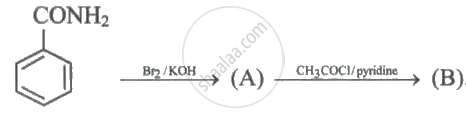
Identify the major product (B).
____________ can be prepared exclusively by Gabriel phthalimide synthesis.
What is the molar mass of the amine formed when acetamide undergoes Hofmann bromamide degradation?
Which of the following reactions is appropriate for converting benzamide to aniline?
Which of the following amines forms a clear solution when treated with benzene sulphonyl chloride and excess of potassium hydroxide?
Identify 'A' and 'B' in the following conversions.
\[\ce{CH3 - I ->[Alc. KCN][\Delta] A ->[Na/C2H5OH] B}\]
For producing amines, the reaction of nitro compounds with iron scrap is preferred because:
Benzylamine may be alkylated as shown in the following equation:
\[\ce{C6H5CH2NH2 + R - X -> C6H5CH2NHR}\]
Which of the following alkylhalides is best suited for this reaction through SN1 mechanism?
The source of nitrogen in Gabriel synthesis of amines is ______.
Amongst the given set of reactants, the most appropriate for preparing 2° amine is ______.
The best reagent for converting 2–phenylpropanamide into 2-phenylpropanamine is ______.
Reduction of aromatic nitro compounds using \[\ce{Fe}\] and \[\ce{HCl}\] gives ______.
Best method for preparing primary amines from alkyl halides without changing the number of carbon atoms in the chain is ______.
Which of the following methods of preparation of amines will give same number of carbon atoms in the chain of amines as in the reactant?
Reduction of nitrobenzene by which of the following reagent gives aniline?
(i) \[\ce{Sn/HCl}\]
(ii) \[\ce{Fe/HCl}\]
(iii) \[\ce{H2 - Pd}\]
(iv) \[\ce{Sn/NH4OH}\]
What is the product when \[\ce{C6H5CH2NH2}\] reacts with \[\ce{HNO2}\]?
Write following conversions:
nitrobenzene `->` acetanilide
How will you bring out the following conversion?

How will you carry out the following conversion?

Match the reactions given in Column I with the statements given in Column II.
| Column I | Column II | ||
| (i) | Ammonolysis | (a) | Amine with lesser number of carbon atoms |
| (ii) | Gabriel phthalimide synthesis | (b) | Detection test for primary amines. |
| (iii) | Hoffmann Bromamide reaction | (c) | Reaction of phthalimide with \[\ce{KOH}\] and \[\ce{R-X}\] |
| (iv) | Carbylamine reaction | (d) | Reaction of alkylhalides with \[\ce{NH3}\] |
Describe Gabriel's phthalimide synthesis. (Give reaction)
Account for the following:
Aniline cannot be prepared by the ammonolysis of chlorobenzene under normal conditions.
Which of the following reactions will not give a primary amine?
In the given reaction what is the X?
\[\begin{array}{cc}
\ce{O}\phantom{.......................}\\
||\phantom{.......................}\\
\phantom{}\ce{R - C - OH <-[H3O] Χ ->[H] RCH2NH2}
\end{array}\]
Which of the following compound is expected to be most basic?
Identify the product ‘C’ in the following reaction.
\[\ce{Aniline ->[(CH3CH)2O][Pyridine] A ->[Br2][CH3COOH] B ->[H^+ or OH^-] C}\]
Amides can be converted into amines by the reaction named ______.
Identify the compo ds A and B in the following reactions:
\[\ce{A ->[Nitrating mixture] B ->[(i) Sn/cone. HCI][(ii) NaOH] Aniline}\]
Identify A and B in the following reaction.
\[\ce{C6H5CH2Br ->[Alco.][KCN] A ->[Na/Ethanol][reduction] B}\]
Write a short note on Ammonolysis.
