Advertisements
Advertisements
प्रश्न
Given below is a well-known quotation.
“Cowards die many times before their death”.
Study the quotations and identify the adverse human qualities that are worse than ‘death’ and discuss the underlying message conveyed.
Advertisements
उत्तर
Few adverse human qualities
- Dishonest
- Selfish
- Mean
- Arrogant
- Rude
- Cruel
- Close-minded
- Hypocritic
- Greedy
- Cowardly
The proverb can be explained that a coward is afraid of anything and everything. However, a brave person is not afraid of any dangers and perils. This statement is found in Shakespeare's 'Julius Caesar', Caesar stated that cowards die many times before their deaths. The valiant would never taste death but once. Cowards fear for one or the other reason. A coward runs away from any danger. It is built in a person from childhood. Such persons normally seek other's help to get their work done. A brave person on the other hand faces any danger without fear and faces it boldly. Fearlessness is a characteristic quality of a great hero. The proverb thus signifies that cowards die many times as they are so scared. We should imbibe in young children from childhood to be brave and bold and not be cowards. Such brave persons are valued in society and have high regard and reach great heights and positions in life.
APPEARS IN
संबंधित प्रश्न
Mr. Anand Tony, director of the award-winning movie ‘Poo’, is meeting the press. Take turns to be the director and media person. Conduct a perfect discussion.
Collect images of some electronic gadgets and play a JAM (just a minute) game by picking one image and talking for a minute about it in your classroom.
Read the following dialogue and report it.
| Johnson | “What are you doing here, Suganthi? I haven’t seen you since June.” |
| Suganthi | “I’ve just come back from my holiday in Ooty.” |
| Johnson | “Did you enjoy it?” |
| Suganthi | “I love Ooty. And the people were so friendly.” |
| Johnson | “Did you go to Coakers Walk?” |
| Suganthi | “It was my first trip. I can show you some pictures. Are you doing anything tomorrow?” |
| Johnson | “I must arrange a couple of things. But I am free tonight.” |
| Suganthi | “You might come to my place. At what time shall we meet?” |
| Johnson | “I’ll be there at eight. Is it all right?” |
Johnson asked Suganthi ______. And he said ______ since June. Suganthi explained that ______ back from her holiday in Ooty. Johnson wondered if ______ it. Suganthi told him that she ______ Ooty and that the people ______ so friendly. Johnson wanted to know ______ to the Coakers Walk. Suganthi said that its first trip and that she some pictures. And then she asked him if he Johnson explained that he ______ a couple of things. But he added that he ______ free at night. Suganthi suggested that he ______ place and asked him at what time ______. Johnson said he ______ there at eight. And finally, he asked ______ all right.
Read the different verb form where they remain the same in the direct and indirect speech in the following case. Fill in the blank with missing indirect speech.
We do not usually change the modal verbs must and needn’t. But must can become had to or would have to and needn’t can become didn’t have to or wouldn’t have to if we want to express an obligation. Would/wouldn’t have to are used to talk about future obligations.

Review an event which your school has hosted recently.
Do you work individually or in pairs?
Imagine that you are going to interview one of the survivors of the Pan Am Hijack. Discuss with your partner and write down the conversation. Then one of you play the role of the interviewer and other the survivor. You can use the sample questions given below.
- Do you have any information regarding the suspects of the hijack?
- Which countries did the hijackers belong?
- What are the details of the hijacked flight?
- How many passengers were aboard?
- What happened in the last few minutes of the hijack drama?
- Do you have information regarding the victims?
- Was there any recorded communication to/from the plane during the hijacking?
- How many terrorists were there?
- How did you feel when you were in the flight?
- Can you recall Neerja’s role in safeguarding the passengers?
Figure of speech.
| The woods are lovely, dark, and deep, But I have promises to keep And miles to go before I sleep, and miles to go before I sleep. |
Pick out any two lines of repetition from the poem.
Change the following into Indirect Speech.
“Halt!” shouted the officer to his men.
Change the following into Indirect Speech.
The teacher said to him, “Do not read so fast.”
Change the following into Direct Speech.
Lakshan asked me if I had anything to say.
See how they speak at this situation and practise as if you were in that situation.

Structures that are useful for this situation.

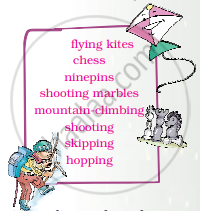
Pick out the names of the games mentioned in the story.
What does ‘features’ mean? Look up the dictionary. What are the different kinds of features of people we come across in the world? Discuss.
Look at the picture again. Describe the picture.

|
beneath, breeze, meet, fear, each, meadow. |
Did you hear what your tongue did?
How do you think you can help children who cannot see?
Do you think that –
Hiawatha liked learning new languages?
Do you think that –
Do birds have secrets?
Tick (✓) the words which end with the sound id. Say each word aloud
| accepted | |
| answered | |
| irritated | |
| failed | |
| completed | |
| challenged | |
| cried | |
| surprised | |
| find | |
| licked | |
| celebrated | |
| fried |
Have you been to another place recently? What is it like? How is it different from your own place?
Work in pairs and arrive at five points that bring out the benefits and challenges of living in either a nuclear family or a joint family. Share your views with your class.
Every member contributes to forming a happy family. Share your views for a minute or two with your class.
You forget to wish your best friend on his/her birthday. He gets very angry. How will you try to pacify him/her? Construct a dialogue of about 4 to 5 exchanges and enact a role play
Is there a link between intelligence and absent-mindedness? Share your views on this subject, with the class.
You have recently shifted to a new locality. You cannot find your way back, after school. Your uncle spots you and takes you home. Narrate the incident to the class.
Here are a few instructions given by a Health Inspector to a group of students, in order to prevent malaria and dengue. Complete the series adding some more important instructions.
- Do not allow water to stagnate in and around your house.
- Keep your surroundings clean.
- Wear long-sleeved shirts/blouses and long pants/skirts that cover your arms and legs.
- ______
