Advertisements
Advertisements
प्रश्न
Tick (✓) the words which end with the sound id. Say each word aloud
| accepted | |
| answered | |
| irritated | |
| failed | |
| completed | |
| challenged | |
| cried | |
| surprised | |
| find | |
| licked | |
| celebrated | |
| fried |
Advertisements
उत्तर
| accepted | ✓ |
| answered | |
| irritated | ✓ |
| failed | |
| completed | ✓ |
| challenged | |
| cried | ✓ |
| surprised | |
| find | |
| licked | |
| celebrated | ✓ |
| fried | ✓ |
APPEARS IN
संबंधित प्रश्न
Form groups and use the following topic for discussion. Take the help of your college library and your teacher.
Equality before law
You are visiting the primary school where you studied classes I to IV, after six years. You get a chance to go to your standard two classrooms and you are permitted to sit at the same place where you used to sit.
What would you remember?
Imagine you are going to celebrate your forthcoming birthday at an orphanage/old age home.
Deliver a short speech about your birthday celebration by using the following hints.
- The reasons for choosing an orphanage/old-age home.
- The people who accompany you.
- The food which you are going to offer them.
- The useful gifts/articles which you are going to give them.
- Other events like cake cutting, conducting games, etc.
I used to admire ______.
Now I really enjoy ______.
Collect images of some electronic gadgets and play a JAM (just a minute) game by picking one image and talking for a minute about it in your classroom.
Read the different verb form where they remain the same in the direct and indirect speech in the following case. Fill in the blank with missing indirect speech.
With modal verbs would, might, could, should, ought to, used to.
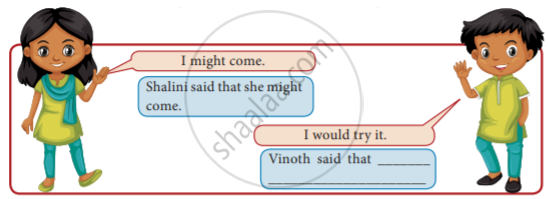
Read the different verb form where they remain the same in the direct and indirect speech in the following case. Fill in the blank with missing indirect speech.
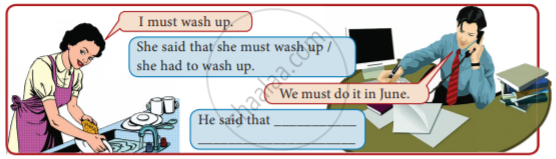
We do not usually change the modal verbs must and needn’t. But must can become had to or would have to and needn’t can become didn’t have to or wouldn’t have to if we want to express an obligation. Would/wouldn’t have to are used to talk about future obligations.
Imagine that you and your friend have decided to spend a day together in your house. You have planned your schedule from morning till night. Discuss in pairs and speak about it in the class. You can start like this:
I like to go for a walk but my friend wants to work out in the gym.
Is there any place near?

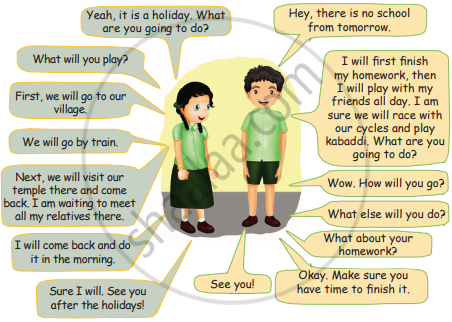
A boy and a girl are talking about their holidays.
Interview your teacher and get her responses for the following questions.
- Why did you become a teacher?
- How do you come to school every day?
- Do you have any pets?
- What kinds of books do you like to read?
- What are your hobbies?
Some letter are missing in each word.
t ______ ch
Some letter are missing in each word.
b ______ p
What are the different kinds of books in this bookshop or in any other bookshop you have seen? Tell the class.
Build a conversation for the following situation with a minimum of five exchange.
A salesman and a customer at an electronic shop.
Imagine you are Baldwin and your partner is Gresham. Try your best to persuade your partner to confess the truth. Build a conversation describing how both of you would react in such a situation. Work in pairs.
Now it’s your turn to speak against the motion “Wars create more problem than they solve.” Express your views with valid points.
Given below is a well-known quotation.
“Cowards die many times before their death”.
Study the quotations and identify the adverse human qualities that are worse than ‘death’ and discuss the underlying message conveyed.
Your school has arranged for a road safety campaign, Share a few ideas with your classmates which can be used during the campaign. For example ‘Speed thrills but kills’.
