Advertisements
Advertisements
प्रश्न
Is there a link between intelligence and absent-mindedness? Share your views on this subject, with the class.
Advertisements
उत्तर
Of course yes, the person who is smart and extremely intelligent focuses his entire being on an issue or an invention. Thus all other things are abstracted. Great geniuses like Einstein and philosophers like Tagore tend to forget mundane affairs. Their minds are always preoccupied with lofty ideals and the ills of society. So, it is believed that eccentricity like absent-mindedness is common among very intelligent people. The best example is Einstein. He sat in the railway coach leaving behind his newly married bride in the car. Only on seeing her furious face, he realized the fact that he forgot to take her along into the railway coach.
APPEARS IN
संबंधित प्रश्न
Form groups and use the following topic for discussion. Take the help of your college library and your teacher.
Equality before law
Prepare a speech in about 80-100 words for the morning assembly, stressing on the importance of games and sports in ensuring a healthy body and mind.
Work in groups of four. Discuss how the story would have been different if.
Pongo had arrived on the scene before the last orange was eaten.
Figures of speech
Anaphora: Repetition of a word or a phrase at the beginning of a sequence of sentences, paragraphs, and lines.
(e.g.) How handsome are your gauzy wings, how brilliant are your eyes!
Identify the figures of speech.
”Your eyes are like the diamond bright, but mine are dull as lead!”
Read the clues given below and develop your story. Narrate your story to the class.
Robert Bruce - King - lying on the ground in a dejected mood - failed to defeat his enemies - was thinking of giving up the attempt - saw a spider falling down from the ceiling - the ceiling far away - wondered how it would get there - the spider fell back again - again it tried - again it fell - it made nine such attempts - no success - climbed up once more - at last succeeded in reaching the roof - Bruce imitated its example - he too tried once again - was successful.
Develop a story with the given pictures and narrate it to your class. Your story must have a plot and vivid details.


When I was a little boy ______,
“Why do volcanoes erupt?”
She wondered why ______.
“How many photos have you got?”
He wants to know how many ______.
Read the different verb form where they remain the same in the direct and indirect speech in the following case. Fill in the blank with missing indirect speech.
With would rather, had better,

Read the conversation of the simple machines. Take roles to play. Then discuss in pairs to describe any simple machine. Create your own storyboard and take roles to play.
Jack: Don't you know how simple machines make your life easy?
Jimmy: Um... I don't know what simple machines are.
Jack: Simple machines are mechanical devices for applying force like a wedge or ramp.
Jimmy: Oh! wow! How I did not know this!
Jack: Like the wheels on hospital bed and IV pole. They help you move people faster by reducing the friction.
Jimmy: Is the stick over there that the TV is attached to, is that a simple machine too?
Jack: Yes it is, it's a lever. The wheels on the bus are simple machines, they make the bus move.
Jimmy: What about the doors?
Jack: 'Yeah' the driver pulls a lever and the doors open and you climb up the inclined plane aka the stairs. The cable in the elevator is wrapped around a groove in the wheel and axle, an electric motor pulls the cable, lifting the car between floors.
Jimmy: So the wheels on the rolling chair are too by rolling the chair back instead of lifting the chair back.
Jack: 'Yes' they are, they move the chair and reduce the friction.
Give a review of a book that has interested you a lot.
Look at the picture. Work in groups and give a short talk about it using the words given below.
- sand
- waves
- when
- as soon as
- collect
- enjoy
- hatchlings
- basket
- boys
- night
- rough sea
- many
- eggs
- incubate
- hatchery
- after
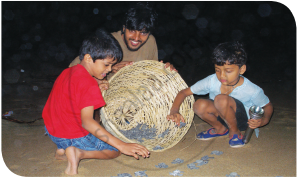
|
Volunteers of the Students Sea Turtle Conservation Network (SSTCN) release Olive Ridley hatchlings into the sea. |
Take something from your school bag. Describe it in three sentences. Ask the class to find out the thing you have described.
Discuss in groups of five. Make a story about the comic strip. Then share it in the class.

Change the following into Indirect Speech.
“What do you want?” he said to her.
Change the following into Indirect Speech.
“Take off your hat,” the king said to the Hatter.
Change the following into Indirect Speech.
“Run away, children,” said their mother.
What did the teacher teach?
In your family, what activities are done individually and as a group?
| My mother decides | |
| My father decides | |
| I decide | |
| We decide |
What is the word that starts with t , rhymes with ‘cease’, and means to playfully make fun of ?
What is the word that starts with 'c' , rhymes with ‘near’ and ‘fear’, and means easy to see, hear and understand?
Say these words and feel what your tongue does when you say –
toe, top, tie, ten
Do you think that –
Do you know the secret language of any animal? Tell the class about it.
Do you like reading story books?
You are travelling by train. When the Train Ticket Examiner enters your compartment, much to your shock, you realize you have forgotten to bring your train ticket. How will you handle the situation?
You forget to wish your best friend on his/her birthday. He gets very angry. How will you try to pacify him/her? Construct a dialogue of about 4 to 5 exchanges and enact a role play
‘When the mouse laughs at the cat, there is a hole nearby.’ Explain the meaning of this statement to your friends.
Prepare a formal five minute speech on the topic ‘The Importance of Education’ and deliver it at your School Assembly.
- The Vellore was h held in 1801.
- The family members of Tippu were imprisoned at Vellore Fort after the fourth Mysore war.
- At the time of Vellore revolt, the Governor of Madras was lord William Bentinck.
- The victory of revolt of Vellore against British was one of the significant event in the history of india.
