Advertisements
Advertisements
प्रश्न
Sherlyn receives a postcard from her friend Pushpa who is holidaying in Sri Lanka. She calls her friend Galen and tells him what Pushpa has written. Help her by filling in the blanks, using reported speech.
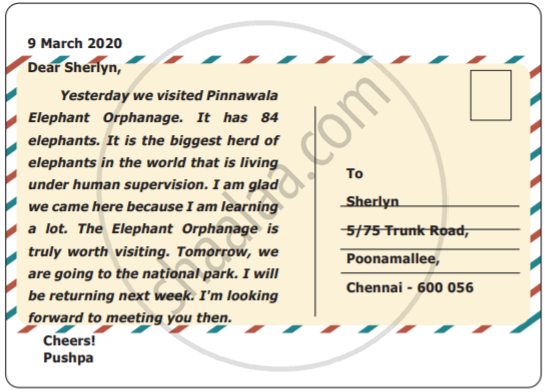
Hello, Galen Today I received a postcard from Pushpa. Remember I had told you that She has gone to Sri Lanka on a holiday? Well, she has written from Colombo. She has written that ____________ Orphanage. It ____________ elephants. She said that it is the biggest herd of elephants in the world that is living under human supervision. She also added that she ____________ because ____________. The Elephant Orphanage ____________ . She said that ____________ national park. She ____________ next week and added that ____________ then.
Advertisements
उत्तर
Hello, Galen Today I received a postcard from Pushpa. Remember I had told you that She has gone to Sri Lanka on a holiday? Well, she has written from Colombo. She has written that she had visited Elephant Orphanage. It had 84 elephants. She said that it is the biggest herd of elephants in the world that is living under human supervision. She also added that she was glad that they had come there because she was learning a lot. The Elephant Orphanage was truly worth visiting. She said that next day. they were going to national park. She would be returning next week and added that she was looking forward to meeting me. then.
APPEARS IN
संबंधित प्रश्न
Form groups and use the following topic for discussion. Take the help of your college library and your teacher.
Freedom of speech
In his speech, Dr. B. R. Ambedkar has expressed his deep concern over the absence of two things in the then Indian society. Discuss with your partner and complete the web.

As a child I spent my free time ______.
“Who took my English book?”
He was curious to know who ______.
Do you work individually or in pairs?
Change the following into Indirect Speech.
He said, “How's your father?”
Imagine that you and your friend have decided to spend a day together in your house. You have planned your schedule from morning till night. Discuss in pairs and speak about it in the class. You can start like this:
I like to go for a walk but my friend wants to work out in the gym.
What do you do when it is dark?
Build a conversation for the following situation with a minimum of five exchange.
Two friends about the NSS camp which they are going to attend.
Your school has arranged for a road safety campaign, Share a few ideas with your classmates which can be used during the campaign. For example ‘Speed thrills but kills’.
