Advertisements
Advertisements
प्रश्न
‘Forgetfulness is the beginning of happiness’- Do you agree or disagree? Discuss in class.
Advertisements
उत्तर
In “Ode to skylark,” Shelly beautifully portrays the human beings’ boundless capacity to worry about dead yesterday, unborn tomorrow, and spoil the happiness of a perfectly beautiful present. He says, “We look before and after and pine for what is not. Our sincerest laughter With some pain is fraught”. Human mind has a soft comer for harboring hurts and pain. It replays them like a broken record often and sustains hostility between individuals. It requires a mature mind to forgive and forget. The road to recovery of any invisible hurt starts the moment one forgives the person and casually forgets all unpleasant memories connected to it. The human mind, according to Robert Lynd, forgets what it chooses to forget. We are in a civilized society because everyone remembers to dress properly and remember the names of friends and relatives. If one develops the attitude to remember only pleasant things, the mind will train itself to forget insignificant bad memories. Thus forgetting is the beginning of real happiness.
APPEARS IN
संबंधित प्रश्न
Pick out two words from the article on folk culture and folklore of Tamil Nadu with which you can form anagrams. Take turns and ask your partner to solve the anagram and come out with the right words.
What will the tree do, if the banks are closed?
It will start its own ____________.
Divide the students into groups of five and conduct a group discussion on the topic "Importance of Mathematics in Our Everyday Life". The teacher will act as a moderator.
Prepare a welcome address on the occasion of Republic day celebration.
Mock anchoring for annual day celebration.
“How many photos have you got?”
He wants to know how many ______.
Review an event which your school has hosted recently.
Which session do you like – art/craft?
Take a few minutes and make hints of the picture. Arrange your thoughts. Using the points you write, deliver a small speech focusing on the issue picturized here. Give an interesting and informative speech. Your speech should include the cause and the solution.

Tips for effective speaking
• Organise your points and ideas well.
• Don’t memorise the speech. If you forget a point, it will make you nervous.
• Avoid the things that are of no value or interest to the audience.
• Before you speak, take a deep breath, smile, greet the audience.
• Don’t be nervous about making a mistake.
• Interesting speech makes your mistakes nothing.
Discuss in groups of five. Make a story about the comic strip. Then share it in the class.

Work in pairs. Take turns and speak about spices.
| Saritha | Saritha: Hi Divya, how are you? |
| Divya | Hi, I’m fine Saritha. |
| Saritha | What did you have for breakfast? |
| Divya | ______ with onion chutney. |
| Saritha | Do ______ onions ______? |
| Divya | ______ Central Asia. |
| Saritha | Do you know chilli too has come from somewhere else? |
| Divya | Is it from______? |
| Saritha | Yes______right. |
| Divya | Many of the ______ came ______. |
Change the following into Direct Speech.
Ebin asked me what I wanted.
Name the character or speaker.
“Are you alright?”
Name the character or speaker.
“Let me try pulling this lever.”
Each person or a group chooses an item from the class and takes two minutes to prepare. He/she must promote and sell the same item in the most humorous way to convince the classmates to buy the product. You can choose items such as eraser, pencil, school bag, book, etc.
It can go like this.
Here I have a magical eraser for you. You can do whatever you want to do with this. You can rub anything that you don’t like. Just rub it against somebody’s hair and it will be gone forever. If you want to see somebody without hair, here you go. Buy this eraser and have fun with your friends.
See how they speak at this situation and practise as if you were in that situation.
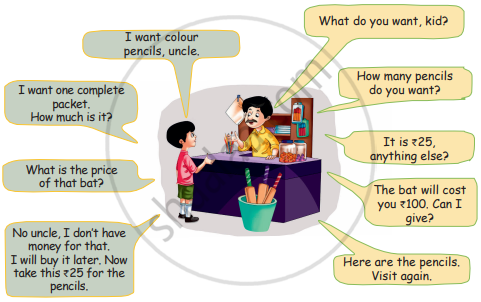
Join in one of the two groups. Choose one character, speak two sentences for and against it.
| I support Kaliyan because ______ |
| I oppose the rich man because ______ |
Speak and win.
Join in one of the two groups. Speak 4 to 5 sentences supporting and opposing the intelligence of the saparrow.
| I support the sparrow for her intelligence. | I oppose the sparrow for using her intelligence to cheat others. |
Pick out the names of the games mentioned in the story.
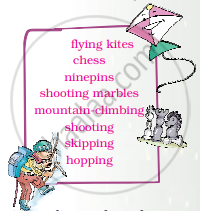
Look at the picture below. In the yellow box there are eight things You can see six of them in the picture. You cannot see the other two. Write down the four things that you can see.

- ______.
- ______.
- ______.
- ______.
Some letter are missing in each word.
tr __ __ s
Ram is a curious little boy. He is always asking questions. One day he came home and asked his grandfather questions like –
- Why can’t we look at the sun during a solar eclipse?
- Why can’t we touch the sun?
- Why can’t we go out to play in the dark?
Discuss these questions with your teacher and class. Do you know the answers?
Have you ever been very frightened? Tell your partner about it.
Where did the tip of the tongue touch?
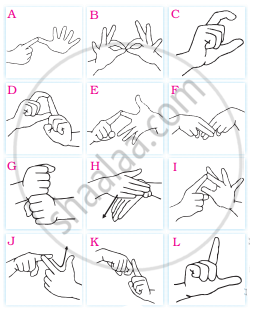
Look at the signs for the letters of the alphabet.

What is your mother tongue?
You forget to wish your best friend on his/her birthday. He gets very angry. How will you try to pacify him/her? Construct a dialogue of about 4 to 5 exchanges and enact a role play
As a friend of the narrator, describe how you would have behaved at the auction.
You are rushing to attend to an important work and you witness an accident on your way. Will you go to the rescue of the injured person? Share your views with the class.
Extend the conversation with two more relevant exchange
| Student | Good morning, sir. May I come in? |
| Teacher | Good morning, why are you late today? |
| Student | ______ |
| Teacher | ______ |
| Student | ______ |
| Teacher | ______ |
