Advertisements
Advertisements
प्रश्न
Shakespeare describes the characteristics of the various stages of man. You are in the second stage of life. What do you think of your roles and responsibilities at this stage? Discuss with your partner and share your ideas with the class
Advertisements
उत्तर
At school age, imagination takes wings. Inquisitiveness is common among my peers. Parents, society, and teachers want us only to study. But we need to explore the world around us. At home, it is our responsibility to keep our things in order. We need to assist the perennial worker, we mean, our moms in completing their domestic chores. Occasionally, we shall take care of siblings too not as a work but as a duty towards a family member who will be a lifelong companion to us.
APPEARS IN
संबंधित प्रश्न
Form groups and use the following topic for discussion. Take the help of your college library and your teacher.
Qualities of an ideal politician
Given below are five main qualities for true sportsmanship.
| i. | Determination |
| ii. | Optimisation |
| iii. | Stamina |
| iv. | Perseverance |
| v. | Decisiveness |
Get into groups of four. Each group will choose one quality to talk about to the whole class for about one minute. But before you talk, you have two minutes to think about it. You can make notes if you wish.
What type of tree fits in your hand?
A ____________ tree.
While I was ______.
GL Home Appliances have introduced a product to purify salt water. The CEO of the company has agreed to meet the press to launch their new product.
“Where does Helen live?”
Jim wants to know where ______.
Read the story board and take roles as pilot and flight attendants to enact the scene.
Inflight Passenger Announcements
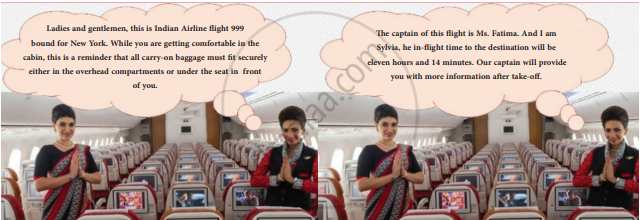
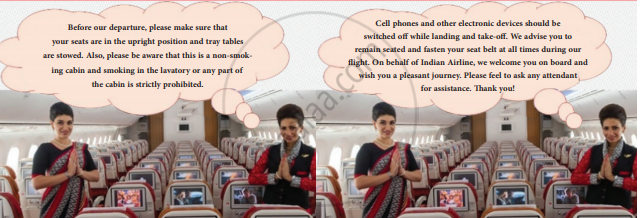
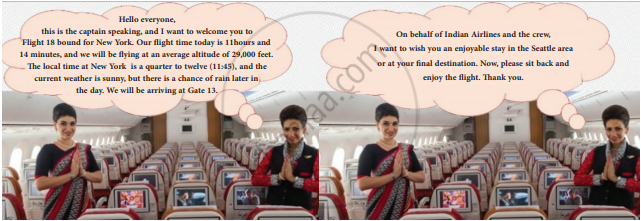
Answer the following:
|
A Tiny Little Plant Deep in the heart of a little seed, Out came the bright Sunshine, A little plant woke up to see, |
List the rhyming words in the first three lines.
Answer the following
Identify the rhyme scheme of the given short poem.
My dog likes bones,
He eats them up,
He’s very sweet,
He’s just a pup.
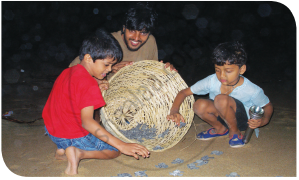
Look at the picture. Work in groups and give a short talk about it using the words given below.
- sand
- waves
- when
- as soon as
- collect
- enjoy
- hatchlings
- basket
- boys
- night
- rough sea
- many
- eggs
- incubate
- hatchery
- after
|
Volunteers of the Students Sea Turtle Conservation Network (SSTCN) release Olive Ridley hatchlings into the sea. |
Change the following into Direct Speech.
Lakshan asked me if I had anything to say.
Change the following into Direct Speech.
Mervin said that he wanted to be a soldier.
Imagine that you and your friend have decided to spend a day together in your house. You have planned your schedule from morning till night. Discuss in pairs and speak about it in the class. You can start like this:
I like to go for a walk but my friend wants to work out in the gym.
I have a robot big and______.
The Maharaja was a wise man and ordered the cook to use the vegetable scraps instead of throwing them away.
- Name some of the things which are thrown away at home or in school.
- Sit in groups of four and think of interesting ways in which they can be made useful.
- Put up your findings on the class board.
In your family, what activities are done individually and as a group?
| My mother decides | |
| My father decides | |
| I decide | |
| We decide |
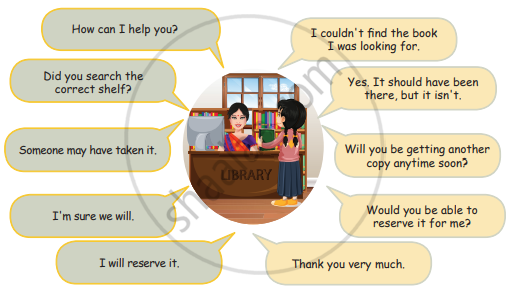
Borrowing a book from public Library.
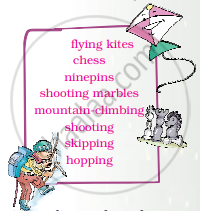
Pick out the names of the games mentioned in the story.
Interview your teacher and get her responses for the following questions.
- Why did you become a teacher?
- How do you come to school every day?
- Do you have any pets?
- What kinds of books do you like to read?
- What are your hobbies?
Have you ever been very frightened? Tell your partner about it.
Did you hear what your tongue did?
Tell the class a joke in your mother tongue.
Is there a bookshop near your home? If there is, do you like to visit it?
What are the different kinds of books in this bookshop or in any other bookshop you have seen? Tell the class.
Build a conversation of eight to ten sets of exchanges , with your grandmother, discussing the incidents that happened in your school that day.
You have recently shifted to a new locality. You cannot find your way back, after school. Your uncle spots you and takes you home. Narrate the incident to the class.
‘When the mouse laughs at the cat, there is a hole nearby.’ Explain the meaning of this statement to your friends.
On the occasion of World Environment Day, you have been asked to deliver a speech during morning assembly on the importance of tree planting. Write the speech in about 100 – 150 words.
- Introduction
- Suggested value points Pollution control – Medicine – Necessary for wildlife – Cause rainfall
- Conclusion
Given below are a few proverb. Prepare a short speech of two minutes on one of the proverb.
Where there is a will there is a way.
