Advertisements
Advertisements
Question
‘Forgetfulness is the beginning of happiness’- Do you agree or disagree? Discuss in class.
Advertisements
Solution
In “Ode to skylark,” Shelly beautifully portrays the human beings’ boundless capacity to worry about dead yesterday, unborn tomorrow, and spoil the happiness of a perfectly beautiful present. He says, “We look before and after and pine for what is not. Our sincerest laughter With some pain is fraught”. Human mind has a soft comer for harboring hurts and pain. It replays them like a broken record often and sustains hostility between individuals. It requires a mature mind to forgive and forget. The road to recovery of any invisible hurt starts the moment one forgives the person and casually forgets all unpleasant memories connected to it. The human mind, according to Robert Lynd, forgets what it chooses to forget. We are in a civilized society because everyone remembers to dress properly and remember the names of friends and relatives. If one develops the attitude to remember only pleasant things, the mind will train itself to forget insignificant bad memories. Thus forgetting is the beginning of real happiness.
APPEARS IN
RELATED QUESTIONS
Form groups and use the following topic for discussion. Take the help of your college library and your teacher.
Freedom of speech
You are visiting the primary school where you studied classes I to IV, after six years. You get a chance to go to your standard two classroom and you are permitted to sit at the same place where you used to sit.
Who do you miss very badly, your friends or teachers?
You are visiting the primary school where you studied classes I to IV, after six years. You get a chance to go to your standard two classroom and you are permitted to sit at the same place where you used to sit.
Share your thoughts with the class.
Mock anchoring for annual day celebration.
“Where does Helen live?”
Jim wants to know where ______.
Can you do an art work or a craft work on your own?
Answer the following
Identify the rhyme scheme of the given short poem.
My dog likes bones,
He eats them up,
He’s very sweet,
He’s just a pup.
Answer the following
Complete this poem on your own with a abab rhyme scheme.
Peas porridge hot,
Peas porridge cold,
__________________
__________________
Imagine that below are some of the paintings of Jane Eyre. Discuss with your partner and describe the paintings.




Change the following into Indirect Speech.
“Are you coming home with me?” he asked.
Change the following into Indirect Speech.
“Run away, children,” said their mother.
Change the following into Direct Speech.
Nevin asked his father when the next letter would come.
Imagine a world with no books, but only e-books. How would you find such a world? Deliver a two-minute talk.
Is there any place near?

Match the rhyming words.
| 1. | tall | best |
| 2. | song | all |
| 3. | rack | along |
| 4. | rest | sack |
Let us see how to speak over phone.
Speak and win.
Join any group. Pick and support any one of the characters. Say some sentences for the one you support and say some sentences against another one to win.
| I support the archer ______ |
| I support the old man ______ |
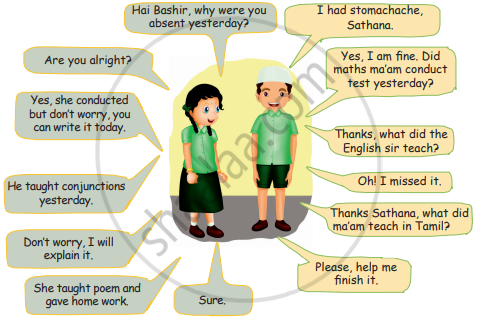
What did the teacher teach?
In your family, what activities are done individually and as a group?
| My mother decides | |
| My father decides | |
| I decide | |
| We decide |
The people who live in cities often wish they could live in quiet towns. Do you like the place you live in?
Tell your partner two things you like and don't like about the place you live in.
What does ‘features’ mean? Look up the dictionary. What are the different kinds of features of people we come across in the world? Discuss.
|
beneath, breeze, meet, fear, each, meadow. |
How do you think you can help children who cannot see?
Pick out the silent letters from these words
| silent letter | |
| hour | |
| knit | |
| wrong | |
| doubt | |
| often | |
| know | |
| night | |
| could | |
| write | |
| knife | |
| high | |
| walk |
Is there a bookshop near your home? If there is, do you like to visit it?
What do you think the naughty boy would see in India?
In groups of five, discuss the following topic taking examples from Mary Kom’s life.
Athletes cannot run with money in their pockets. They must run with hope in their heart and dreams in their head.
The following expressions may help you in connecting ideas and presenting your views to the class.
- In my opinion…
- I wholeheartedly support…
- At the outset, let me say…
- I should like to draw your attention to…
How will you organize or plan for a trip or an event? Do you have the habit of preparing a check-list? Discuss.
Now, write a set of 8 to 10 instruction for the following situation.
A traffic police personnel to the public, as to how to move around in safety, in crowded public places during festival seasons.
Your school has arranged for a road safety campaign, Share a few ideas with your classmates which can be used during the campaign. For example ‘Speed thrills but kills’.
